Original experimental research figures
Interpretation and provenance
These are original source-verified research SVG assets; the earlier figures were copied from their named draft branches and the newer long-chain plot was constructed from the original retained scientific case results, not generic stock illustrations. They visualize simulation evidence, not results from human-subject recordings. Their presence here does not make the underlying experimental methods available in the stable 1.1.0 installation.
Sparse-group inference F1
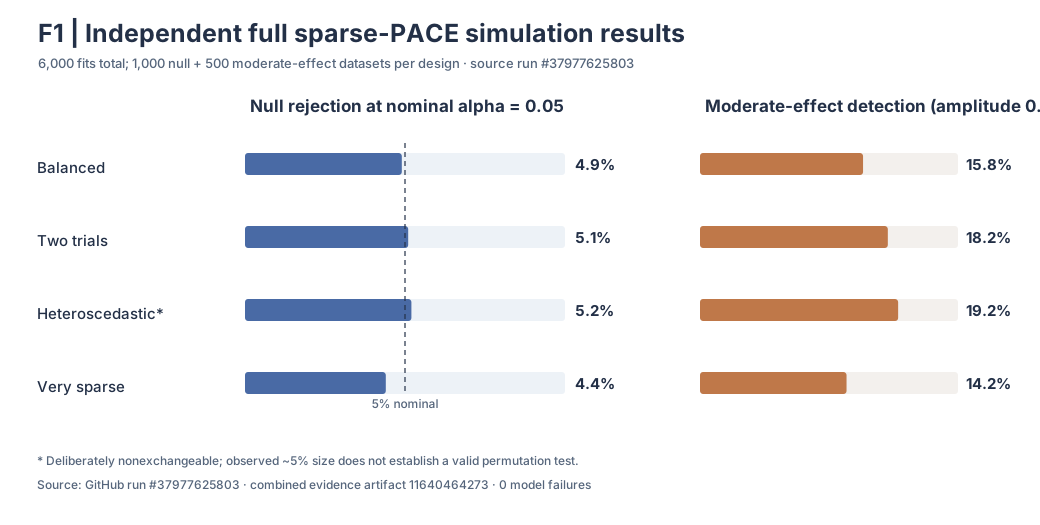
Independent fitted F1 null/power study · Source run #37977625803
Bayesian B6/B7
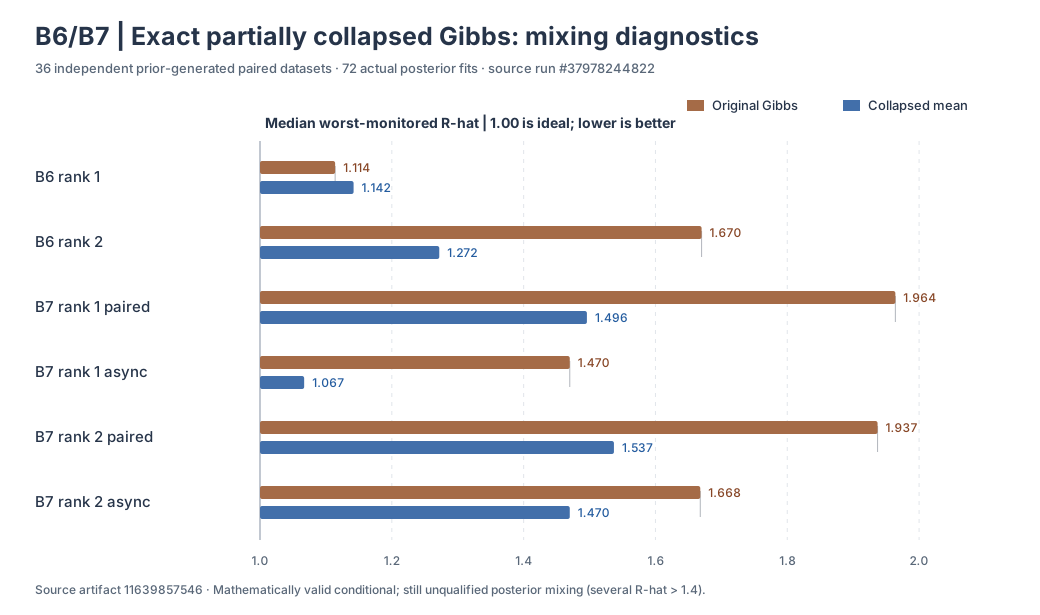
Exact partially collapsed population-mean experiment
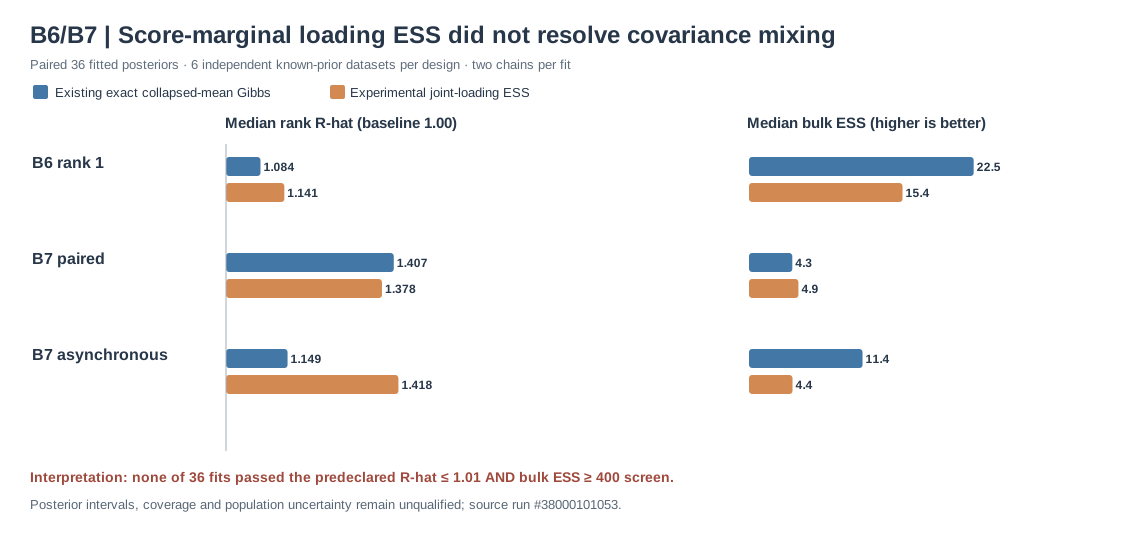
Negative joint-loading sampler experiment · Original source #38000101053
Longer-chain independent covariance reference: nine source fits
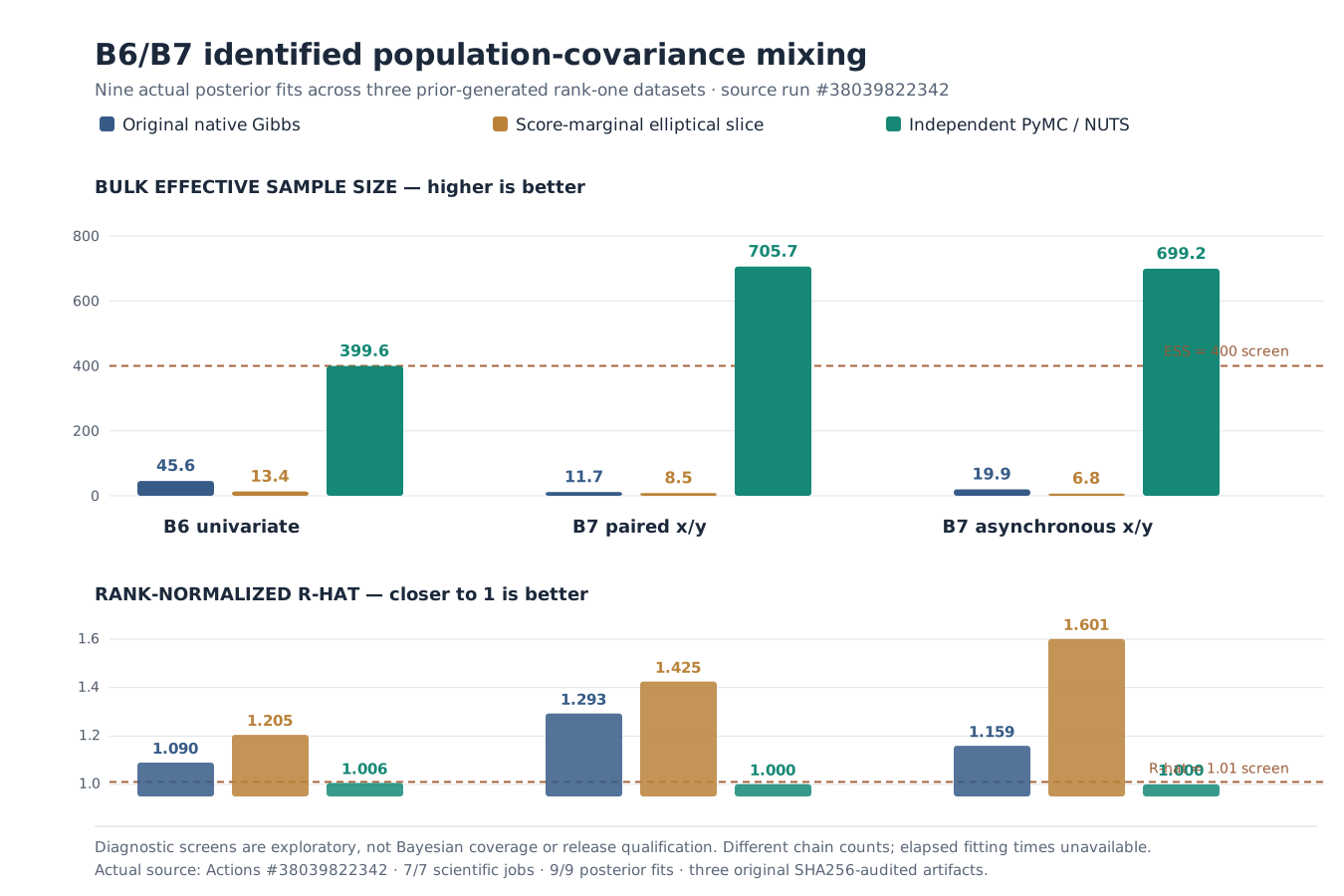
Full original-source study, B6/B7 results and limitations · Original workflow #38039822342 · Original artifacts: 11665746776, 11665707552, 11665607799.
This added scientific SVG is source-accurately constructed from the nine original fitted case results; it is not an independently collected dataset and does not establish posterior coverage.
Four-chain independent reference, two fresh datasets per rank-one design
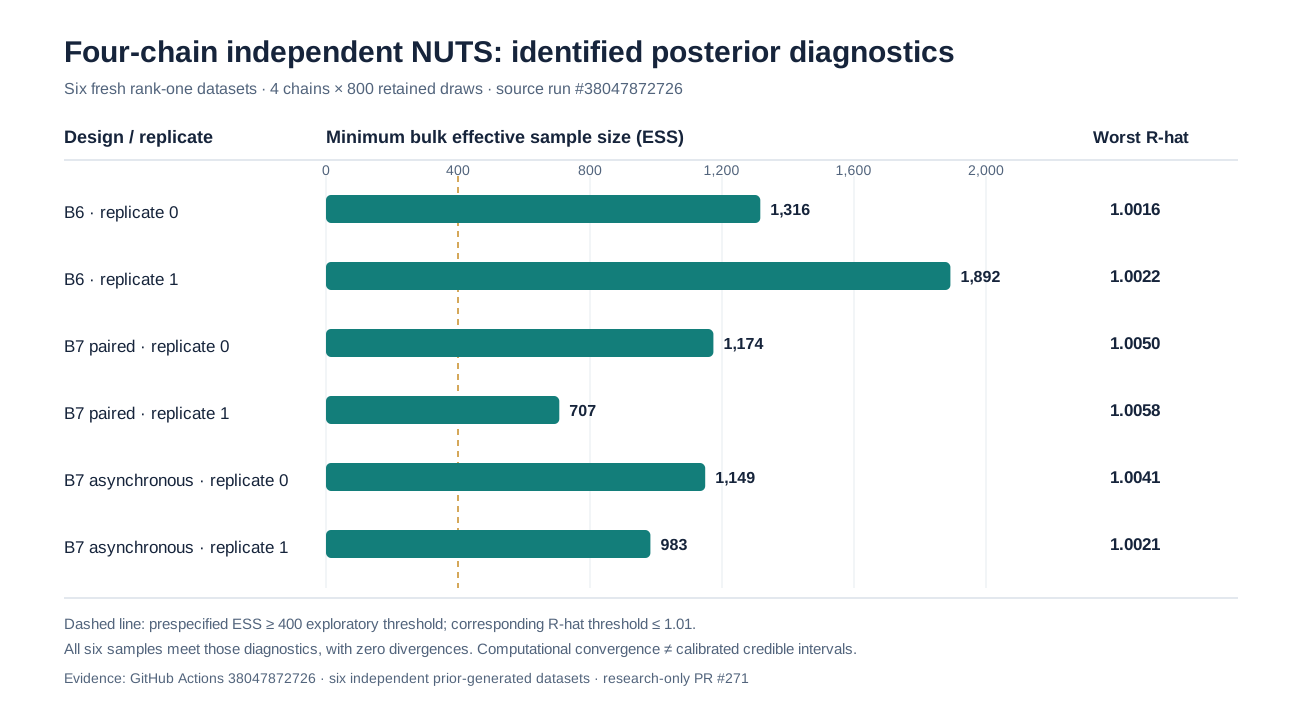
Six-fit source results, full provenance and unqualified inference limits · Original workflow #38047872726.
All six four-chain fits passed the exploratory mixing diagnostics; this is not evidence of 90% interval coverage or rank-two validity. The plot depicts one rank-one fit per replicate (six independently generated datasets), not independent posterior interval calibration.
Rank-two actual PyMC log posterior and automatic-gradient contract (R2)
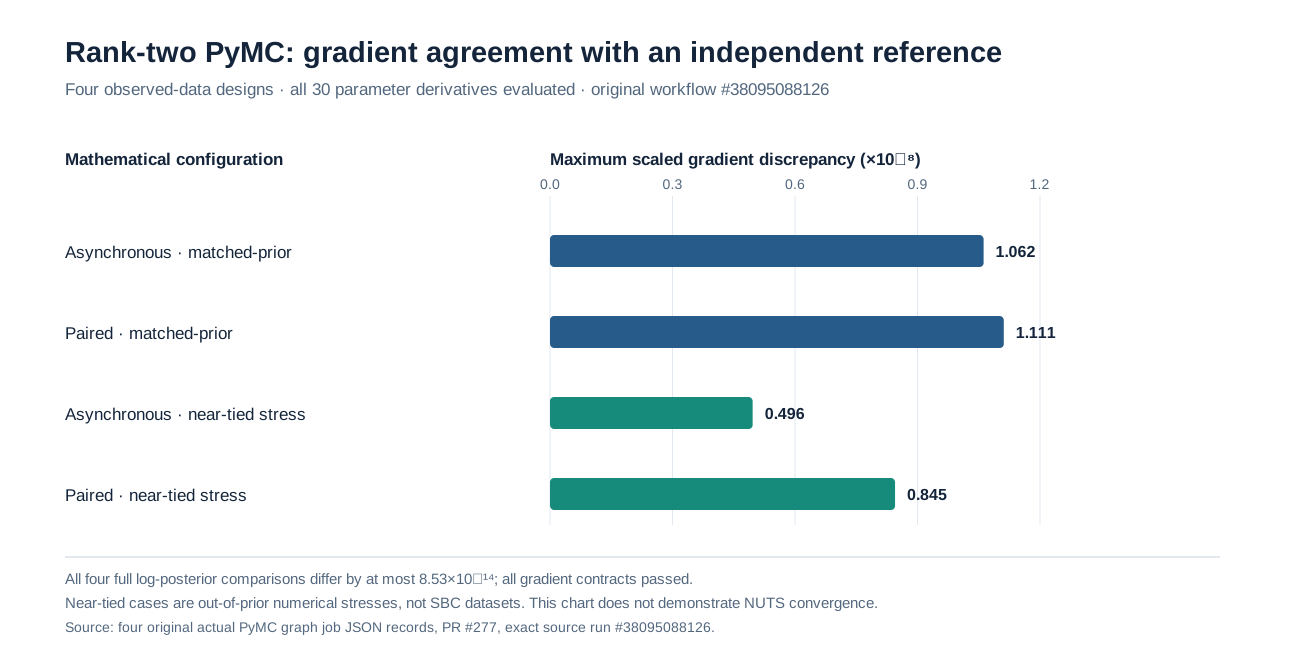
Source-verified mathematical comparisons and four artifact identifiers · Original scientific workflow #38095088126.
This is an original plot of the four actual source-run numerical derivative comparisons. It is not a completed rank-two NUTS fit, inference validation, or an independent human eye-tracking study.
B6 SBC R2: same-data computational-screen rescue, not new calibration data
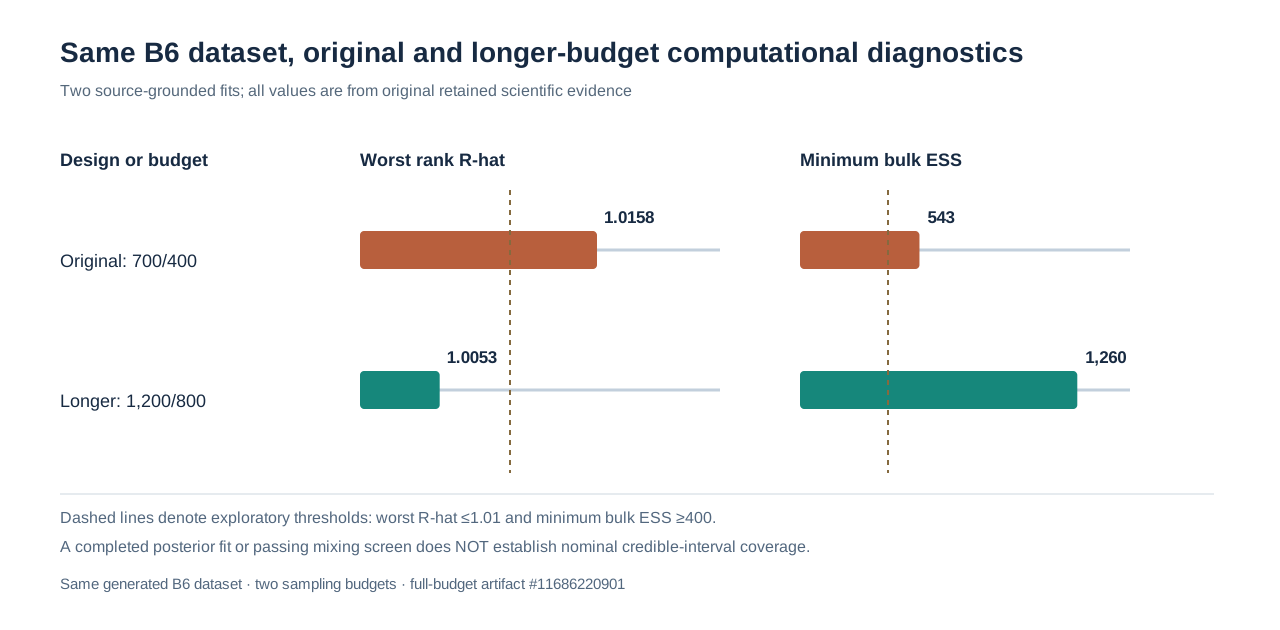
Source B6 longer-budget refit and unchanged stage-zero failure · Original workflow #38095220518.
The same prior-generated replicate is used twice. Do not count the longer refit as another independent SBC dataset or interpret its 90% interval inclusion as repeated coverage.
Rank-two NUTS R3: first real posterior computation on paired and asynchronous designs
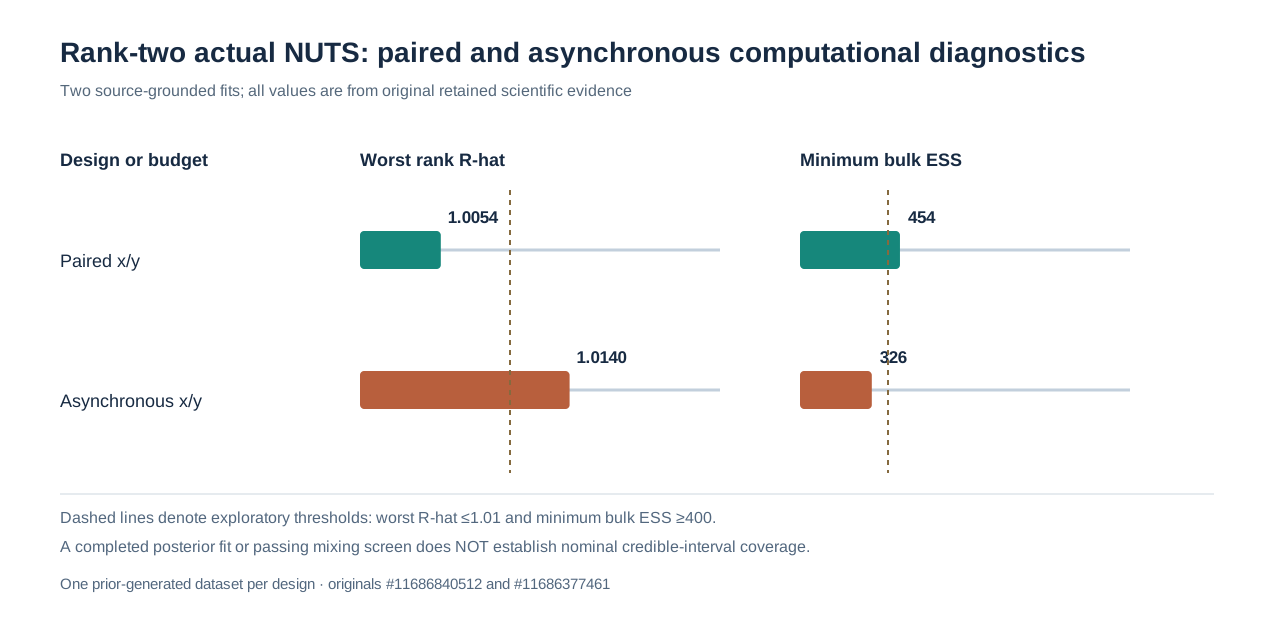
Rank-two paired-versus-asynchronous pilot and numerical failure localization · Original scientific workflow #38096271285.
Both fits completed; all six population-mean functionals in the asynchronous dataset failed an exploratory screen, while its nine covariance functionals passed. One dataset per design cannot establish a general asynchronous-data effect or interval calibration.
Rank-one prior-SBC pilot: original four-dataset midpoint ranks
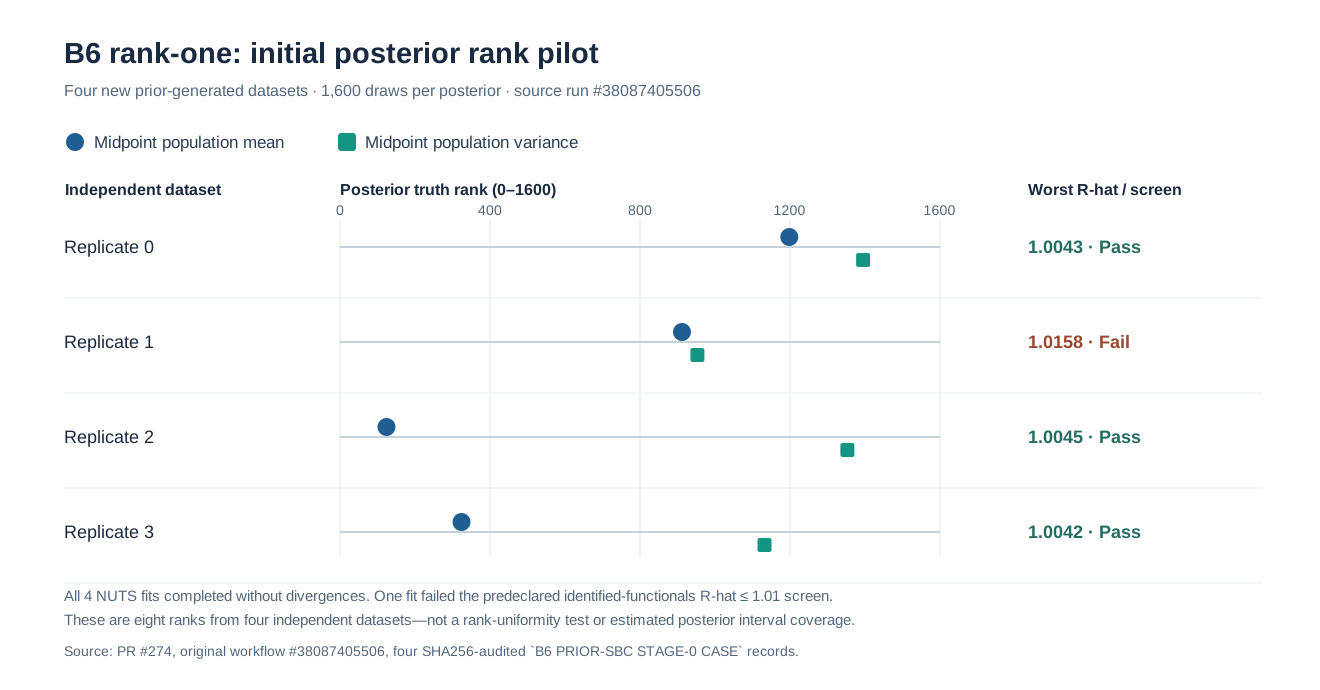
Four-dataset SBC stage-0 report, original ranks and diagnostic failure · Source workflow #38087405506.
The four datasets are insufficient for rank-uniformity or interval-coverage claims. One completed posterior fit failed the exploratory computational convergence screen; that failure is explicitly shown. The rank-two mathematical validation is presented as a source-audited numerical contract, without an invented discrepancy plot because exact case-level differences must be read from the retained source artifacts.
F5 change-point null behavior
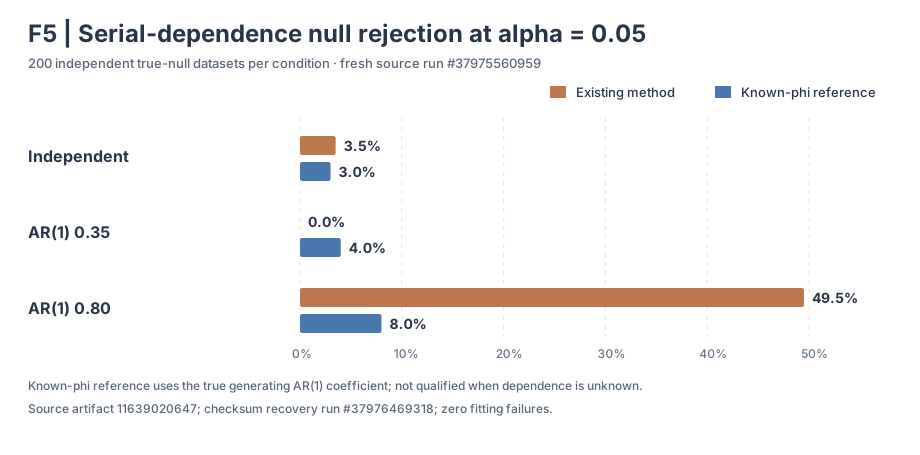
External-baseline dependence testing
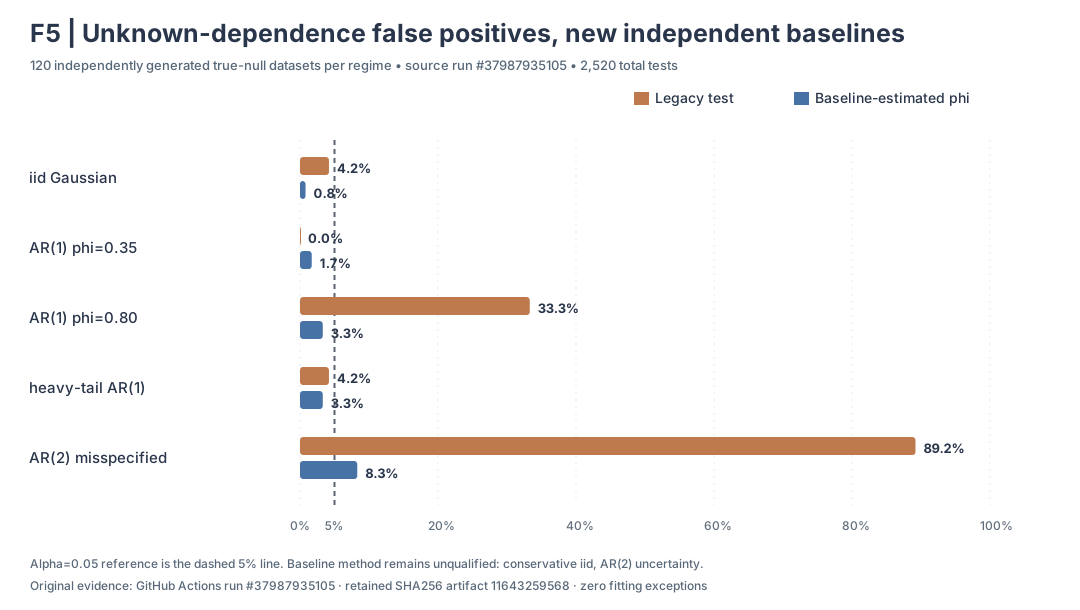
Unknown-AR(1) external-baseline study
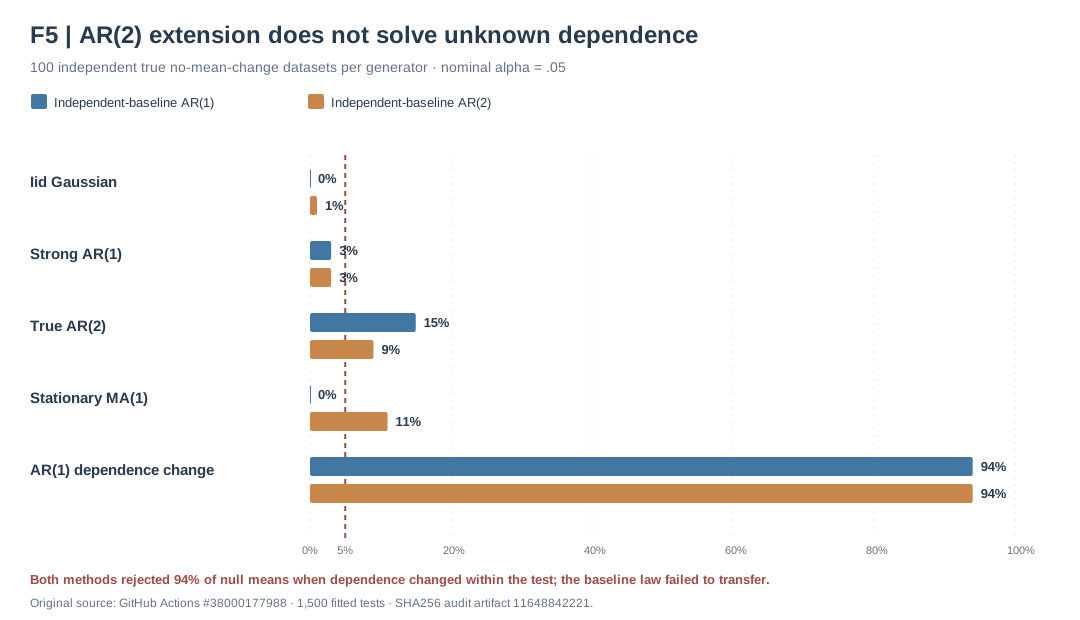
AR(2) / MA(1) / nonstationary falsification · Source run #38000177988
W3 original known-truth functional regression validation
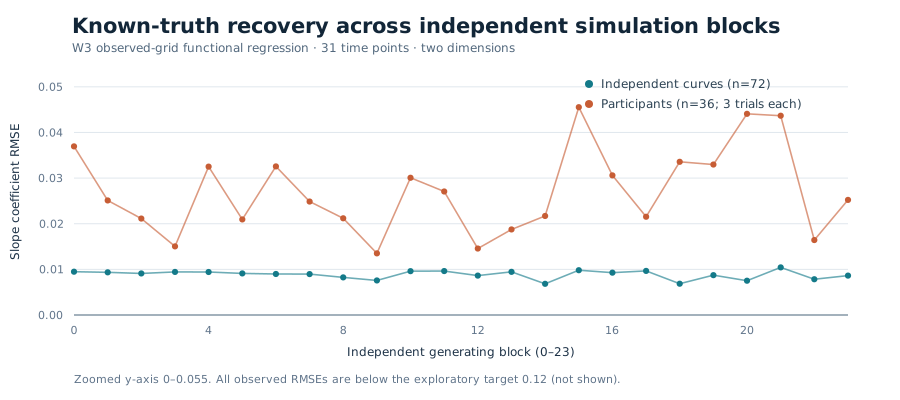
Original W3 source-audited results, exploratory target, and study limits · Scientific workflow #38173426113 (source artifact 11715355738).
All 48 workflow fits completed across 24 generating seed blocks. The plotted values are original case-level recovery RMSE, not empirical eye-tracking recordings. Curve- and participant-level inference units have different simulated dependence structures; exact agreement with a numerical OLS oracle does not qualify statistical intervals.
W3 simultaneous-band falsification and leverage support (R71–R76)
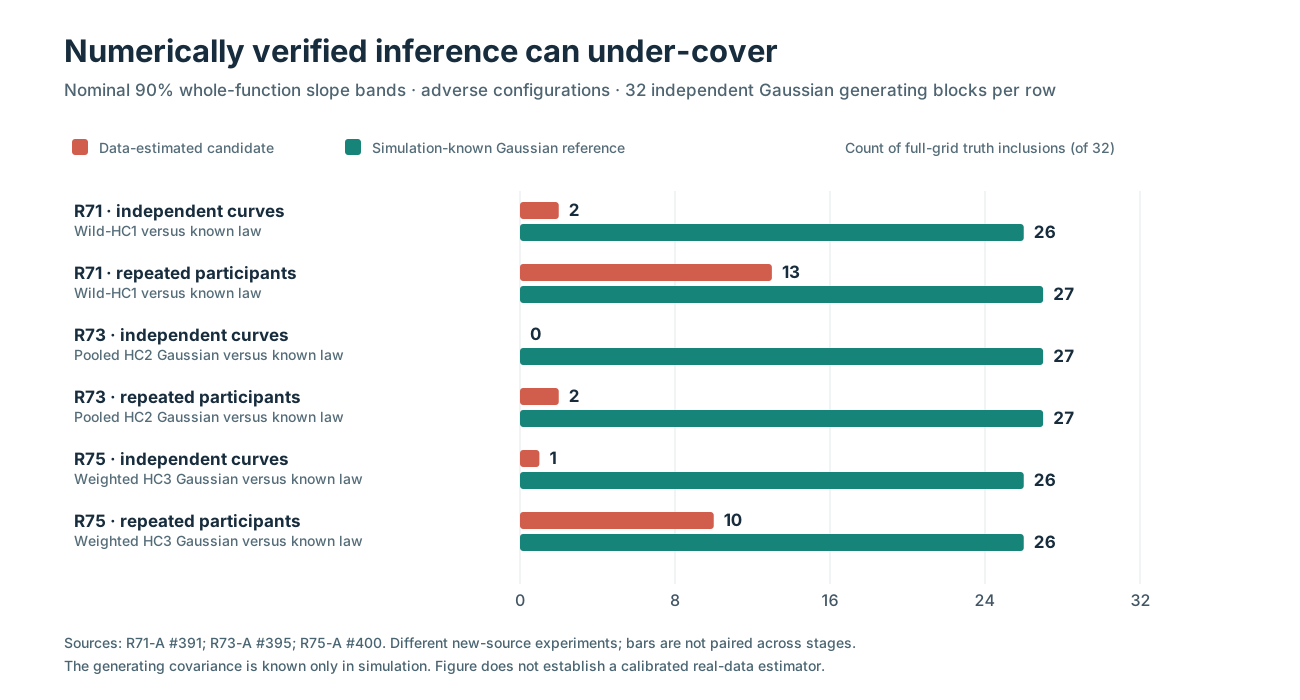
The first new figure compares original separate source experiments (32 independent generating blocks per plotted condition) with a generating-law Gaussian benchmark. It is not a pooled estimator comparison or human-gaze result. Read the article.
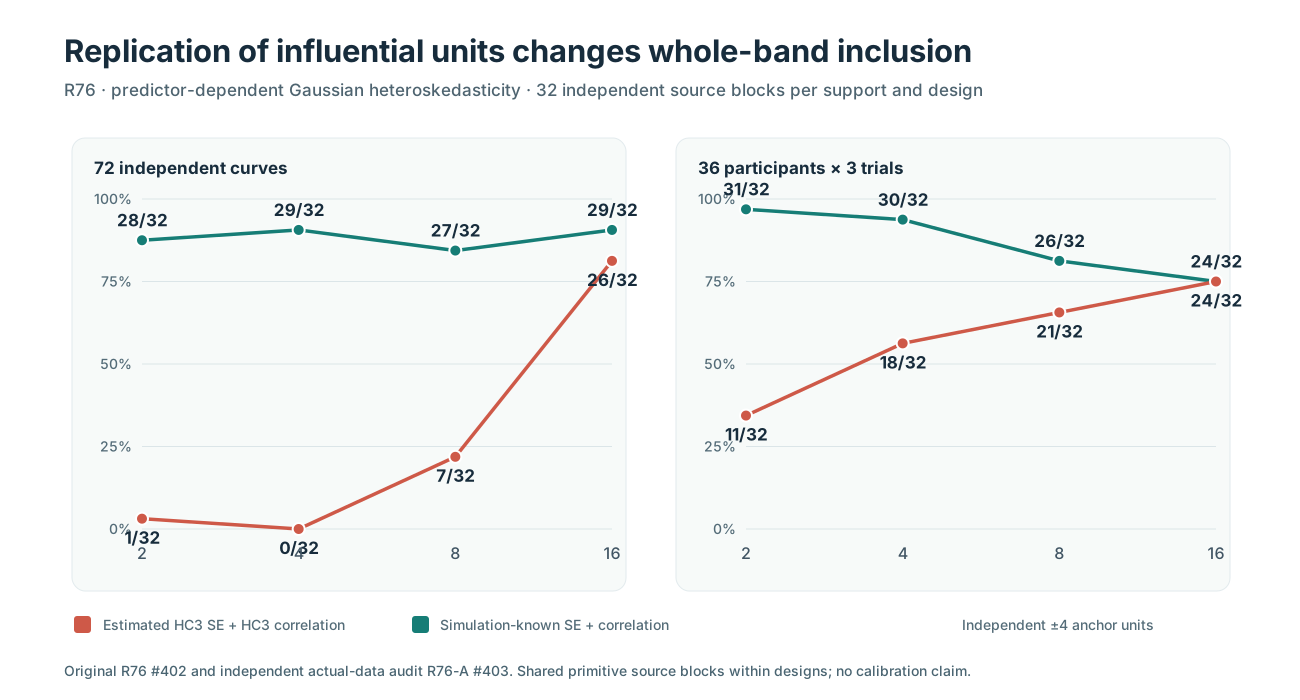
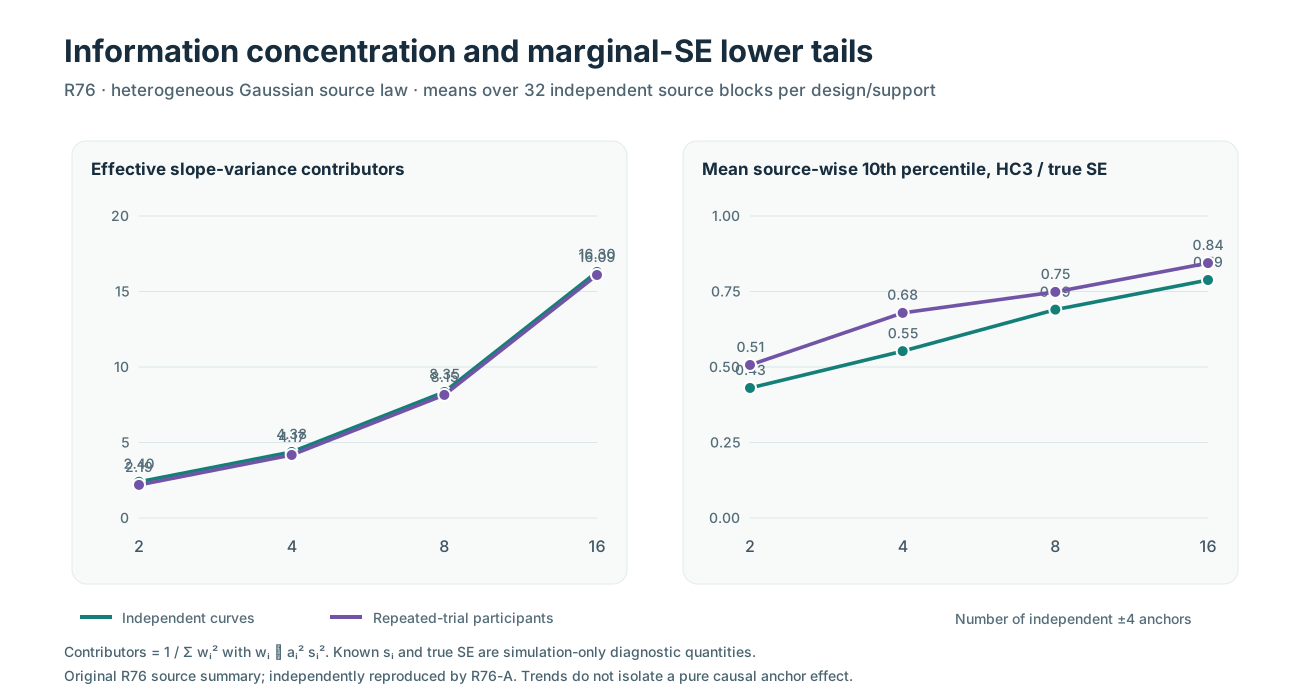
The R76 plots reproduce source-audited 2, 4, 8 and 16 separately independent ±4 predictor anchor conditions using 32 independently generated blocks per design and anchor count. Source cases and 999-draw conditional bootstrap maxima are not independent replication counts. R76 article · Full figure/count/source ledger · Original evidence and independent R76-A replay.
All plotted confidence-band methods remain unqualified for general nominal coverage and W3 inference blocker #289 is open.
R77 — prospectively frozen estimated functional covariance regularization
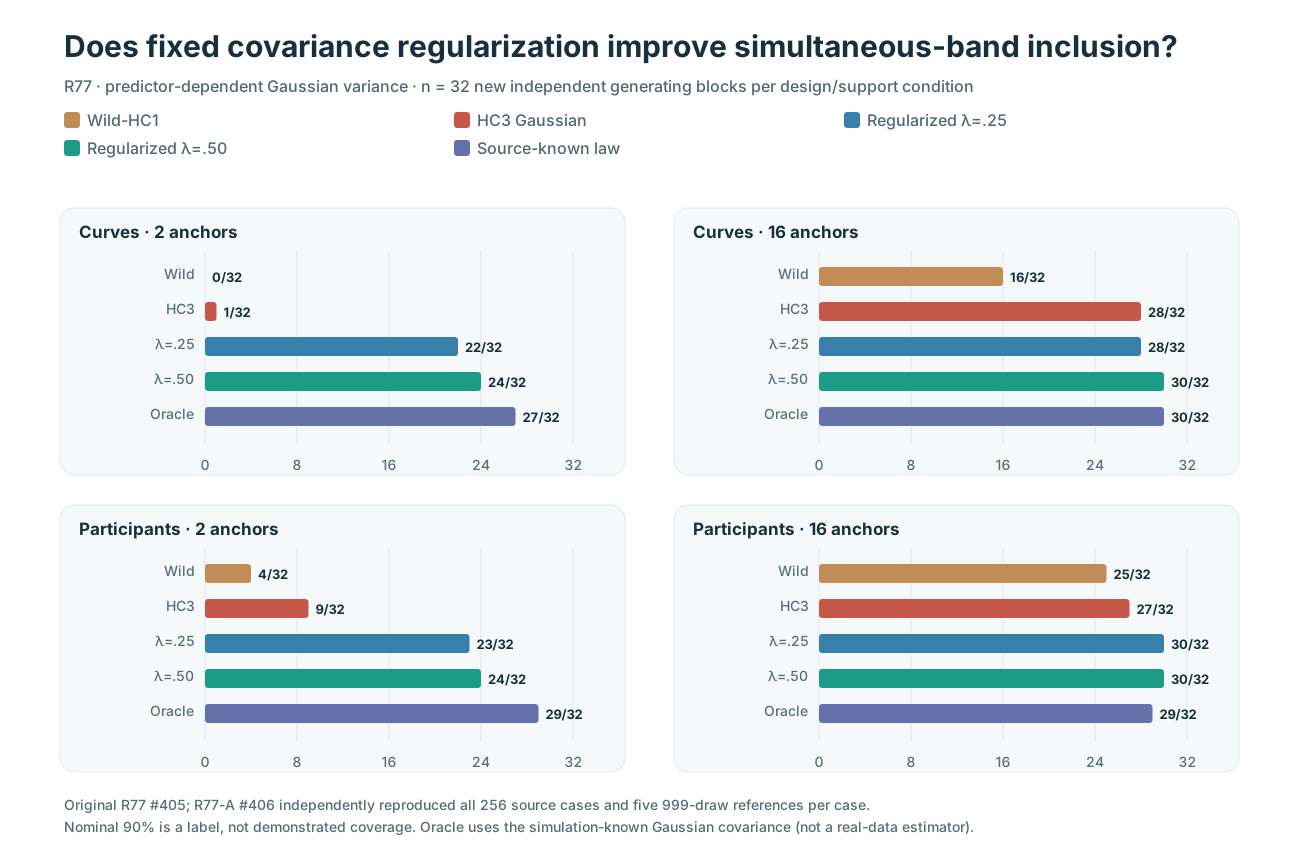
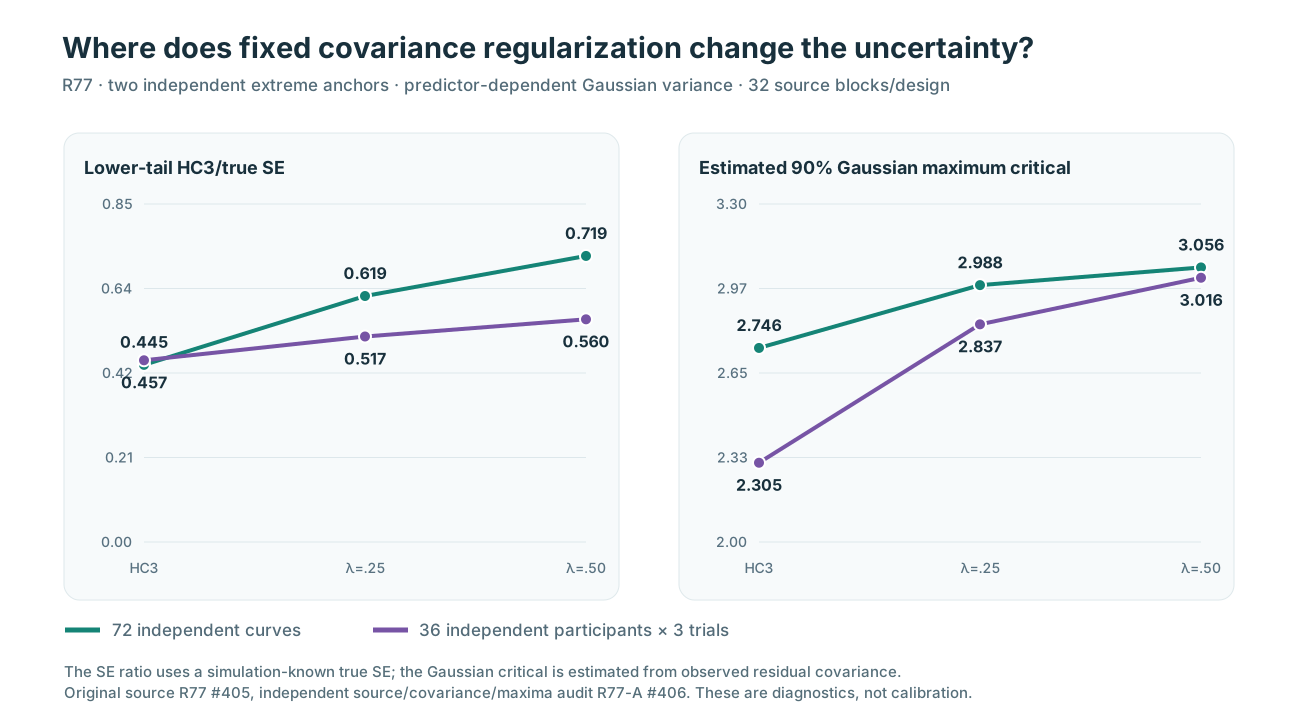
The two additional scientific SVGs depict original new-source R77 computations independently reconstructed in R77-A: 256/256 accepted synthetic Gaussian source cases, 1,278,720 original 999-draw maximum-statistic values, zero refusals, and a true unit of independence of 32 generating blocks per condition. Strengths λ=.25/.50 and a seven-time-point smoothing target were frozen before these results. These figures do not establish general nominal-90% calibration or product qualification. Read the R77 research article · R77 science · R77-A independent audit.
R78 — independently audited temporal covariance robustness
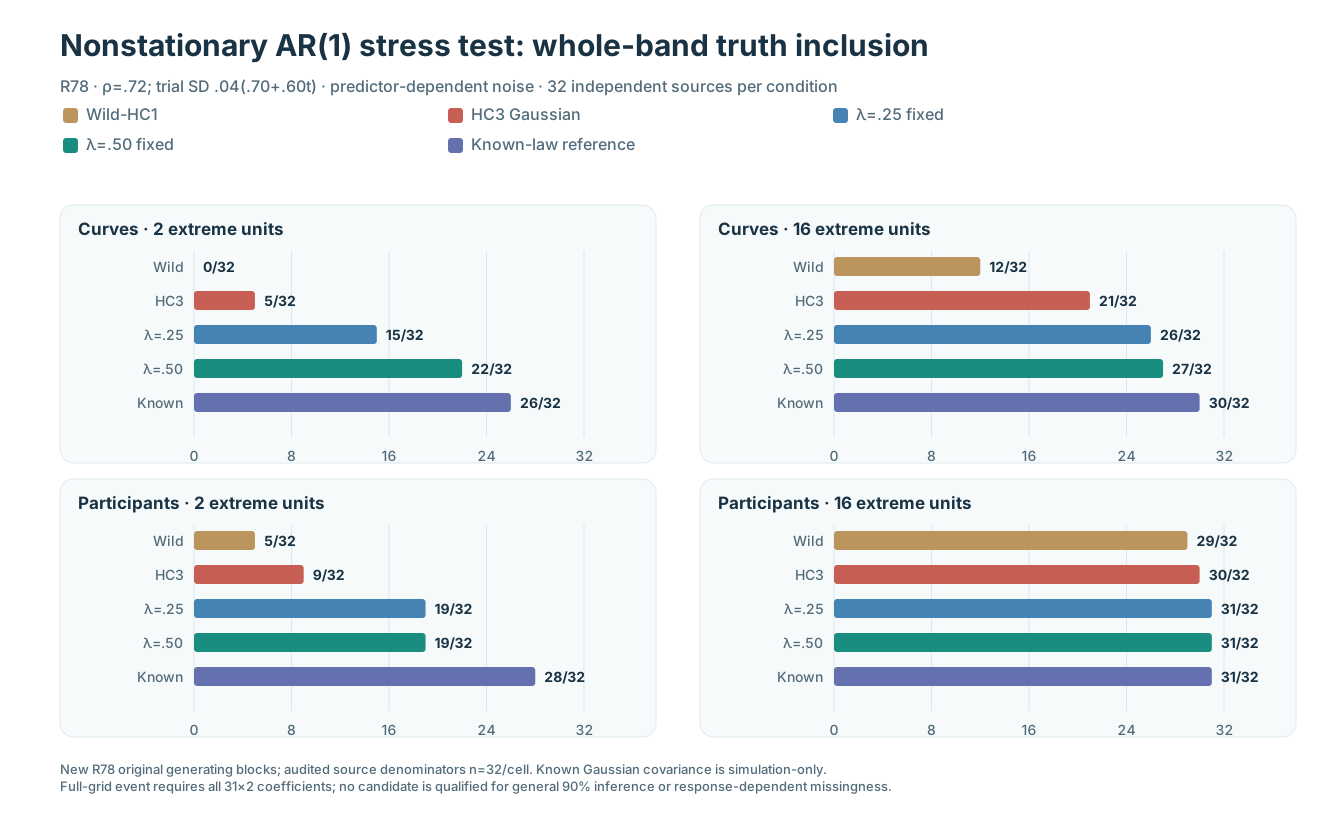
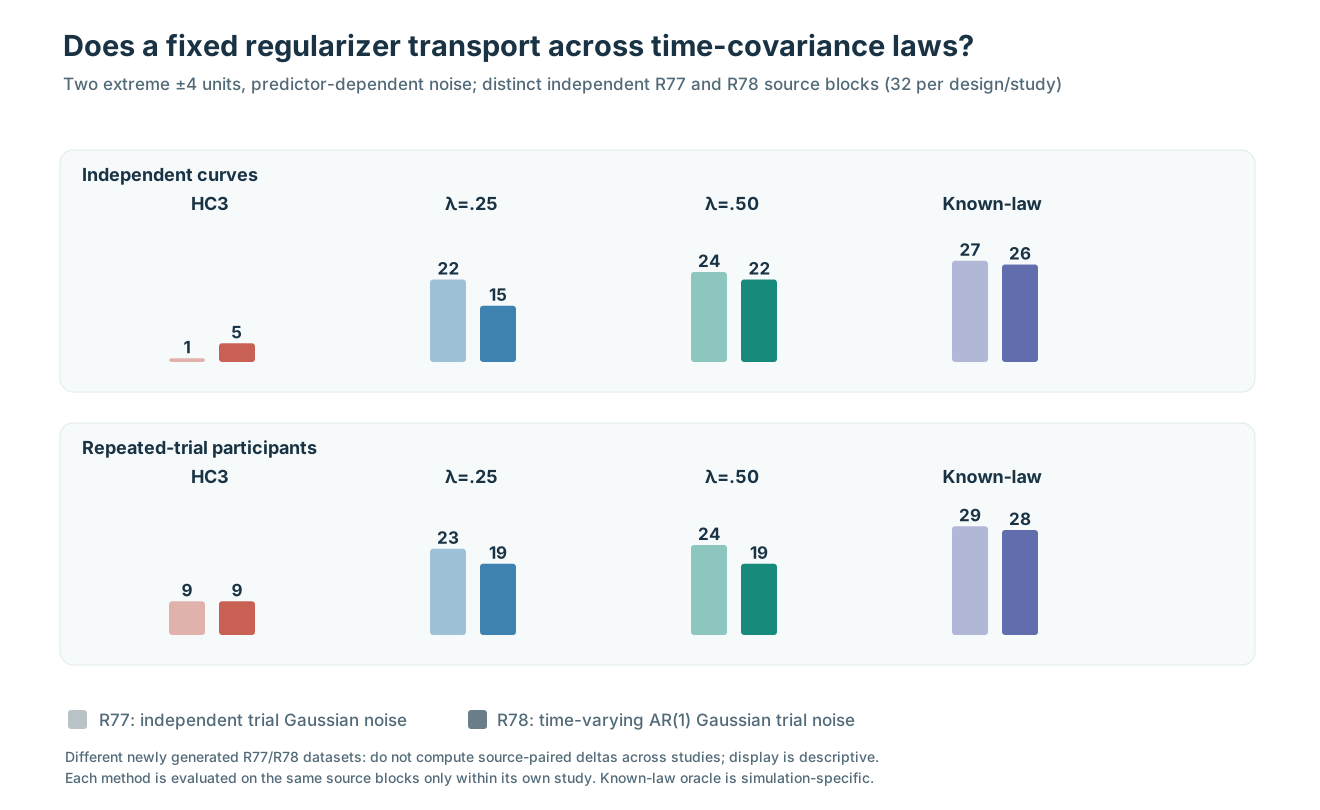
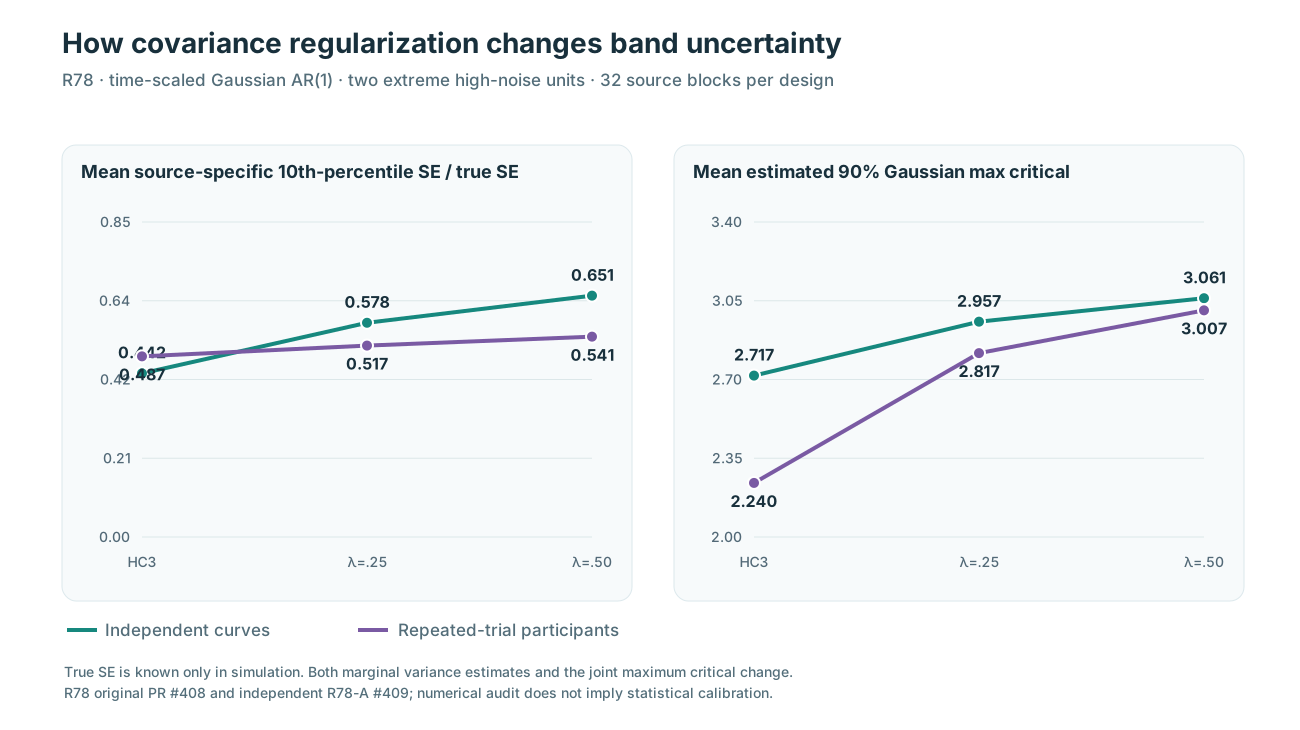
These new scientific figures retain source-level n=32 independently generated primitive blocks per condition and separate the Gaussian time-independent R77 source experiment from the new Gaussian time-scaled AR(1) R78 stress. R78 original 12/12 science and R78-A independent 4/4 source-audit jobs verify 256/256 original source cases, 0 refusals and 1,278,720 original reference maxima. The generating covariance remains simulation-known only, no candidate is generally nominal-90%-calibrated, and gaze loss/non-Gaussian errors remain untested here. Read R78 article · Exact numeric plot ledger.
R79: nonseparable cross-coordinate Gaussian covariance
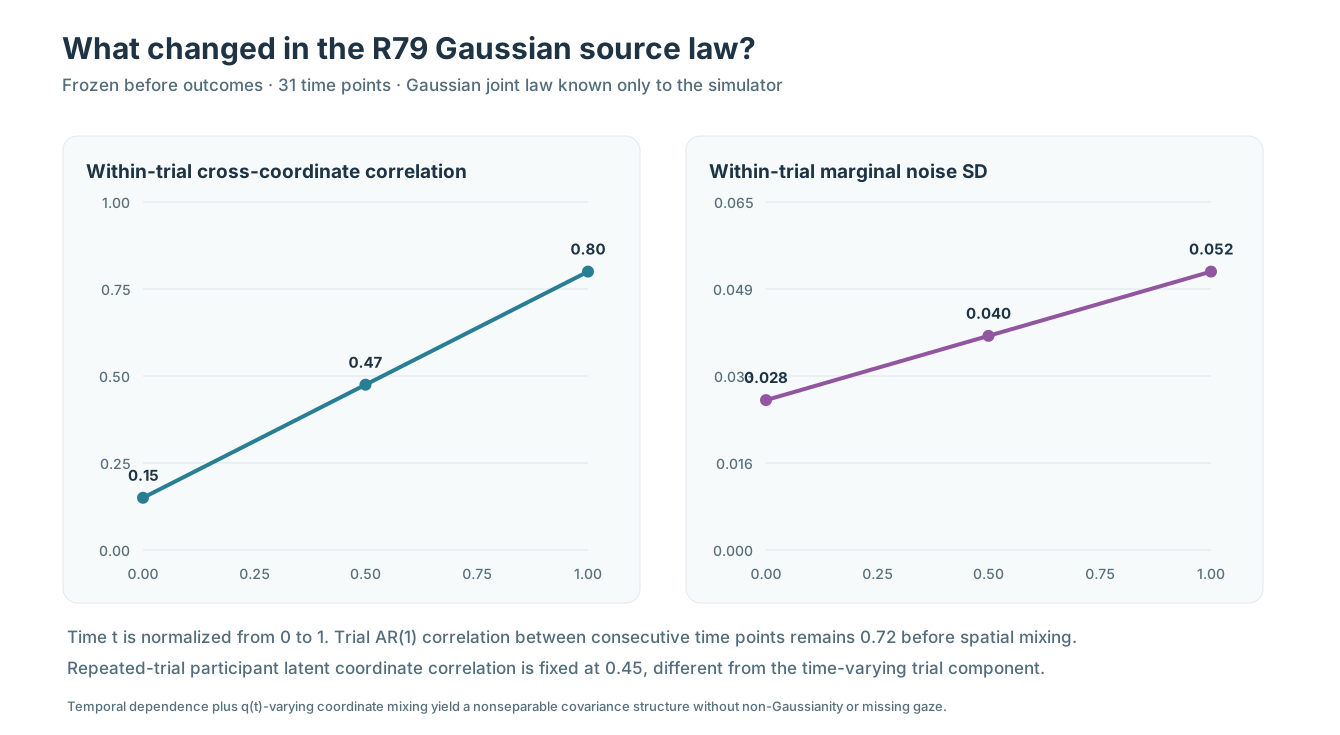
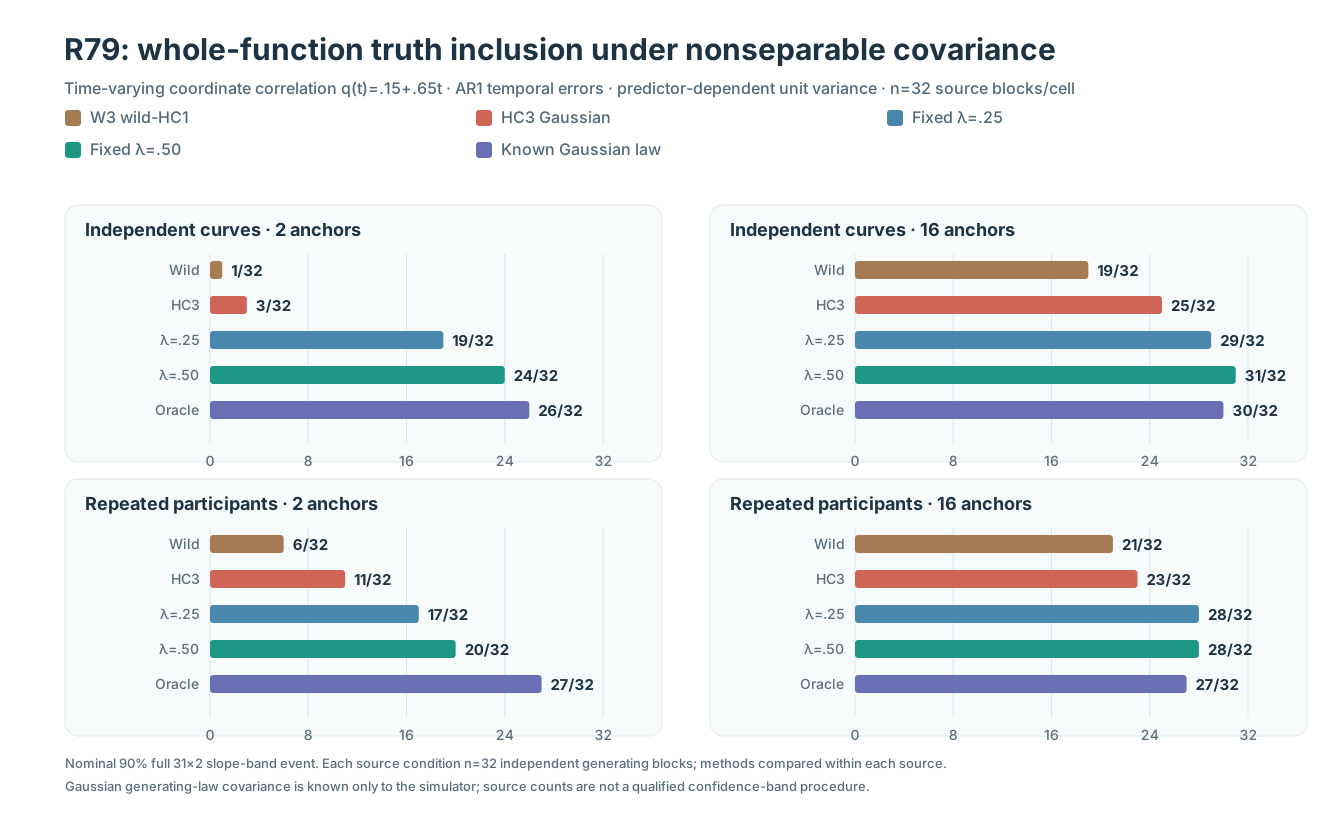
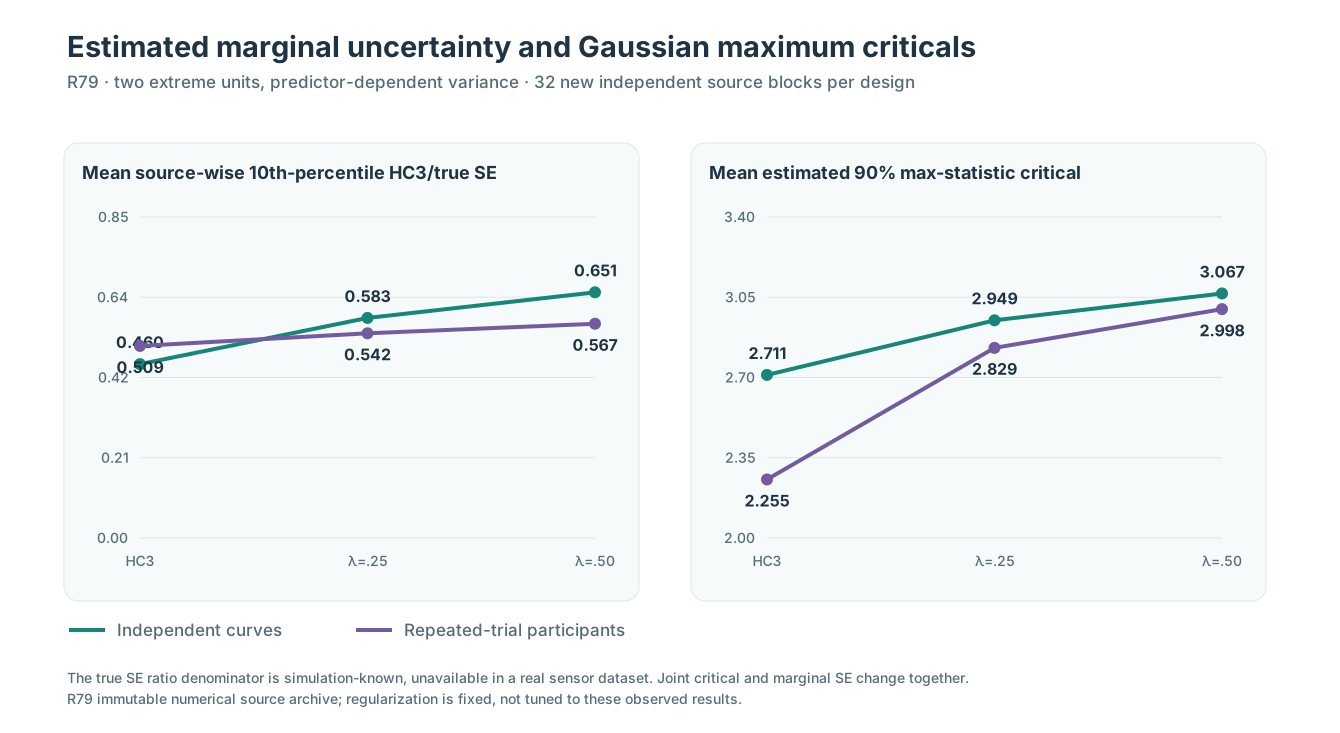
All three original scientific figures are grounded in the R79 12/12 original source workflow and the separate R79-A 4/4 mandatory independent source audit: 256/256 source cases, zero refusals, 1,278,720 original maximum statistics, and 32 independently generated primitive blocks per design/support/variance condition. Candidate λ=.25/.50 values remain frozen, not selected from observed source inclusion. Fully synthetic Gaussian data, no MNAR or general coverage qualification. Scientific article · Detailed count/source ledger.
R80: independent-unit Student-t5 heavy-tail Gaussian scale mixture
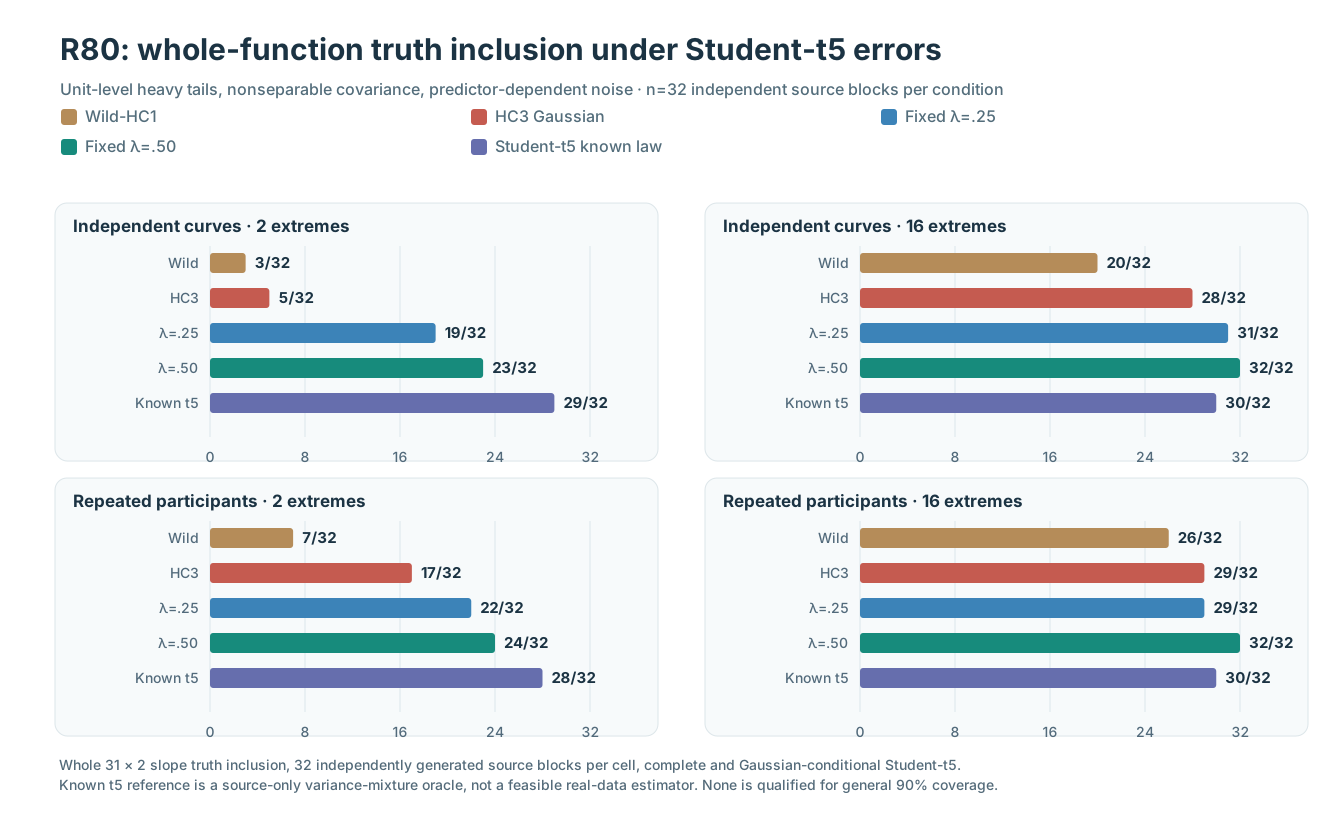
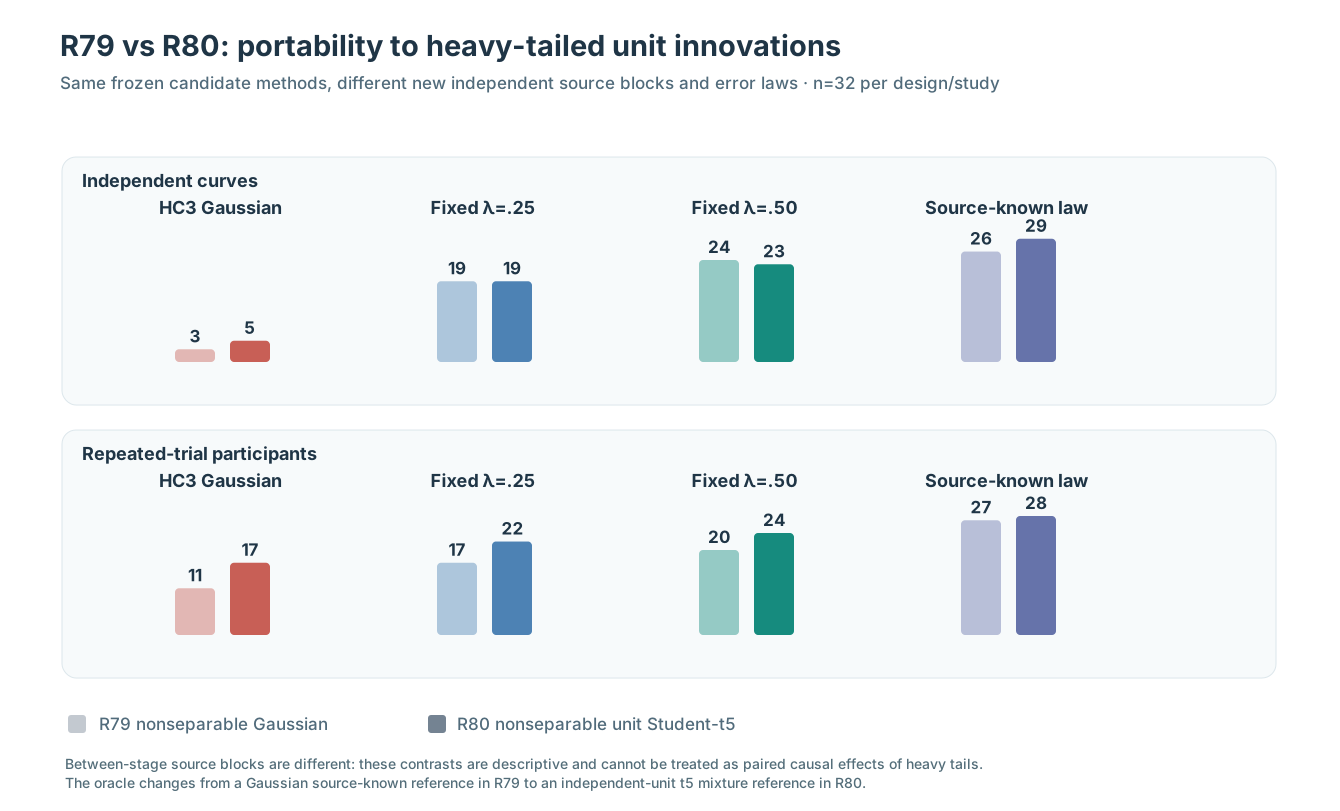
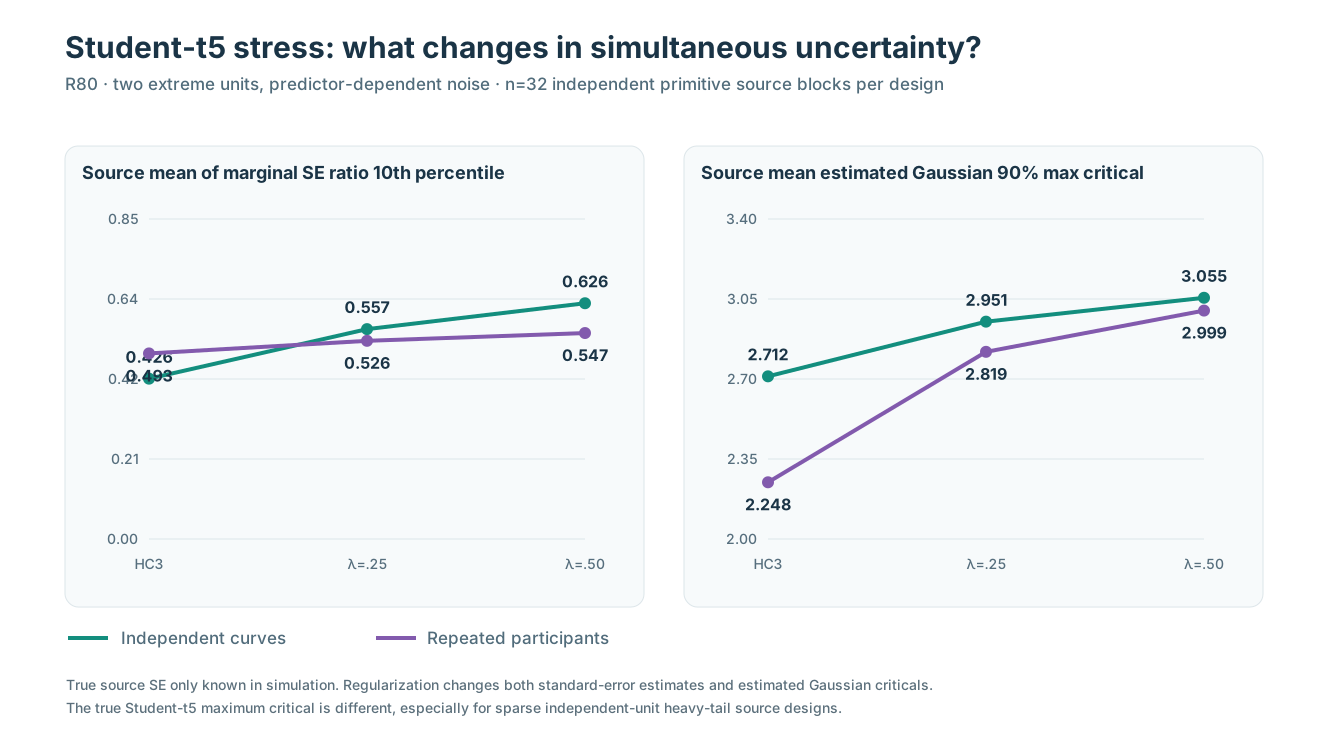
The new R80 original SVGs preserve 32 independent primitive Gaussian-conditional Student-t5 source blocks per cell, 256/256 attempted and accepted factorial cases, and 1,278,720 original conditional maximum values verified by separately coded source replay. R80 original workflow #39487449656 12/12 science PASS; independent R80-A actual archive #39487811433 4/4 audit PASS. The source-known Student-t5 mixture benchmark is available only in simulation, not a Gaussian observed-data estimator. No general 90% calibration, no authentic gaze recordings, no MNAR claim. Read R80 article · Figure provenance.
R81: asymmetrically contaminated Student-t5 independent units
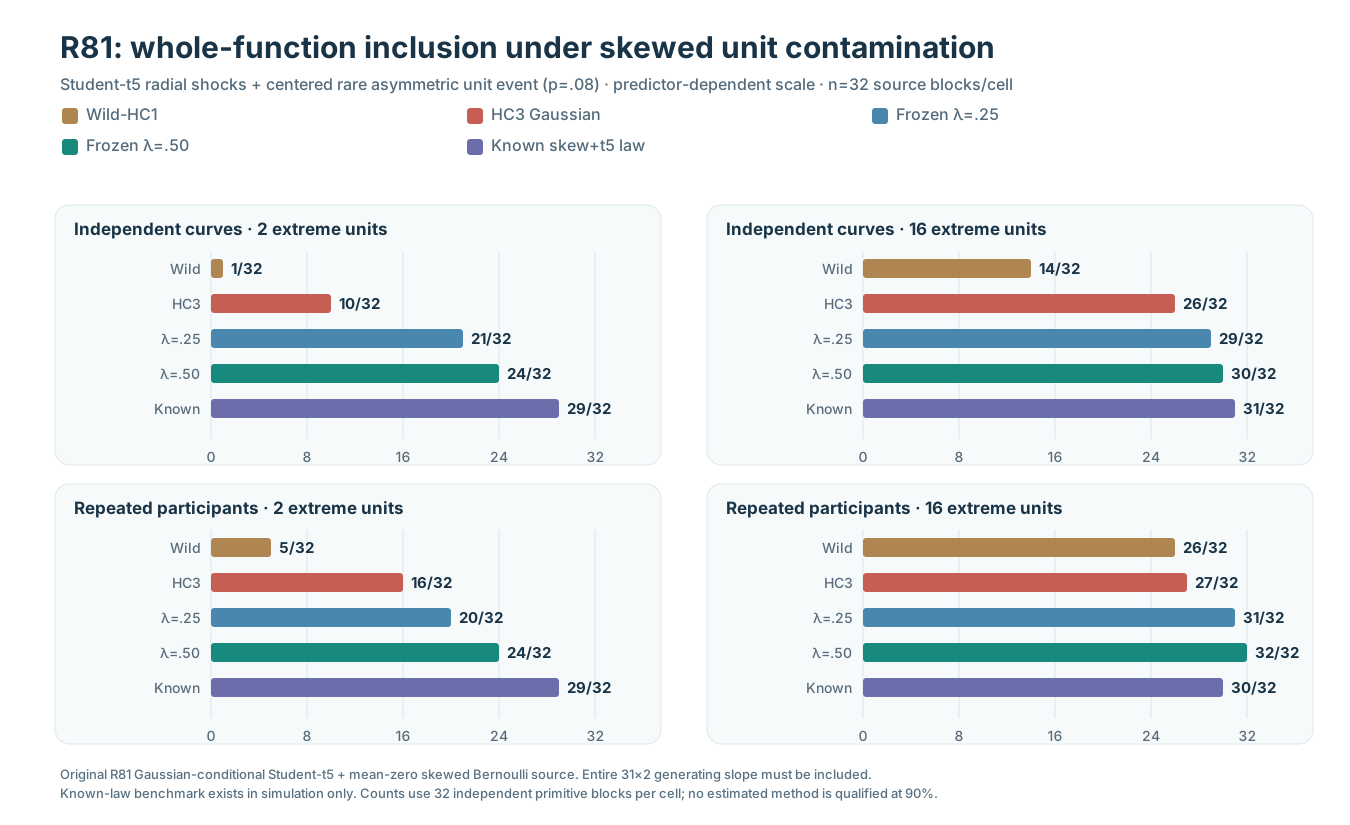
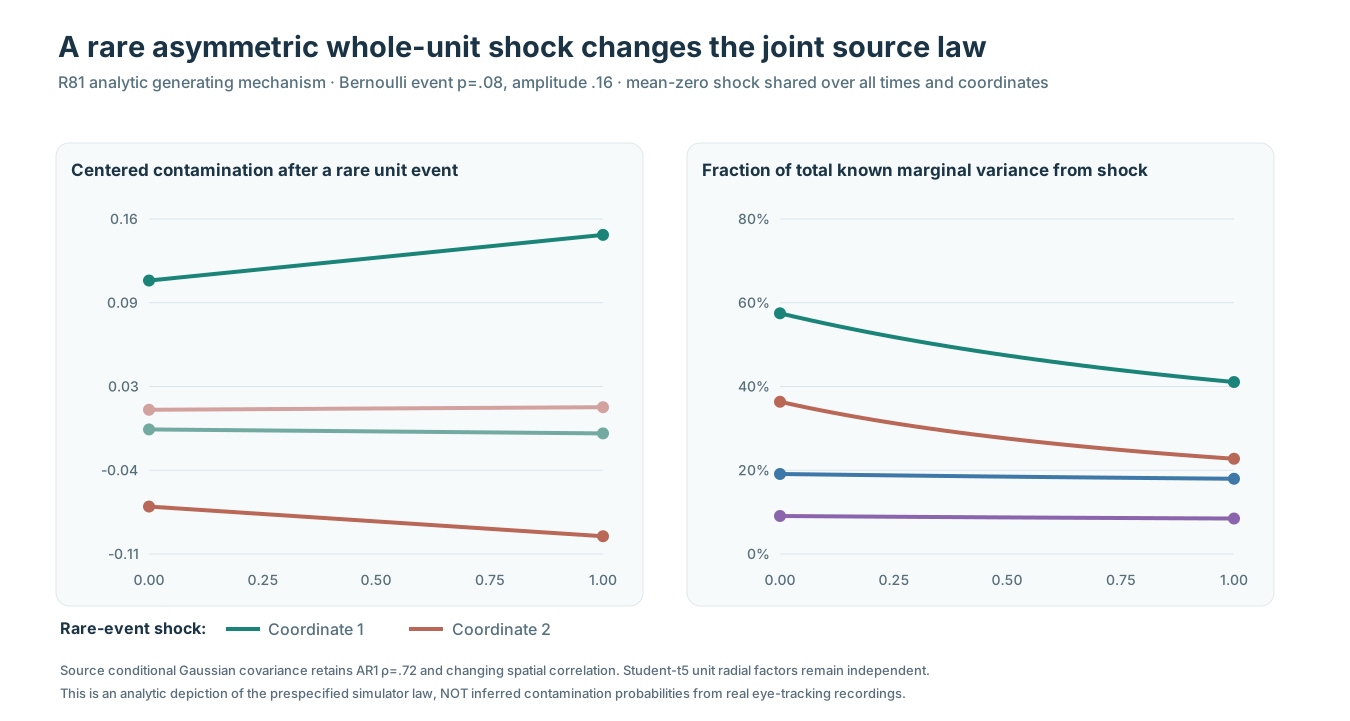
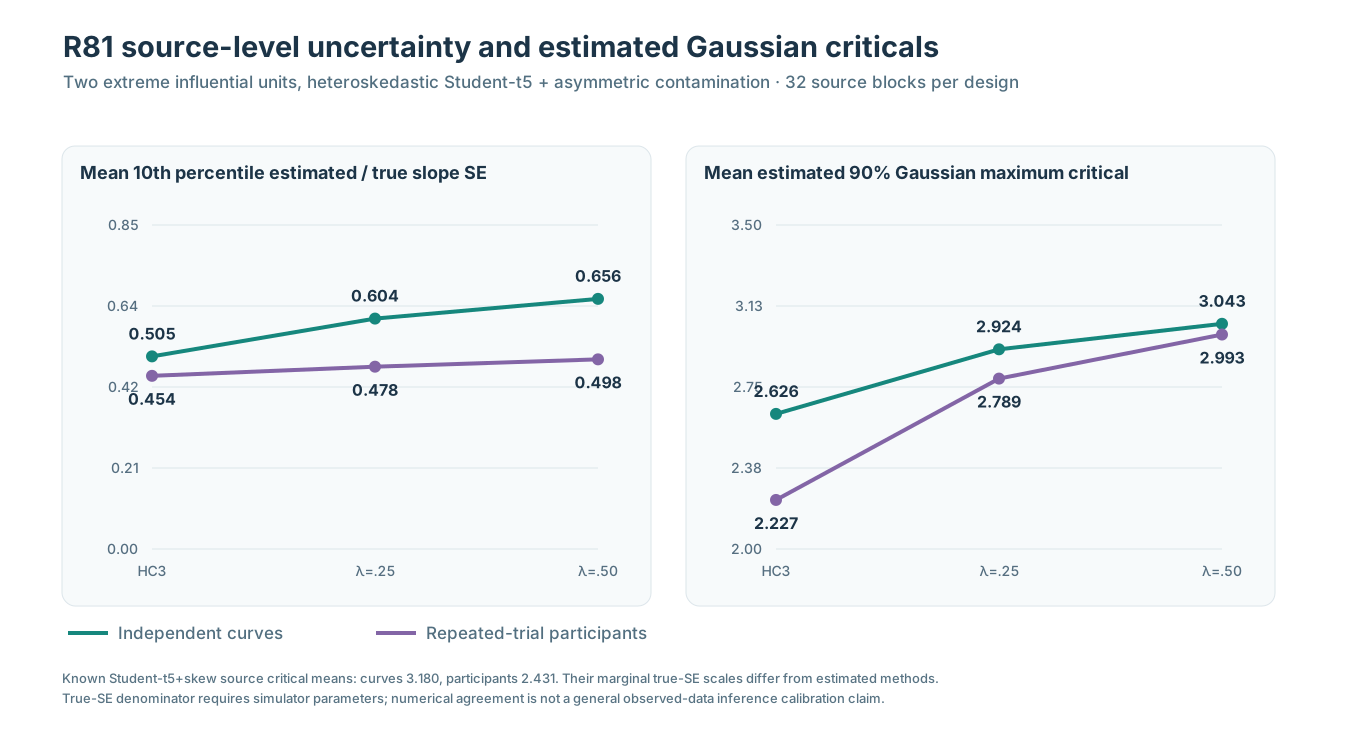
The original R81 scientific run #39490888383 passed 12/12 original science jobs; separately coded R81-A original archive audit #39491187099 passed 4/4. Each of the 256/256 original new Student-t5 + centered skew Bernoulli X/Y source cases, zero refusals and all 1,278,720 conditional reference maxima were independently replayed. Source n=32 independent primitive generating blocks per fixed condition. Frozen λ=.25/.50 methods are not nominal-90%-qualified; true Bernoulli contamination parameters are simulator-only, no field recordings or MNAR. Full scientific article · Numerical figure/source ledger.
R82: complete/MCAR/MAR/MNAR observation-process falsification
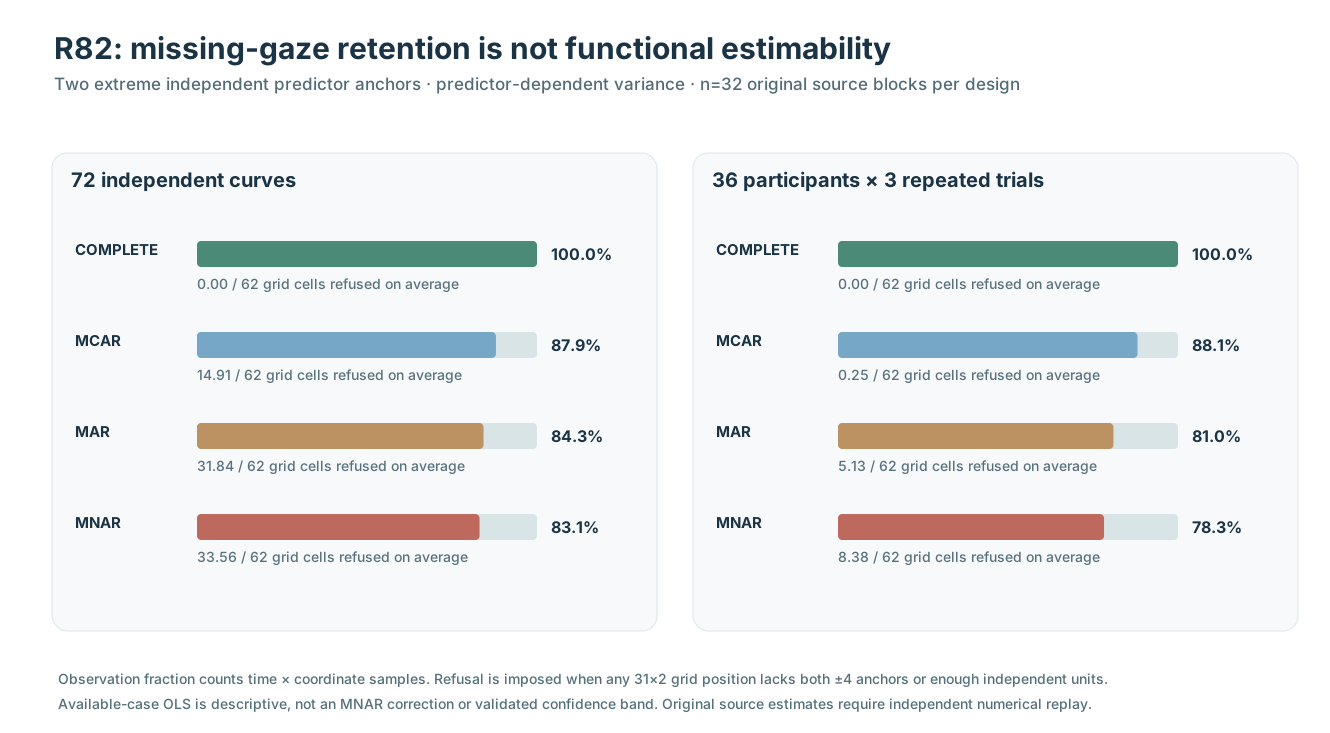
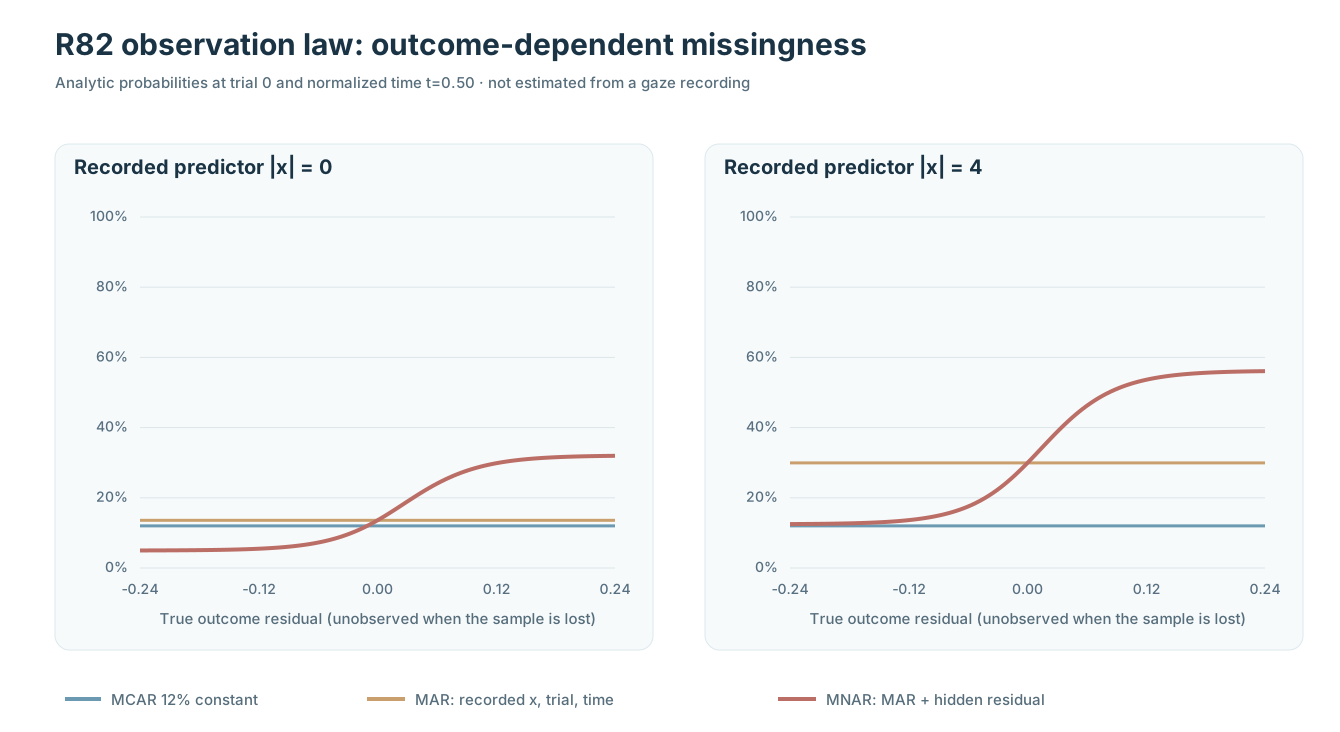
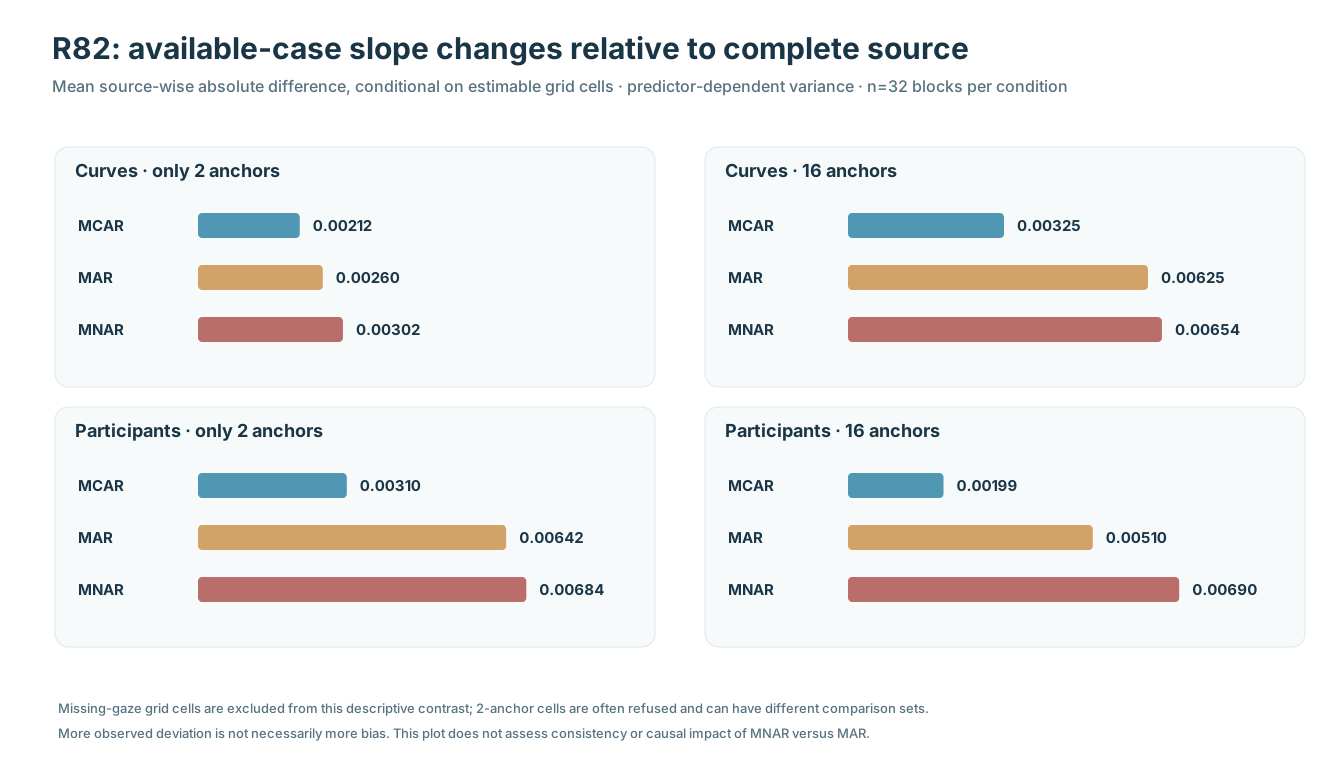
The original R82 science workflow #39571308151 passed 12/12 dedicated source jobs, and independent original-archive replay #39572315409 passed 4/4. Complete 256 original X/Y source conditions and all 1,024 paired MCAR/MAR/MNAR masks and grid diagnostics independently regenerated; 32 new independent source blocks per design/support/variance cell. Under primary two-anchor heteroskedastic curve MNAR, 83.1% observed samples and 33.56/62 refused grid positions coexist. This is not an MNAR correction or confidence band; public native missingness rejection is preserved, #289/#296 OPEN, version 1.2 HOLD. Full article · Evidence/figure ledger.
R83: nonidentified MNAR assumption weighting and simulator-only oracle
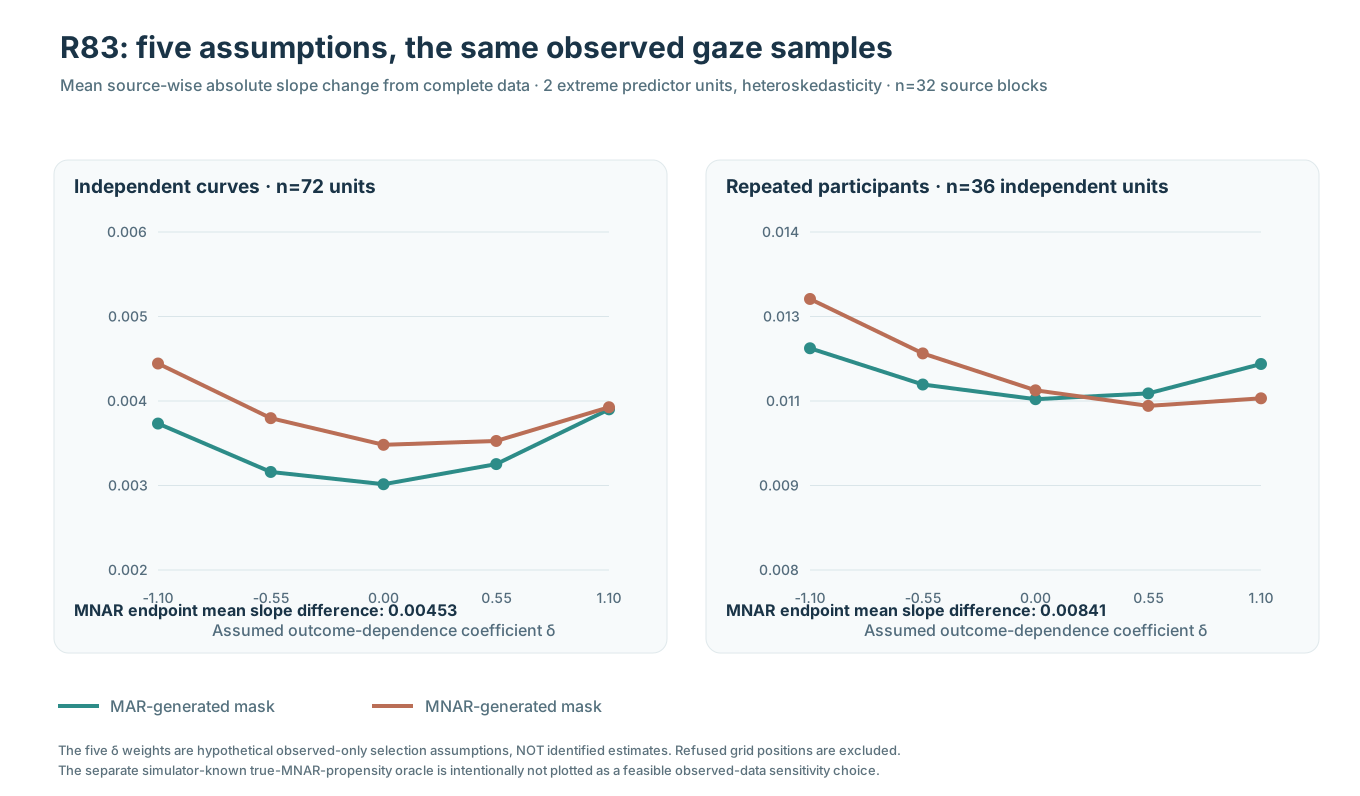
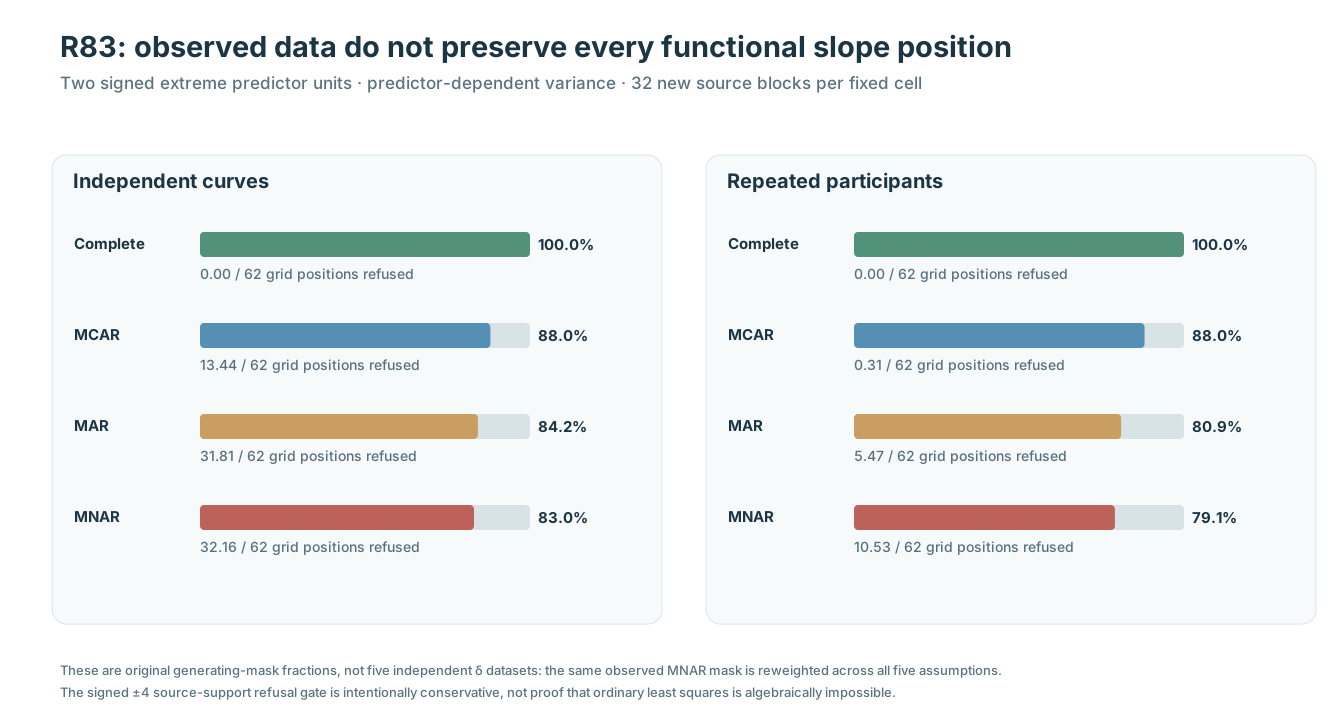
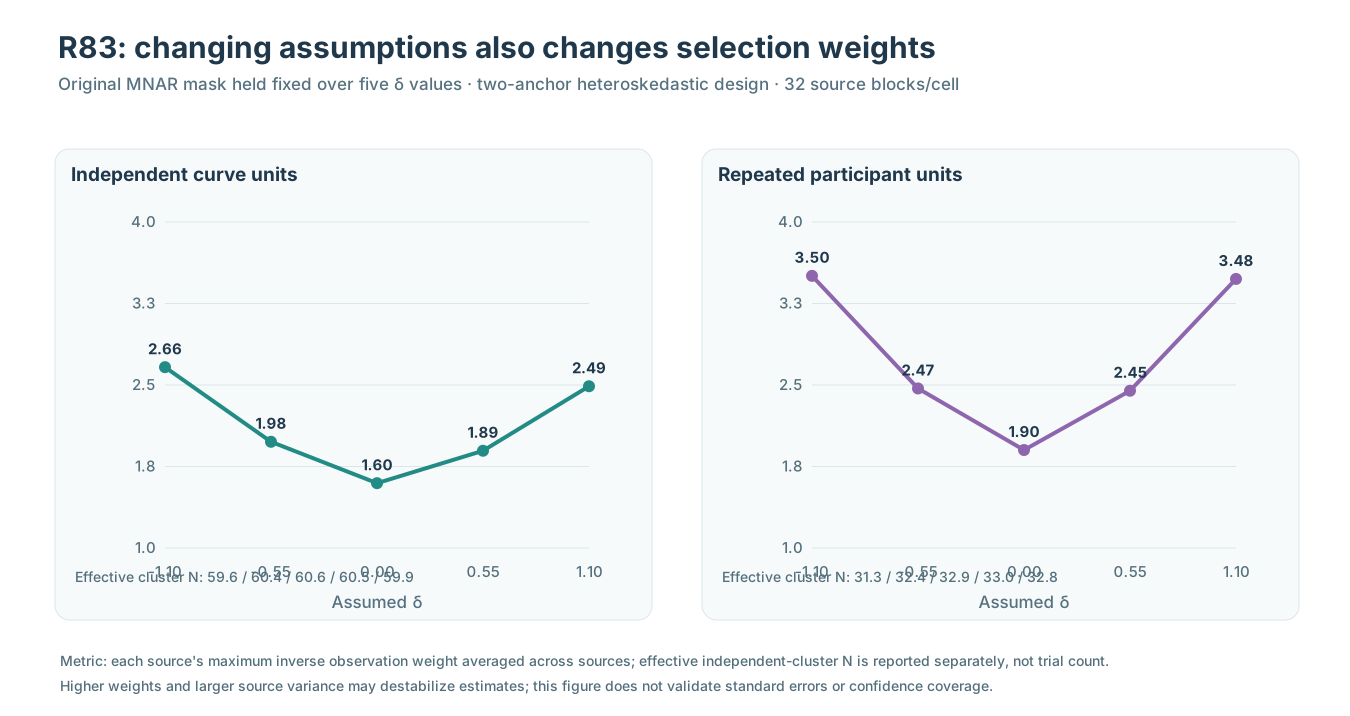
Original R83 source #39575847765 12/12 science PASS; independently coded R83-A true original replay #39576738539 4/4 PASS. Independently verified 256/256 original source X/Y, 1,024 actual paired masks, all 3,328 source-specific descriptive pointwise delta/oracle records and original SHA256 identities, 32 new independent primitive blocks per fixed cell. This is not identified MNAR, an observed-data oracle, or nominal-90% inference. Full study · Figure ledger.
R84: independent synthetic external ascertainment of otherwise missing outcomes
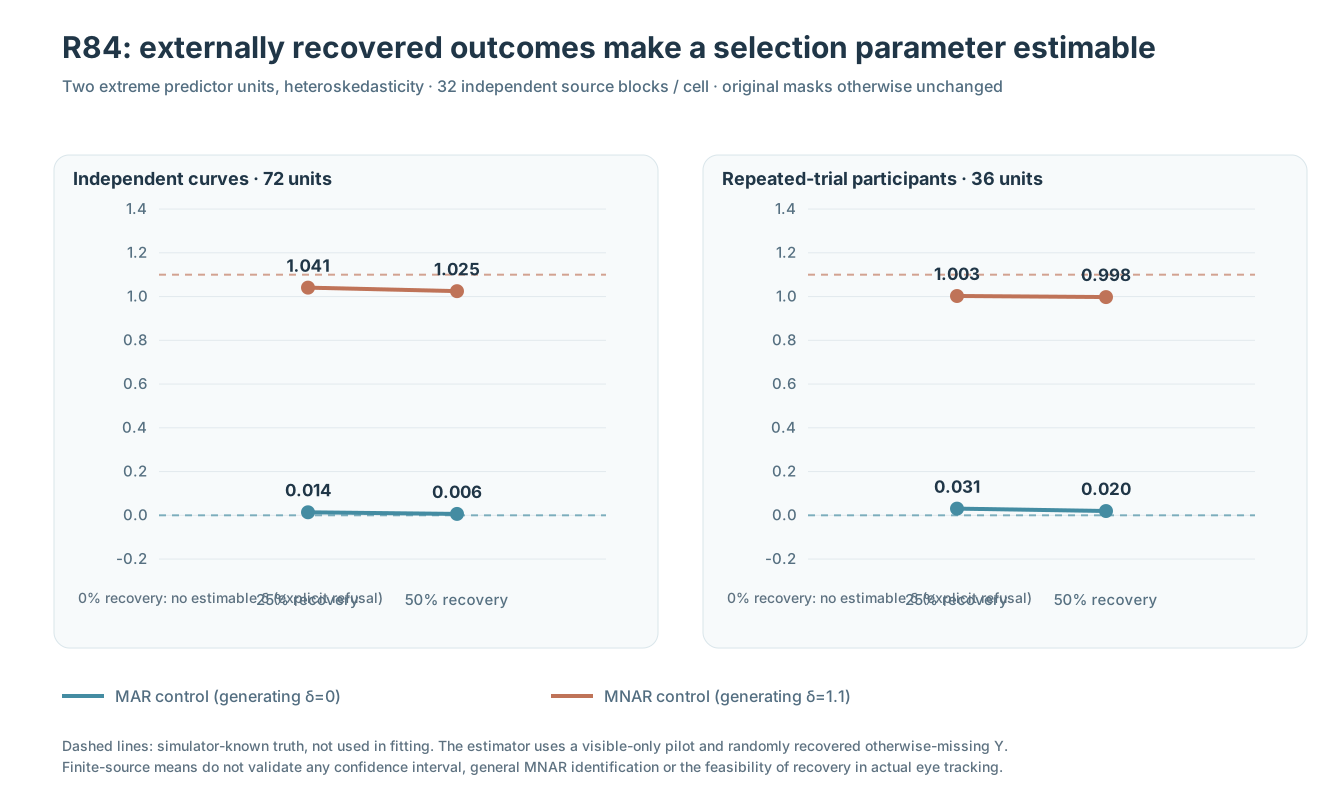
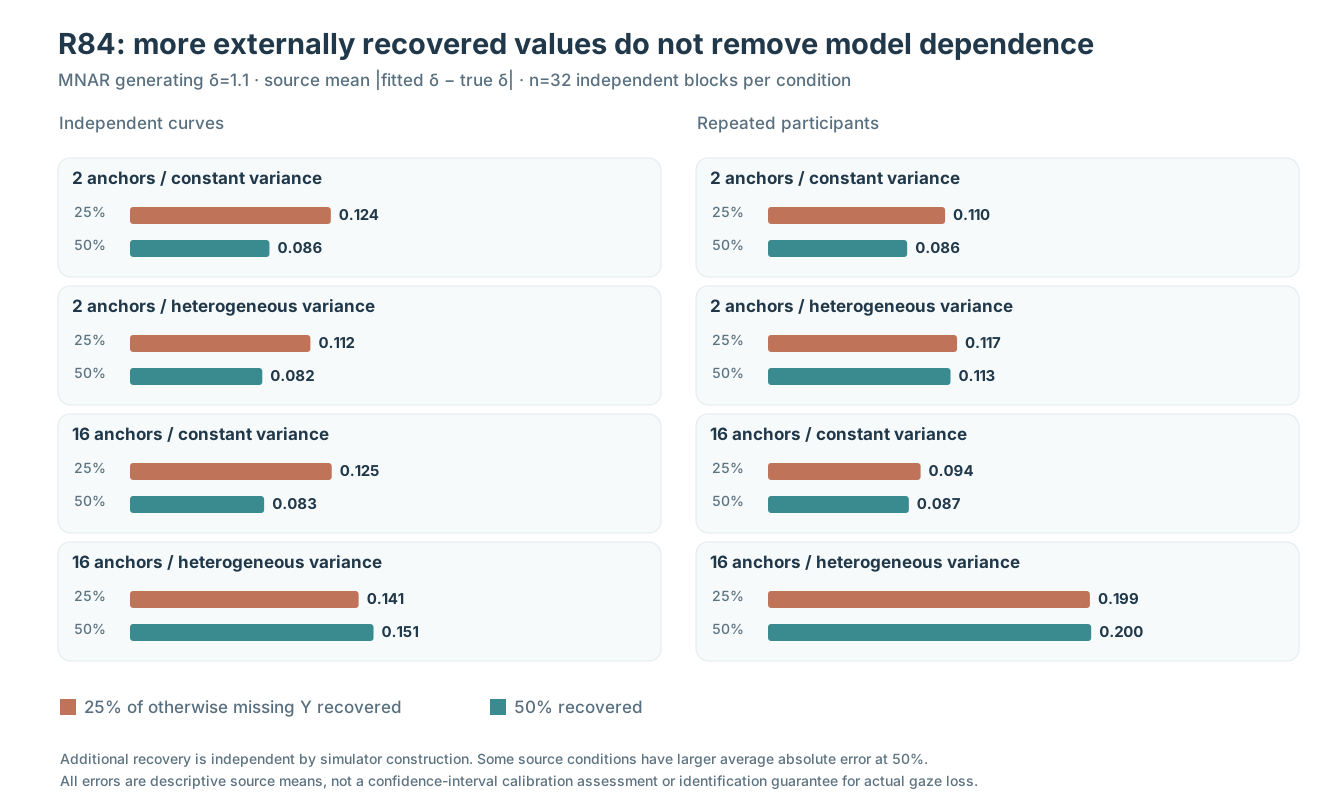
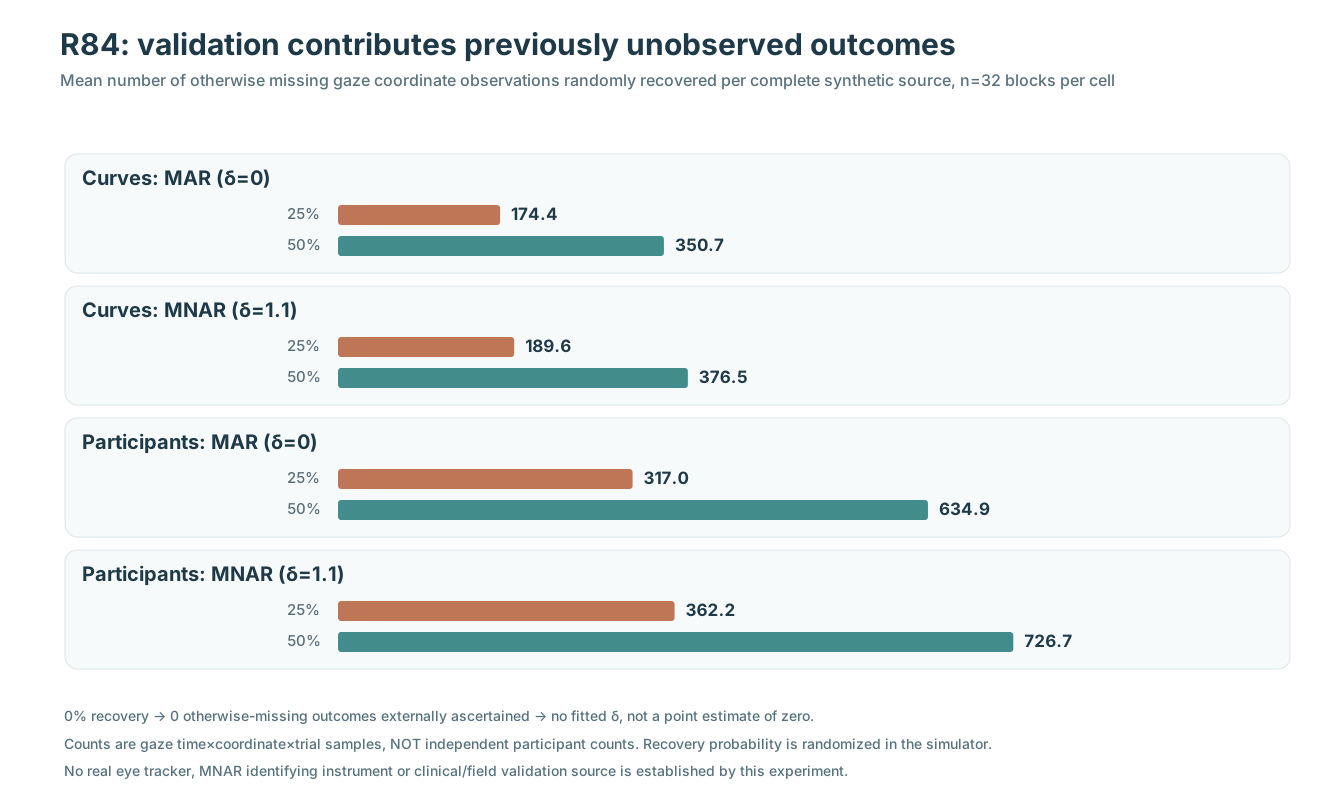
Original R84 science #39581392688 12/12 dedicated jobs PASS, separately implemented R84-A original real archive #39582618020 4/4 PASS; independently reconstructed 256/256 complete original source conditions, 512 genuine MAR/MNAR masks, all 1,536 nested external recovery records, 32 new independent primitive blocks per fixed cell. The fitted δ is NULL at 0% recovery; newly ascertained outcomes permit only conditional model-dependent scalar δ estimation, not identification of arbitrary MNAR or general confidence bands. Stable public API unchanged, #289/#296 OPEN, v1.2/PyPI HOLD. R84 article · Source and figure ledger.
R85: biased validation of otherwise missing gaze values
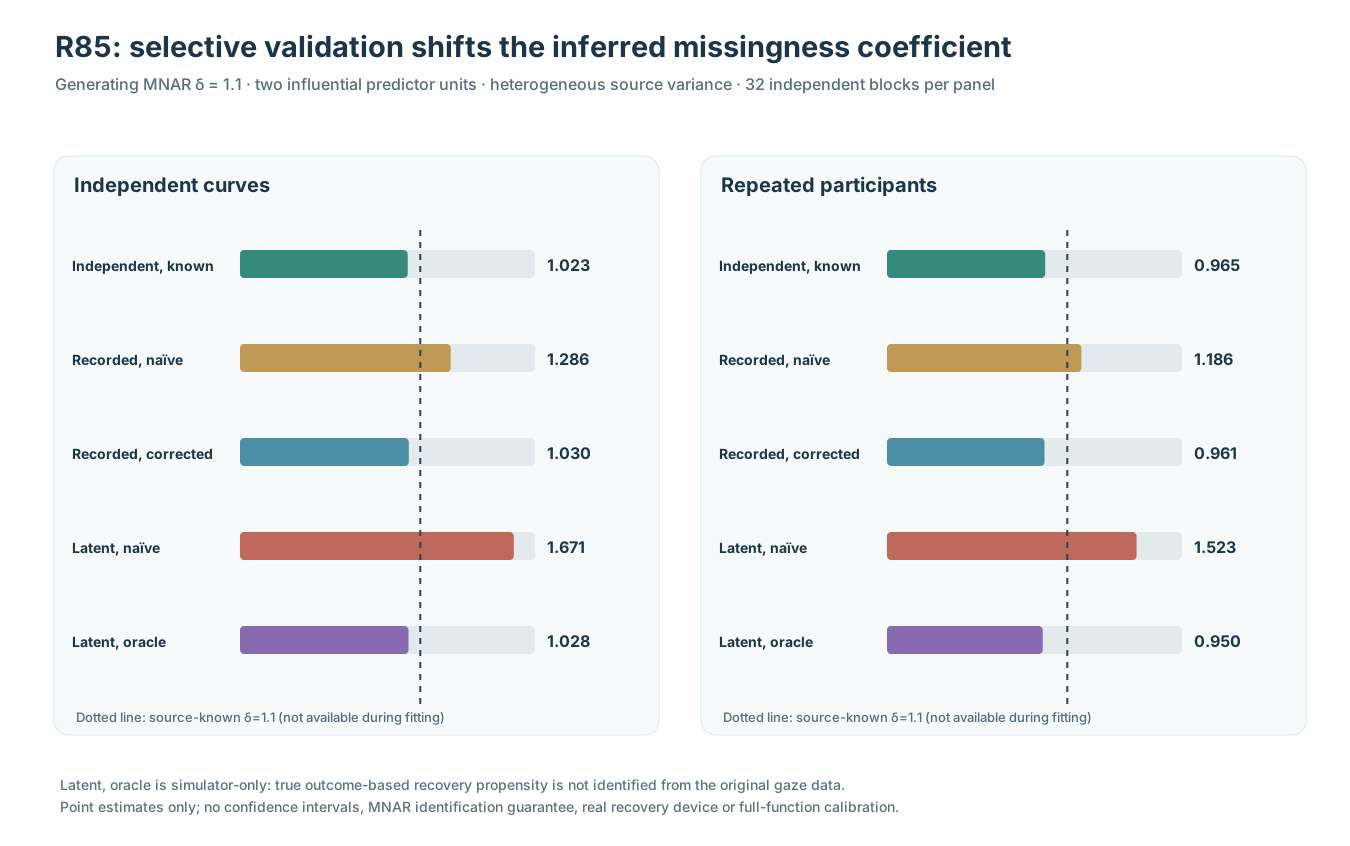
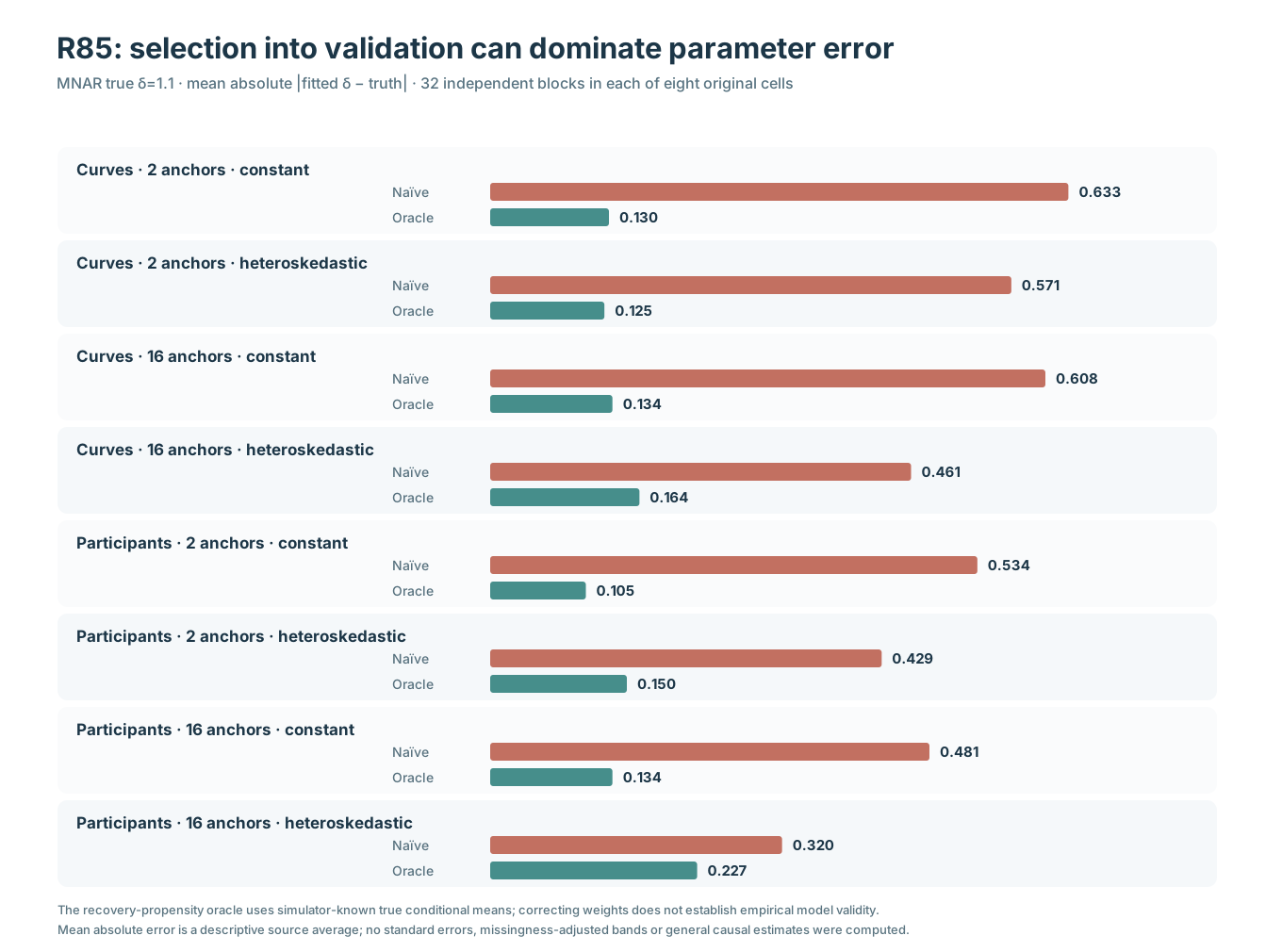
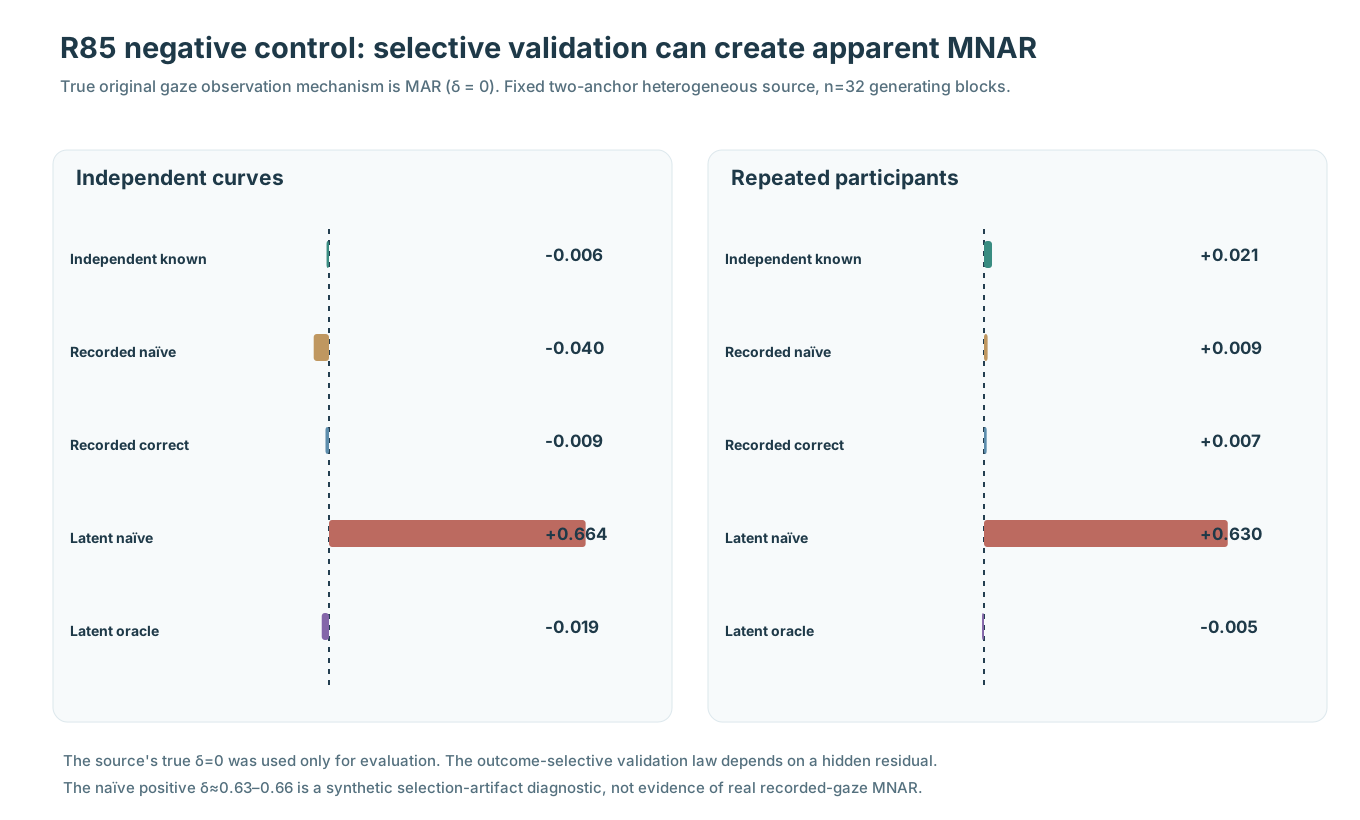
Original R85 science #39629520741 12/12 dedicated PASS; independent R85-A true original replay #39630863879 4/4 PASS. Independently reconstructed 256 original X/Y source conditions, 512 first-stage MAR/MNAR masks and 2,560 recovered-data estimator strategies with 32 independent new primitive blocks per fixed cell. The naïve second-stage selection analysis is not an observed-data MNAR correction; exact latent propensity oracle is unavailable outside simulation. No public inference release or confidence bands. R85 article · Figures and numerical provenance.
R86: independently randomized audit of secondary validation failures
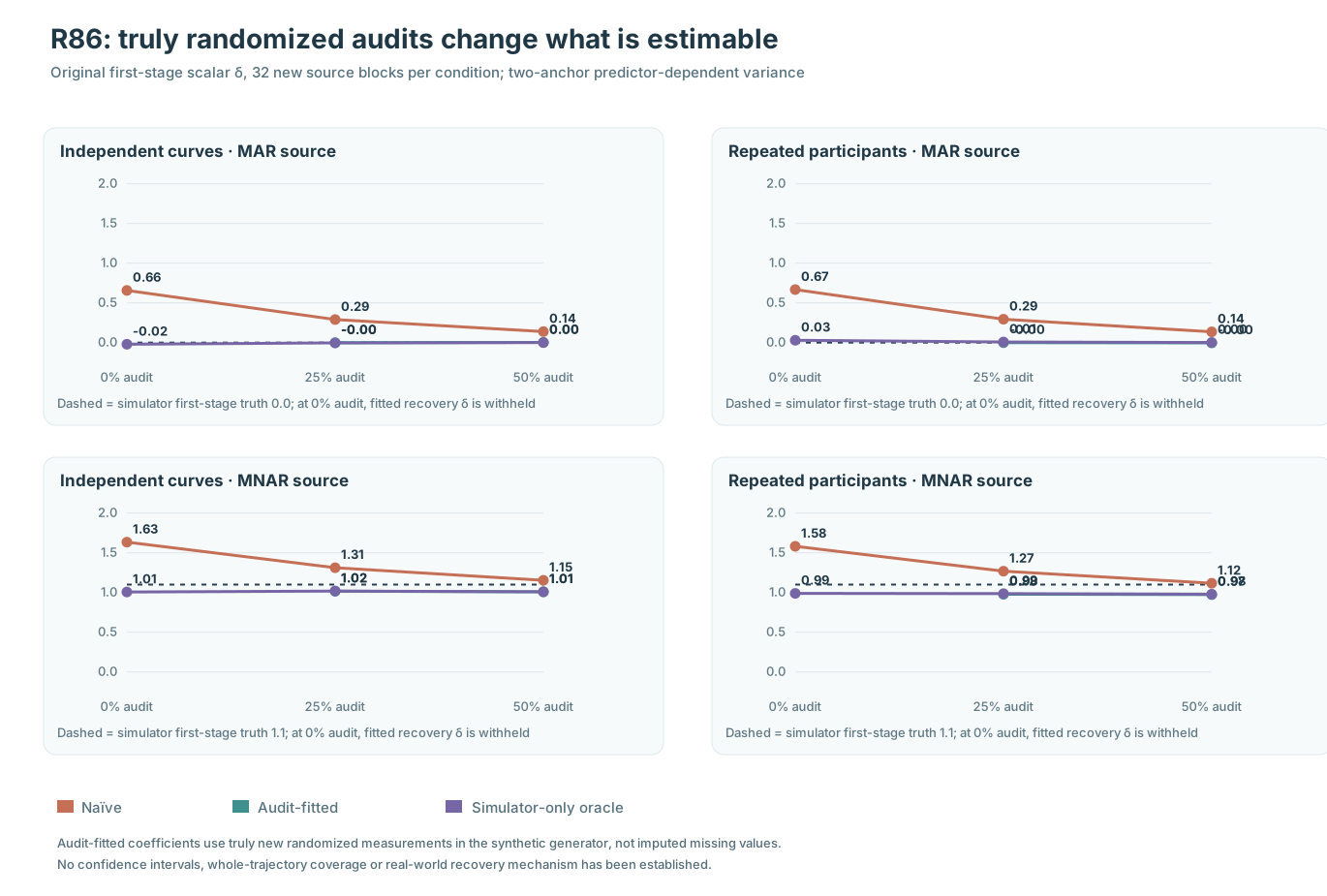
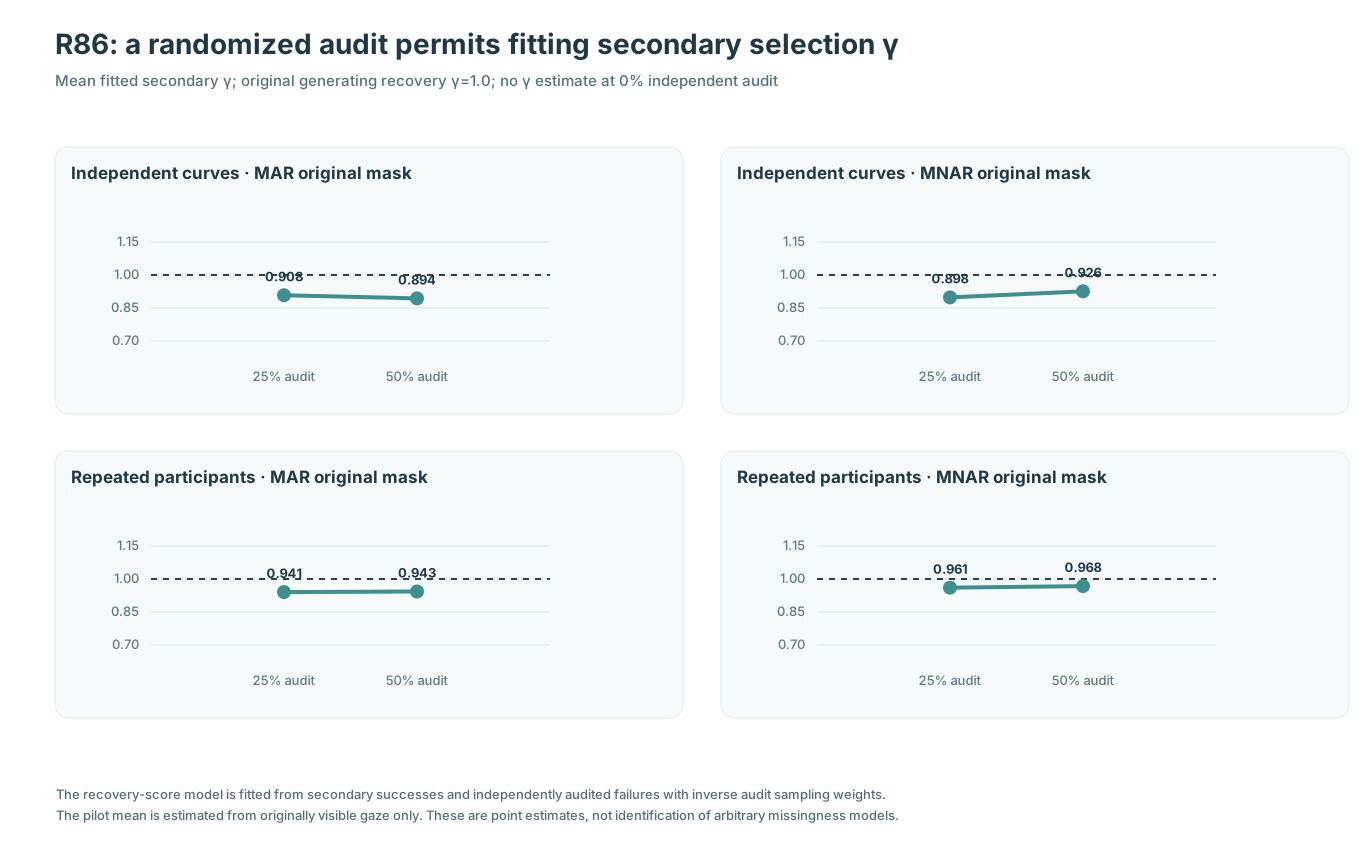
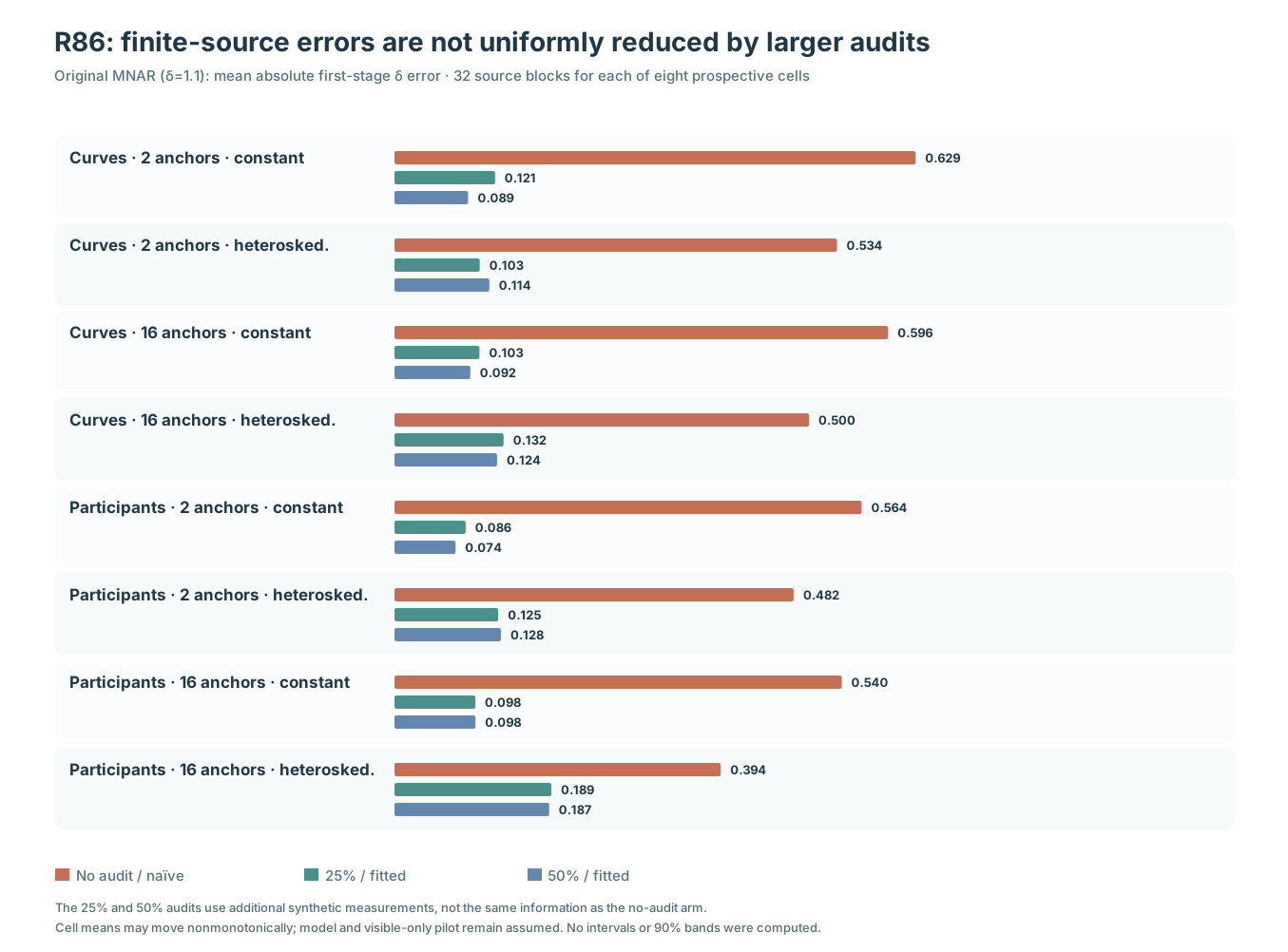
Original R86 source #39639148930 12/12 jobs PASS, independent R86-A genuine original replay #39640120223 4/4 PASS. Source-independent evidence covers 256 new complete X/Y source conditions, 512 paired MAR/MNAR masks, 4,608 third-stage audit/estimation records, with 32 new primitive independent source blocks per fixed cell. Random audit supplies genuinely new otherwise missing synthetic responses, not field recovery technology; source oracle unavailable to actual recordings, no confidence bands. R86 article · full evidence.
Reproducible provenance
These figures are version-controlled scientific assets in the research PRs, embedded without regenerating simulated results using a different source state. For source dataset counts, original workflow artifacts and SHA256 audit evidence, consult the scientific dashboard.
Figures for earlier E1–E4 workflows remain available through the existing experimental gallery. Other proposed B5–B10 or F1–F6 demonstrations that lack an original committed SVG are not represented here as if they were completed research figures.