B6/B7 rank-two NUTS R3: paired versus asynchronous posterior computation
Two actual rank-two fits; only one passed its exploratory screen
Both four-chain PyMC/NUTS models fitted successfully and original evidence was retained, but one of two independent datasets failed the identified-functionals screen. This is a stage-zero computational pilot, not convergence qualification over many datasets, simulation-based calibration, nominal interval coverage, or authorization to publish 1.2.
Independent original source
The actual PyMC rank-two full posterior and all 30 parameter gradient comparisons were previously validated mathematically in R2. The present study is the next, separate statistical-computation step, on experimental draft PR #279, original scientific source commit cbfe81680654ab6b2b17265d14b0bf7f4a377042.
Original scientific workflow #38096271285 completed the two genuine four-chain PyMC posterior fits, the three Python rotation-invariance research contract environments, and SHA256 verification. The audit reports two planned datasets, two completed fits, zero fitting exceptions, one exploratory screen pass and one failure, with no missing evidence artifact. The original engineering workflow on that commit had an optional ArviZ test-collection failure (not a numerical sampler error); it was corrected on experimental PR #279 in subsequent commit fc3dc8329f4e5d46d8758e87ec8d793c3578ddf6. The mathematical/sampling conclusions here are sourced to the unchanged original scientific run; corrected-head overall CI is a distinct status.
The design uses one new independent matched-Gaussian-prior rank-two dataset in each planar observation design (paired x/y; genuinely asynchronous x/y timestamps), four synthetic participants per dataset, fixed known noise, four NUTS chains with 700 warmup and 400 retained draws per chain, and target acceptance 0.94. Population means, x and y variances, and x/y cross-covariances at quarter/midpoint/three-quarter grid positions produce 15 sign- and factor-rotation-invariant functionals per dataset. All source plots and table quantities below were read from original checksum-validated case.json artifacts.
| Actual scientific outcome | Paired x/y | Asynchronous x/y |
|---|---|---|
| Original fitting artifact | 11686840512 |
11686377461 |
| Actual fit status | Completed | Completed |
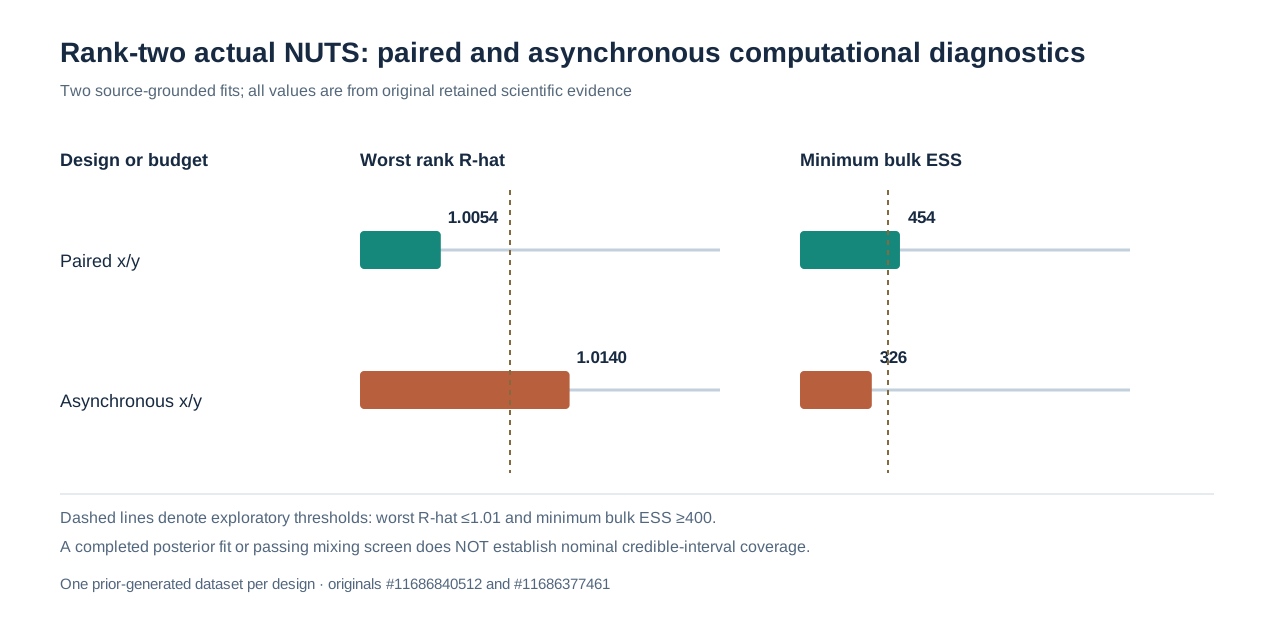
| Worst rank-normalized R-hat across 15 identified functionals | 1.00538756 | 1.01397328 |
| Minimum bulk ESS | 454.35 | 326.41 |
| Minimum tail ESS | 693.11 | 540.59 |
| Minimum energy BFMI | 0.69472 | 0.82954 |
| NUTS divergences | 0 | 0 |
| Number failing identified-functionals screen | 0/15 | 6/15 |
| Marginal 90% intervals containing the generating truth (descriptive only) | 15/15 | 10/15 |
| Total fitting time including compilation/tuning/sampling | 668.58 sec (11.1 min) | 2,146.16 sec (35.8 min) |
The separately preserved original aggregate artifact 11686793076 verifies both dataset attempts and source hashes. Fitting succeeded in both; computational qualification did not in the asynchronous one.
Localization of the asynchronous failure
All six asynchronous failed population functionals are means: x and y at each of the quarter, midpoint and three-quarter grid positions. The largest R-hat is 1.01397328 for x mean at three-quarters, and the lowest bulk ESS is 326.41 for y mean at quarter. All nine population variance and x/y covariance functionals in the asynchronous dataset passed their individual numerical screens, despite the overall failure.
This is a targeted diagnostic clue, not a proven general property of asynchronously sampled eye-tracking models. The study has only one dataset per design and four simulated participants per dataset. The posterior-mean geometry, asynchronous observation sparsity and identification should be investigated before deciding whether a longer chain, a different parameterization or different sampling design is warranted. No causal comparison of pairing versus asynchrony is established.
The original single-dataset truth-in-90%-interval counts 15/15 and 10/15 must not be treated as coverage estimates: the 15 outcomes within each dataset are dependent and one dataset failed the convergence screen. Likewise, the elapsed times are not a matched-hardware cross-architecture speed comparison.
Scientific decision
Rank-two PyMC log posterior/gradient correctness is verified in the four earlier mathematical cases; actual rank-two posterior computation is feasible in these two attempts but not reliably qualified, and its asynchronous mean-functionals warning is unresolved. A subsequent rank-two study must prespecify additional independent datasets and assess the failure mechanisms without silently conditioning on successes. Proper SBC, posterior predictive validation, fixed-truth coverage, rank-two interval calibration and matched-compute runtime comparisons remain separate gates.
Research implementation remains in draft PR #279; documentation integration does not authorize merging that implementation or replacing native Gibbs in the stable package. Bayesian blocker #255 remains open, as does independent F5 blocker #256. Published stable 1.1.0 remains unchanged; 1.2 is unreleased.