W3 R85: secondary validation selection, full original-source evidence and figures
Source and independent audit provenance · 21 October 2026 · synthetic research, not public inference
No identification from ordinary gaze, no confidence bands
The R85 validation-stage mechanisms (independent, recorded-covariate selective, and latent-outcome selective) are synthetic. Exact hidden-outcome recovery weights require simulator-known generating mean and selection law. The experiment does not validate an actual technology for recovering lost gaze, observed-data MNAR identification, unbiased two-stage estimation, 90% simultaneous coverage or a released estimator. Stable 1.1.0 unchanged; version 1.2/PyPI HOLD; W3 #289/#296 OPEN.
Original and independent numerical provenance
| Contract | Verified actual source |
|---|---|
| Prospectively frozen R85 source PR | Draft PR #430 |
| Original dedicated scientific workflow | #39629520741, 12/12 source jobs PASSED |
| Original immutable SHA256 archive | Artifact #12359490292 |
| Exact original science PR-merge checkout | 39ed0ed74d5eb23dfee316a8b5dcd73d498a4a9e |
| Independently coded actual original audit | Draft PR #431 |
| Actual original immutable archive replay | #39630863879, 4/4 independent jobs PASSED |
| Independent source/strategy reconstruction artifact | #12359206531 |
| New source RNG seeds | Source 202610218580, original missingness 202610218581, external validation 202610218582 |
| True generating primitive blocks | 32 per fixed design/support/variance cell |
| Complete synthetic X/Y source conditions | 256, from 32 ×2 unit designs ×2 predictor supports ×2 noise scales |
| Paired first-stage MAR/MNAR masks | 512, original generating δ=0 /+1.1 |
| Distinct recovery laws | Three: independent .25, recorded-input selective, latent-outcome selective |
| Strategies per source/mask | Five, including naïve/correct known recovery and privileged latent-oracle contrasts |
| Original strategy rows independently verified | 2,560, not 2,560 independent generating blocks |
| Original public function-on-scalar behavior | Still refuses missing gaze |
| Interval and release qualification | None; no inferred confidence bands or valid general nominal-90% statement |
R85-A reconstructs all original real archived source-level results, rather than independently verifying only test fixtures. It uses centered-sufficient-statistic pilot OLS and independent Newton roots to compare against original trial-level least-squares and bounded bisection. Original X/Y, original masks, recovered masks, propensity arrays, pilot fits, final deltas, source-level error records and immutable hashes are independently verified for the entire factorial.
Figure 1 — primary adverse MNAR source δ
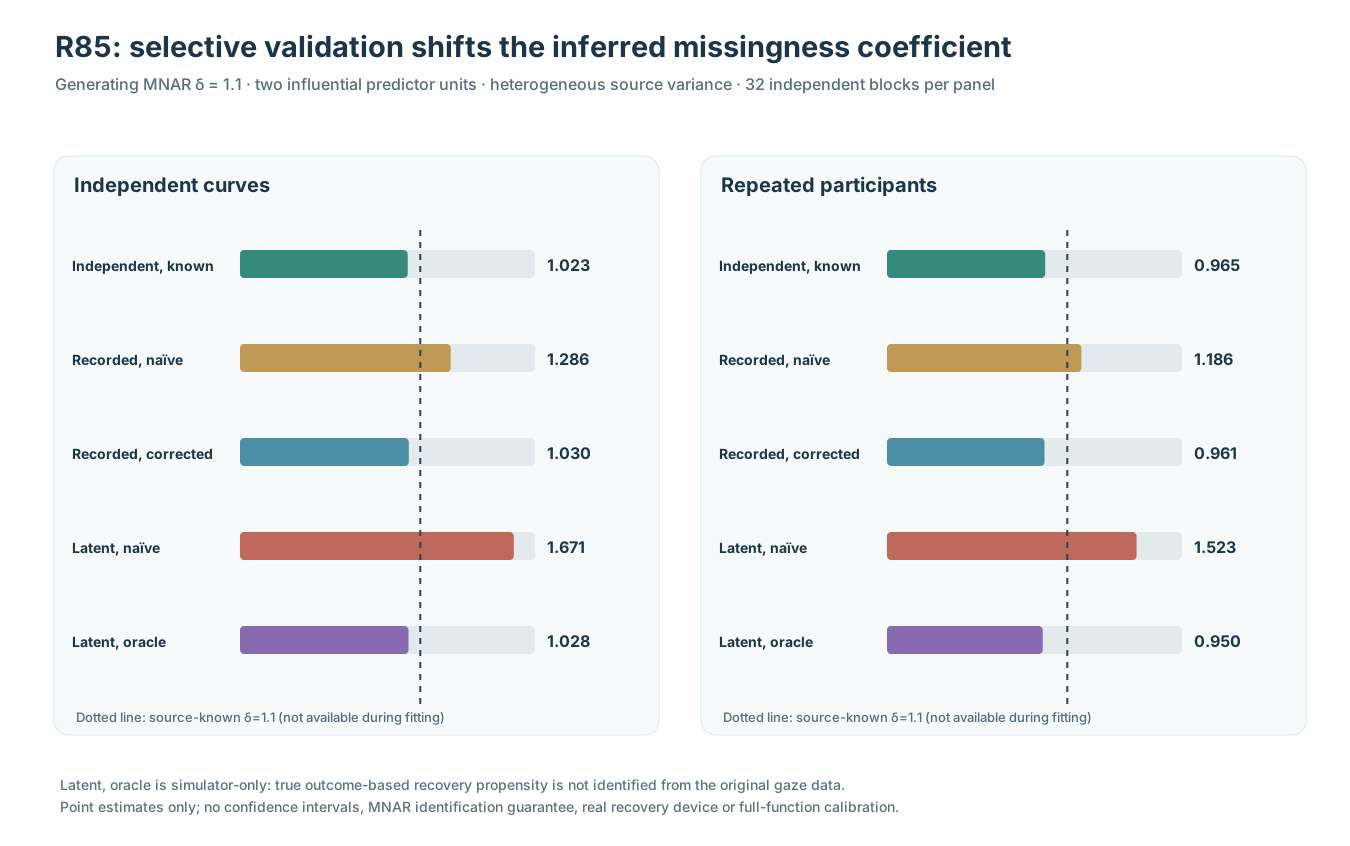
Figure 1. Two signed influential predictor units, predictor-dependent source variance; 32 independent blocks/design, true first-stage MNAR δ=1.1.
| External recovery strategy | Independent curves, fitted δ | Repeated participants, fitted δ |
|---|---|---|
| Independent known .25 | 1.023421 | .965294 |
| Recorded-selective, naïve .25 | 1.285682 | 1.186202 |
| Recorded-selective, known recorded propensity | 1.030105 | .960964 |
| Latent-selective, naïve .25 | 1.670758 | 1.522912 |
| Latent-selective, simulator-known oracle propensity | 1.028327 | .950261 |
The MAR/MNAR first-stage generating truth is not used by fitting; the simulator-only recovery-propensity oracle uses true conditional mean only to calculate correct validation weights. These are descriptive mean point estimates, not inferential bounds.
Figure 2 — full eight-cell latent-selective source error
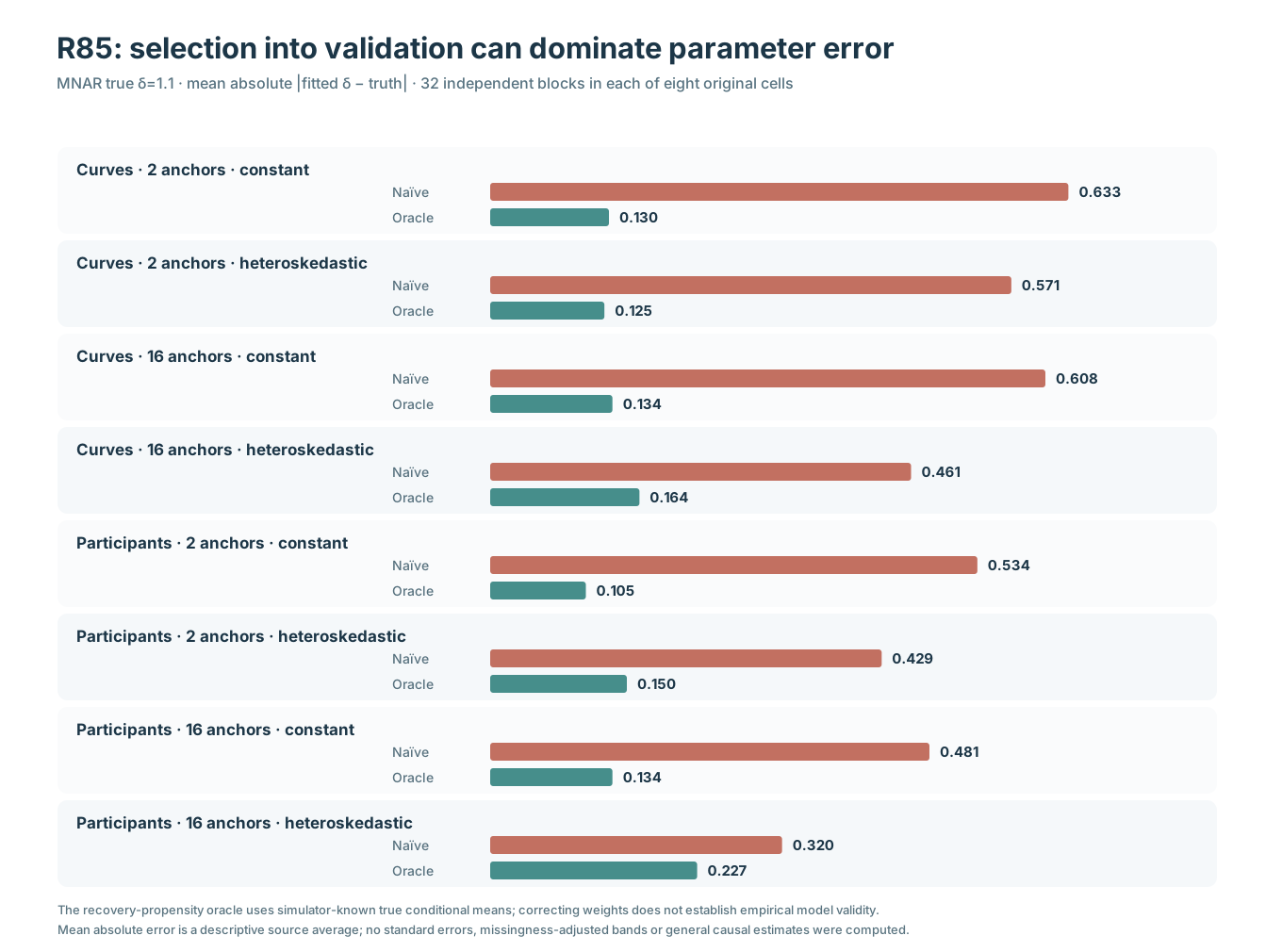
Figure 2. Mean source \(|\widehat\delta-1.1|\) across 32 primitive independent source blocks/cell for actual original first-stage MNAR masks and the same recovered samples under both weighting strategies.
| Independent-unit design | Extreme signed units | Variance law | Naïve .25 mean absolute error | Privileged true-propensity error |
|---|---|---|---|---|
| Curves | 2 | Constant | .6333 | .1301 |
| Curves | 2 | Heteroskedastic | .5708 | .1251 |
| Curves | 16 | Constant | .6081 | .1339 |
| Curves | 16 | Heteroskedastic | .4610 | .1635 |
| Participants | 2 | Constant | .5336 | .1048 |
| Participants | 2 | Heteroskedastic | .4288 | .1497 |
| Participants | 16 | Constant | .4811 | .1339 |
| Participants | 16 | Heteroskedastic | .3197 | .2267 |
The oracle's lower source-mean absolute errors in these eight cells are a synthetic diagnostic, not evidence that the oracle recovery propensity can be identified from actual observed gaze.
Figure 3 — first-stage MAR, validation-stage MNAR produces a false coefficient
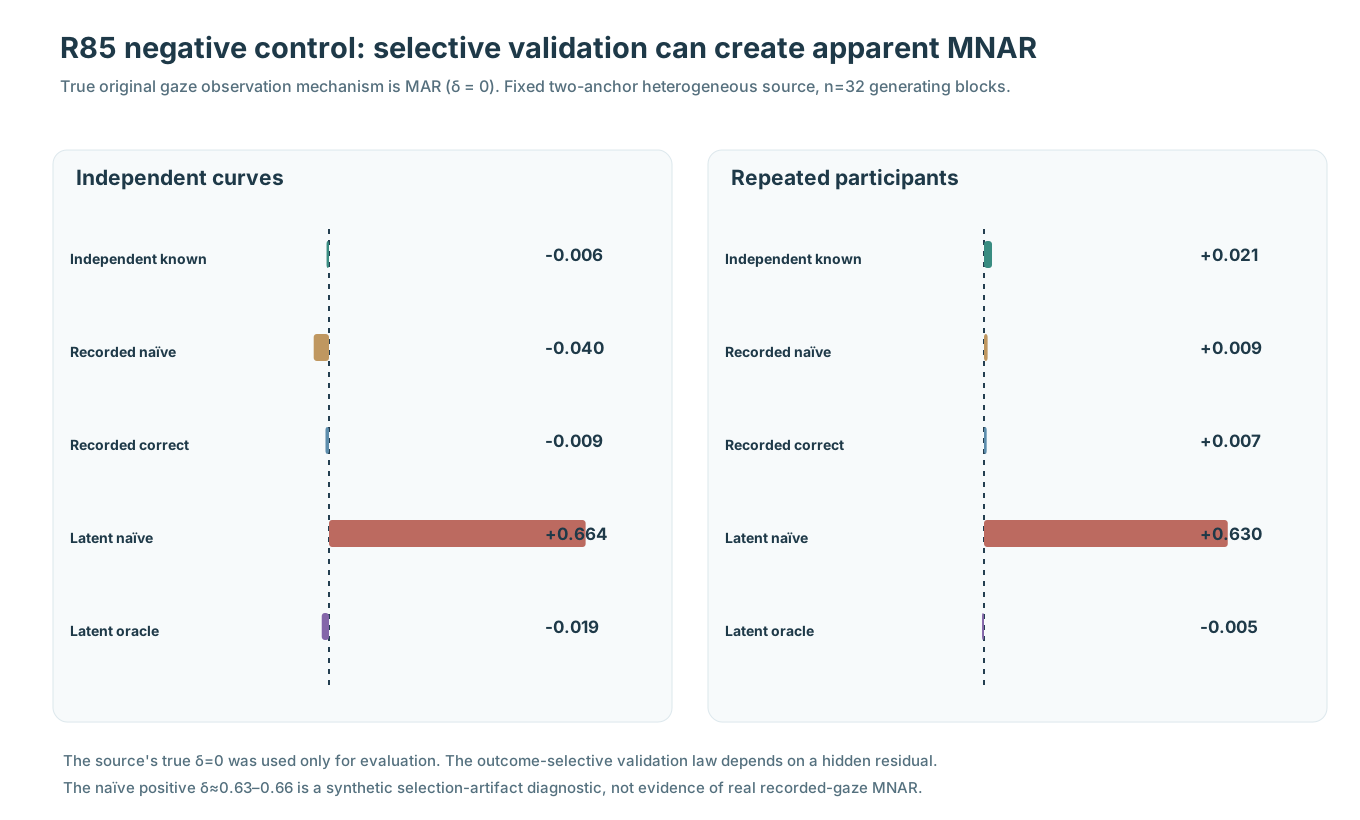
Figure 3. First-stage generator true δ=0, 2-anchor heteroskedastic source, 32 new independent blocks/cell.
| Original MAR first-stage source | Independent known .25 | Recorded-selective naïve .25 | Recorded known propensity | Latent naïve .25 | Latent source oracle |
|---|---|---|---|---|---|
| Independent curves | −.0063 | −.0396 | −.0091 | +.6637 | −.0188 |
| Participants | +.0207 | +.0094 | +.0069 | +.6304 | −.0051 |
The source with MAR original gaze selection does not become truly MNAR merely because a secondary validator preferentially recovers certain hidden residual values. Ignoring that second selection can nevertheless lead to a fitted positive original MNAR coefficient. These are not formal significance tests or false-positive probabilities.
Qualifications of secondary observed-input weighting
The recorded-selective corrected strategy assumes the validation law is known, logged and governed by recorded predictor/time. It is not generally guaranteed to reduce finite-sample mean absolute first-stage δ error relative to an incorrectly constant recovery weight. For the adverse 2-anchor heteroskedastic original MNAR participants, source-mean absolute δ error was .1189 under naïve versus .1390 under stipulated correct recorded-input recovery weights, although source-mean signed fitted coefficients shifted from 1.1862 towards .9610 (truth 1.1). Error magnitudes and signed shifts address different criteria.
No source-independent uncertainty, estimated participant-cluster covariance, valid missingness-adjusted functional coefficient or calibrated whole-trajectory confidence band is computed here. The validation mechanism is itself a scientific object requiring independent information and measurement justification.
The full R85 article and methods companion explain the falsification and its limits. The original archived datasets, individual original source/mask/recovery hashes and all 2,560 source-strategy diagnostics remain available in the linked numerical evidence, not extrapolated to real eye-tracker behavior.
Research source code stays draft, blockers #289/#296 OPEN, protected-main inference unchanged, version 1.2/PyPI RELEASE HOLD.