Why narrower missing-gaze bounds need information from outside the returned data
It is tempting to treat high audit completion as evidence that missing outcomes can be accurately reconstructed. R93 shows why that is insufficient: different latent outcome populations can generate exactly the same observable audit-return distribution. R94 and R95 ask what additional, externally justified knowledge would change that result.
Compare assumptions on a shared observed law
Within the deliberately simple frozen symmetric binary law, let invited nonreturn be \(delta\), so \(q_0=q_1=(1-delta)/2\). The population mean \(p=P(Z=1)\) has different sharp sets depending entirely on an externally asserted restriction.
| Extra externally justified information | Width of sharp population set | Width divided by nonreturn \(delta\) |
|---|---|---|
| Nothing (R93) | \(delta\) | \(1\) |
| Both outcome-specific completion rates at least \(1-1.5delta\) (R94 example) | \(delta/[2(1-1.5delta)]\) | \(1/[2(1-1.5delta)]\) |
| Actual return rate for \(Z=1\) at least that for \(Z=0\) (R95) | \(delta/2\) | \(1/2\) |
| Same known direction and return-rate ratio at most \(1+delta\) (R95) | \(delta/[2(2+delta)]\) | \(1/[2(2+delta)]\) |
| Exactly equal return rates by outcome (R95) | \(0\) | \(0\) |
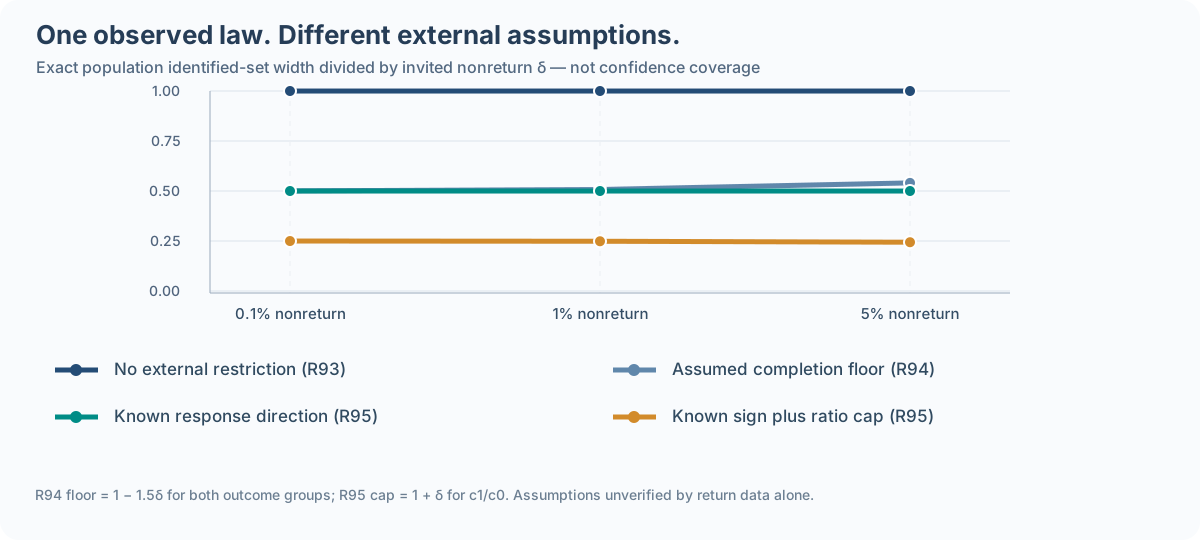
Figure. Original algebraic R93–R95 width formulae evaluated at \(deltain{.001,.01,.05}\). All scenarios use the same observed return law but make different latent assumptions. A narrower bar or curve is not an empirical accuracy improvement, not a preferred estimator and not a confidence interval.
What evidence would support a claim?
Completion floors (R94) require independently warranted minimum actual return probabilities for each latent outcome. Observed returned cases do not validate those floors, because the unreturned outcomes remain unknown.
Return direction (R95) requires credible external knowledge of which latent group returns at least as often. Unknown monotone direction is merely the union of both possibilities and leaves the full R93 set unchanged.
Equality of actual completion (R95) is a powerful, restrictive assumption. The resulting singleton is a property of the assumed population model—not empirical proof of equality or a calibrated sample estimate.
More simulations under the same observed event law cannot distinguish observationally equivalent latent mechanisms without new information. A field study seeking narrower, defensible bounds must document genuinely independent ascertainment, physically credible return guarantees or scientifically warranted restrictions, with uncertainty handled separately.
Two distinct uncertainties
An identified set characterizes which population parameter values remain compatible with an observed law and assumed model. A confidence region accounts for finite-sample variability in estimating that observed law. Even a sharp exact population interval is not automatically a valid 90% statistical interval or functional band.
Read R93 exact observational equivalence, R94 completion floors, R95 known response direction, and the original/independent evidence ledgers. Nothing here qualifies the unresolved W3 simultaneous-band inference #289 or real-gaze missingness #296.