Scientific article library
An organized route through method tutorials, interpretation guidance, independently auditable research and negative results. Articles explain a specific question, the assumptions behind it and its evidence boundary; they do not turn experimental methods into stable product APIs.
Published software versus research
Stable 1.2.0 is now the current PyPI release, including ten transparent module-scoped workflows. E1–E4 helpers remain experimental. W3 studies and their original/independent archives do not establish general 90% simultaneous confidence-band calibration or field identification of observation-dependent missing gaze.
Start with the scientific method
- Which trajectory analysis should I choose?
Functional PCA, paired sparse MFPCA, repeated-trial regression, generalized responses and recurrence.
Choose among ten workflow families · Input representations
- How should I read a figure?
Component alignment, effect functions, covariance diagnostics and explicit recurrence parameters.
Interpret synthetic workflow figures · Scientific figure atlas
- How should a study be reproduced?
Model contracts, input audit, declared choices and portable reproducibility bundles.
Reproducible bundles · Research source reproduction
- Which evidence actually qualifies a claim?
Distinguish a passing execution, an independently replayed archive, identifiability, interval coverage and released product readiness.
Functional inference under stress (R76–R81)
| Question | Read |
|---|---|
| Why can nominal whole-function bands under-cover? | Whole-band coverage interpretation |
| What if predictor leverage is concentrated? | R76 independent leverage support |
| Does fixed covariance regularization help? | R77 regularization |
| What if errors are temporally dependent? | R78 time-varying AR(1) |
| What if coordinate covariance is nonseparable? | R79 bivariate covariance |
| What if independent units are heavy-tailed or asymmetrically contaminated? | R80 Student-t5 · R81 skewed shocks |
These synthetic inclusion proportions are tied to registered data-generating laws and are not universal estimates of nominal coverage.
Observation-dependent missing gaze and external validation (R82–R88)
| Question | Read |
|---|---|
| Can high gaze retention conceal insufficient functional support? | R82 observation process |
| Are signed MNAR sensitivity parameters empirically identified? | R83 selection sensitivity |
| When can genuinely new missing-outcome measurements identify a restricted model? | R84 external validation |
| What if secondary validation is itself selective? | R85 secondary return |
| Can randomized audits of validation failures help? | R86 |
| What if randomized audit returns still depend on the missing outcome? | R87 · R88 |
Sharp bounds and identification (R89–R95)
These studies increasingly separate new observed information from assumptions about unreturned values.
| Stage | Central finding | Method detail |
|---|---|---|
| R89 | Observed-only finite-population bounds | Sharp-bound methods |
| R90 | Assignment saturation does not ensure actual response | Saturation analysis |
| R91 | Completed randomized recovery as a distinct design | Design-based methods |
| R92 | Selective return can bias nominal weighting | Conditional-bias methods |
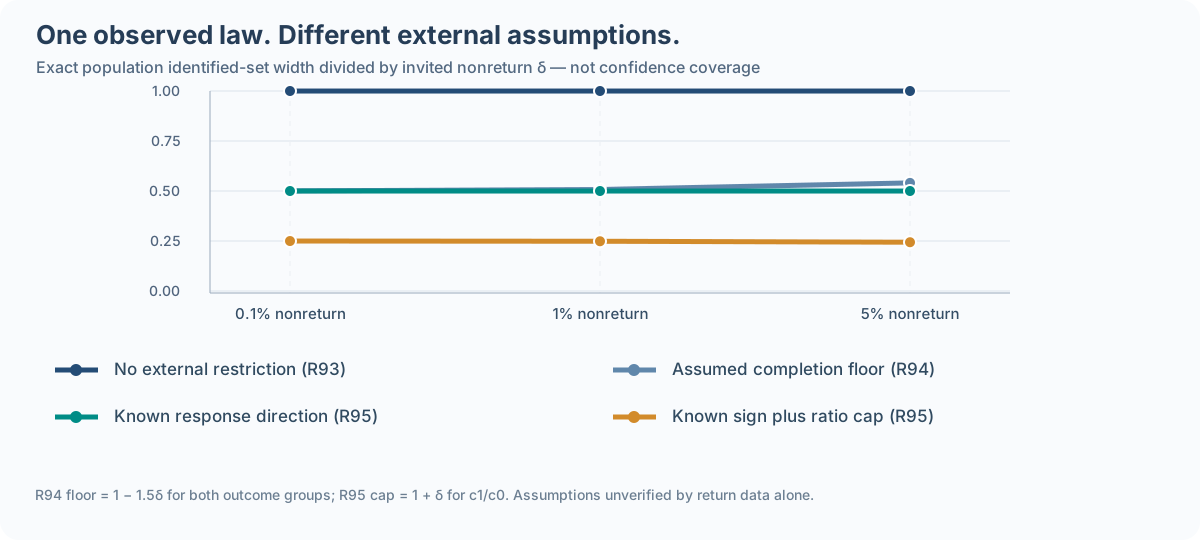
| R93 | Exact same observed law permits different latent means | Exact proof |
| R94 | Sharp mean sets under externally justified completion floors | Fraction methods |
| R95 | Known return direction narrows; unknown sign does not | Exact independent derivation |
Interpret identification bounds · Compare the R93–R95 assumption ladder and widths · Research study map
More research and validation context
The independent source and figure ledgers document original artifacts and numerical audit denominators. Read Bayesian feasibility boundaries, authentic gaze usability and interpreting W3 source audits for adjacent research questions.
Research blockers remain open: #289 (simultaneous inference) and #296 (observation-dependent missing gaze). Release status · News