From a workflow to a reproducible analytical record
A 1.2 workflow result is a typed research object: it contains a primitive scientific fit, an explicit configuration, provenance for meaningful decisions, ordered execution steps, reports, tables and portable state. The workflow layer does not choose preprocessing or a scientific model on the analyst's behalf.
Stable 1.2.0 module workflows
The ten eyetrajectoriespy.workflows routes are supported in published 1.2.0. E1–E4 experimental helpers remain unstable, and workflow results do not imply broader statistical guarantees.
Install with pip install eyetrajectoriespy==1.2.0 before running these examples.
1. Fit an explicitly configured example
from eyetrajectoriespy import simulate_planar_trajectories
from eyetrajectoriespy.workflows import (
    FPCAWorkflowConfig,
    run_fpca_workflow,
)

gaze = simulate_planar_trajectories(
    n_participants=18,
    trials_per_participant=1,
    n_time=61,
    random_state=2201,
)
result = run_fpca_workflow(
    gaze,
    config=FPCAWorkflowConfig(n_components=2, scaling="dimension_sd"),
)
This is a deterministic synthetic input used to explain the software, not a participant study or ground-truth validation claim.
2. Inspect decisions and step records
from eyetrajectoriespy.workflows import (
    workflow_decisions_frame,
    workflow_steps_frame,
    workflow_summary_frame,
    workflow_reporting_text,
)

print(workflow_summary_frame(result))
print(workflow_decisions_frame(result.decisions))
print(workflow_steps_frame(result.steps))
print(workflow_reporting_text(result))
The decision table distinguishes:
| Source | Interpretation |
|---|---|
analyst |
An explicitly supplied and scientifically relevant input |
audited_selector |
A named qualified selector with retained criterion |
workflow_contract |
A fixed property of the versioned workflow |
derived |
Calculated from declared inputs, not an additional analyst choice |
Figures from the same audit records
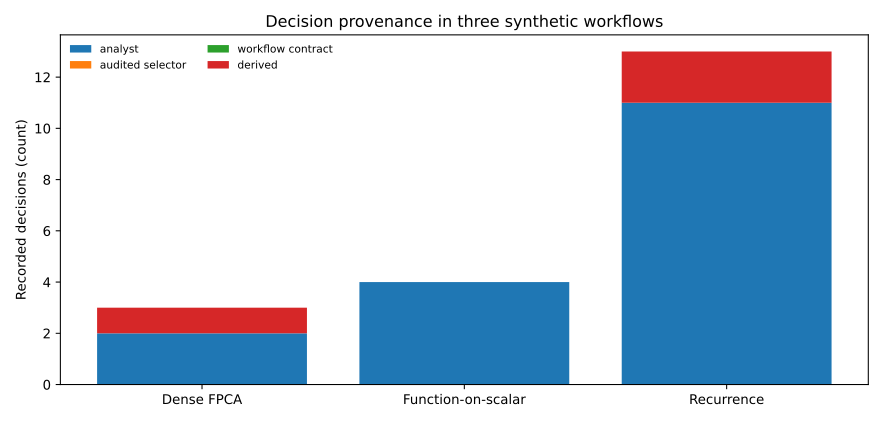
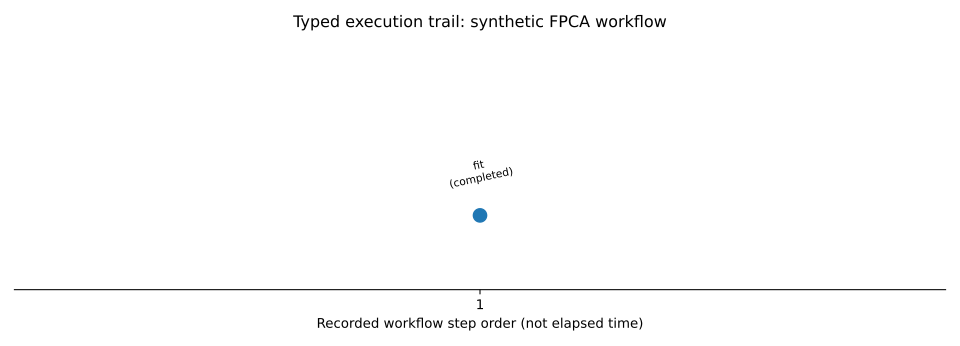
The figures document provenance and ordering; they do not measure estimator quality or comparative speed. The scripts use the retained result objects rather than handwritten provenance categories.
3. Export reports, figures and portable state
from eyetrajectoriespy.workflows import (
    export_workflow_bundle,
    save_workflow_figure,
)

save_workflow_figure(
    result,
    "fpca-component.svg",
    plot="fpca_component",
    component=0,
    dimension=gaze.dimension_names[0],
)
export_workflow_bundle(result, "my-analysis-bundle")
The figure's scientific plot type and coordinate are explicit. The bundle contains a serialized workflow/configuration record, provenance/environment, steps.csv, decisions.csv, portable scientific-result manifest/arrays, reports, tables and SHA256SUMS. Backend-native objects that cannot be represented portably are not silently pickled.
4. Audit what can—and cannot—be reproduced
Reproducibility checks should include the package and workflow schema/contract version, input definitions and preprocessing provenance, operating environment, outcome family, resampling/calibration units, failure/warning handling and the retained export checksums. The bundle does not by itself contain or validate access permissions for a restricted original dataset.
For real analyses, archive a legal/ethical provenance record for source data separately; do not use synthetic examples as a substitute for empirical validation.
5. Match the analysis claim to its evidence
A completed workflow demonstrates that its composed functions were executed and serialized under a declared contract. It does not show that fitted values are unbiased, that confidence regions cover at their nominal rate, or that a model is scientifically preferable. See workflow product qualification, scientific methods and limits, and reproducibility checklist.