Do regularized functional confidence bands survive time-varying AR(1) errors?
Research article · 20 October 2026 · R78 original and independent R78-A source audit
Simulation evidence, not a qualified inference method
No generally calibrated nominal-90% W3 simultaneous-band method is established here. This experiment exists only in R78 research PR #408 and its separately implemented original-source R78-A audit PR #409. Stable release 1.1.0 is unaffected. Version 1.2 remains unreleased, and scientific blockers #289 and #296 remain open.
Why challenge the covariance law?
The preceding R77 regularization experiment suggested that a fixed, positive-definite modification of the estimated HC3 covariance can improve full-function slope truth inclusion when only two independent observations carry extreme predictor values. That experiment generated temporally independent Gaussian innovations within a trial, with a simple participant latent random-effect function in its repeated-trial design.
The observed improvement is not guaranteed to persist when measurement errors are serially correlated and have variance that changes over the trial. R78 therefore changes the simulation source law, while freezing the previously tested candidate estimators, regularization strengths, smoothing window, number of conditional reference draws and functional truth grid. It is a robustness falsification, not a search for a better hyperparameter.
Prospective Gaussian generating mechanism
The protocol was frozen before original R78 source outcomes. The trial-level innovation has a time-scaled Gaussian AR(1) correlation law:
The true within-trial covariance is consequently the AR(1) correlation matrix pre- and post-multiplied by the known diagonal of time-specific standard deviations. Gaze coordinates are independent across dimensions within the trial-innovation component. In the participant design, an additional dimension-specific Gaussian random-effect trend of scale \(0.065(1+0.35t)\) is shared across each participant's three trials. The participant is the independent observation unit; three trials do not generate three independent participants.
The source experiment uses 32 entirely new independent primitive generating blocks, two observation designs (72 independent curves; 36 participants × 3 trials), two or 16 independent predictor extremes at \(x=\pm4\), and either constant independent-unit noise scale or predictor-dependent scale \(1+0.75|x|\). These produce 256 source-condition cases: 32 × 2 × 2 × 2. Because anchor/variance conditions within a block are paired, the correct simulation denominator for each design/support/variance cell is 32 independent source blocks, not 256 or 999.
Everything is fully observed, synthetic and Gaussian, on the fixed 31 × 2 slope grid. No gaze dropout, MNAR process, non-Gaussian innovation or real participant recording appears in this experiment.
Exactly which inference candidates were retained?
The original unchanged W3 Rademacher wild-HC1 band, the source-weighted HC3 Gaussian maximum-statistic reference, and two previously frozen covariance regularizations were carried forward without parameter changes:
Here \(a_i\) is the independent-unit slope design weight, \(r_{ik}\) the observed residual and \(h_i\) the estimated leverage, while \(K_7\) is the unchanged seven-time-point moving mean within each gaze coordinate. Each estimated Gaussian reference standardizes its 999 maximum-statistic draws with its own candidate marginal SE. The fifth reference, using the true temporally correlated Gaussian generating law, is a simulation-only benchmark. Its true covariance is not supplied to any data-estimated method.
For every original source, the study archived 999 maximum-statistic draws for all five references, estimated and known marginal SE grids, source coefficient deviations from known truth, full-grid maximum pivots and exact truth-inclusion events.
Full-grid results under predictor-dependent noise
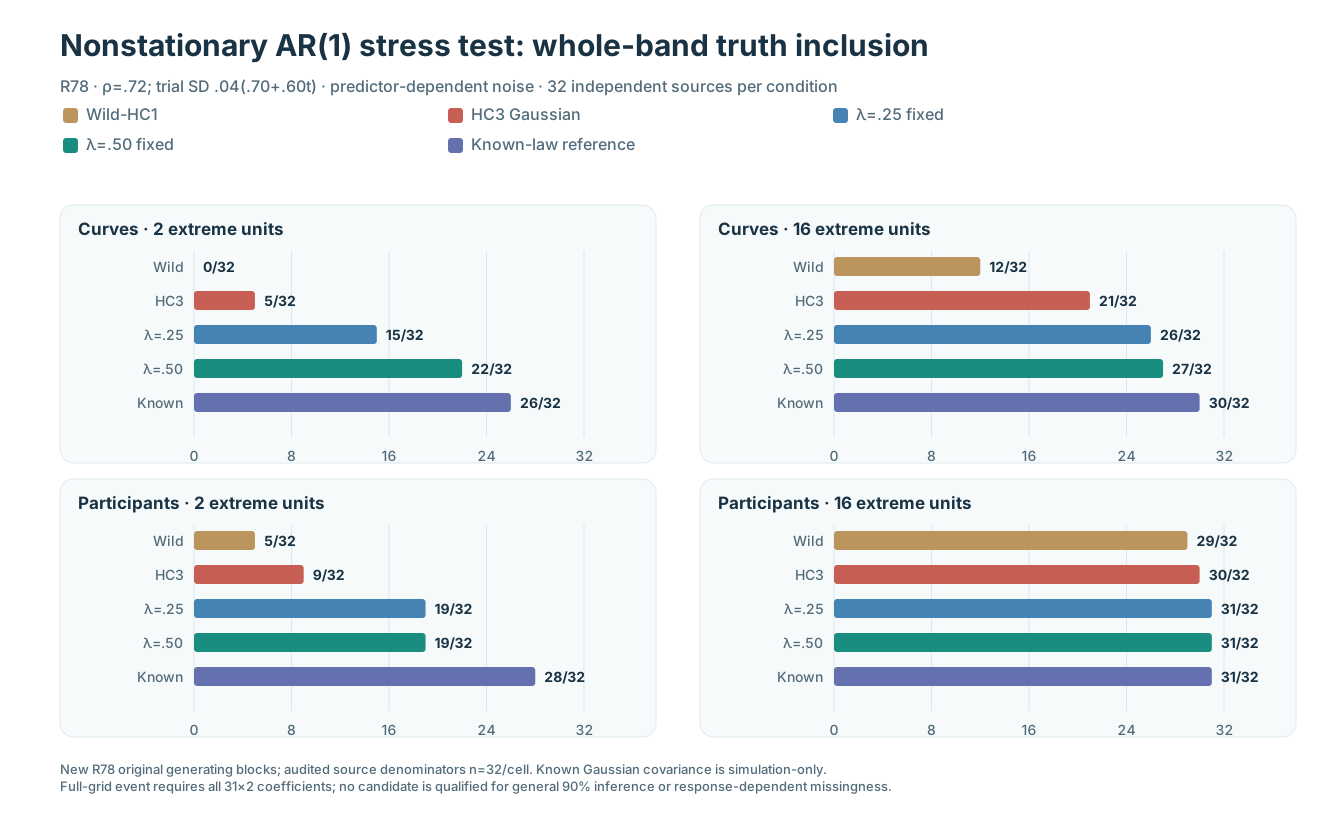
Figure 1. Nominal-90% 31 × 2 whole-slope-function inclusion under time-scaled Gaussian AR(1), with source-level denominator 32 for each design/support combination. The known-law Gaussian covariance is specified by the simulator, not estimated from observations.
| Reference | Curves, 2 extreme units | Participants, 2 extreme units | Curves, 16 extreme units | Participants, 16 extreme units |
|---|---|---|---|---|
| Original W3 wild-HC1 | 0/32 | 5/32 | 12/32 | 29/32 |
| Estimated HC3 Gaussian | 5/32 | 9/32 | 21/32 | 30/32 |
| Fixed regularization λ=.25 | 15/32 | 19/32 | 26/32 | 31/32 |
| Fixed regularization λ=.50 | 22/32 | 19/32 | 27/32 | 31/32 |
| Simulation-known Gaussian | 26/32 | 28/32 | 30/32 | 31/32 |
When only two extreme high-noise independent units are present, the original HC3 reference includes the true entire slope in 5/32 curve datasets and 9/32 participant datasets. Fixed λ=.50 regularization yields 22/32 and 19/32, respectively. The numerical change is substantial, but 22/32 is 68.75% and 19/32 is 59.38%, not validated nominal 90% coverage. Under 16 independent extremes, counts are generally higher, but those designs also differ in their regression weights and information distribution; the comparison cannot establish an independent causal effect of information concentration.
The constant-variance falsification cells
For the prespecified constant-variance setting with two extreme units, HC3 / λ=.25 / λ=.50 / known Gaussian whole-grid inclusion was 19/32, 23/32, 27/32, 28/32 for curves and 18/32, 25/32, 28/32, 28/32 for participants. These cells remain visible to avoid selecting only favorable candidate comparisons. The new experiment does not identify a universally reliable strength, and fixed smoothing can be either unhelpful or excessively conservative under other covariance laws.
Did the improvement transport from R77?
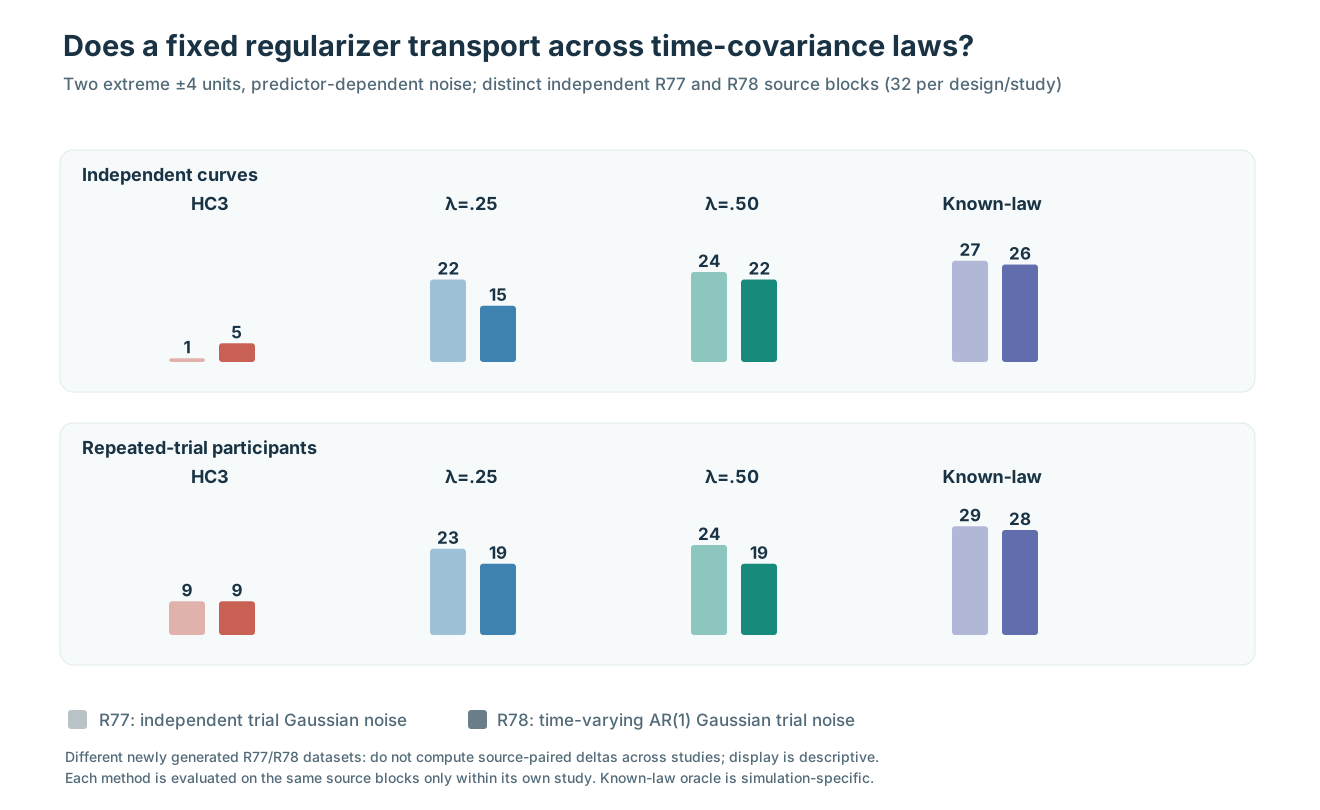
Figure 2. A descriptive comparison of separate R77 and R78 experiments, each with 32 new independent primitive generating blocks per design and condition. The experiments do not use the same original datasets. Comparisons across stages cannot be treated as source-paired experimental differences or as a clean estimate of the causal effect of serial correlation.
| Band reference | Curves: R77 → R78 | Participants: R77 → R78 |
|---|---|---|
| Original estimated HC3 | 1/32 → 5/32 | 9/32 → 9/32 |
| Fixed λ=.25 | 22/32 → 15/32 | 23/32 → 19/32 |
| Fixed λ=.50 | 24/32 → 22/32 | 24/32 → 19/32 |
| Source-known Gaussian benchmark | 27/32 → 26/32 | 29/32 → 28/32 |
R77's temporally independent within-trial Gaussian law was more favorable for some regularized candidates. R78's correlated and time-scaled noise retained some improvement relative to HC3, but observed inclusion under high leverage remained markedly short of a broadly credible nominal-90% target. The independent source generation makes this transportability evidence, not a single paired test of two generating laws.
Why did the band widths change?
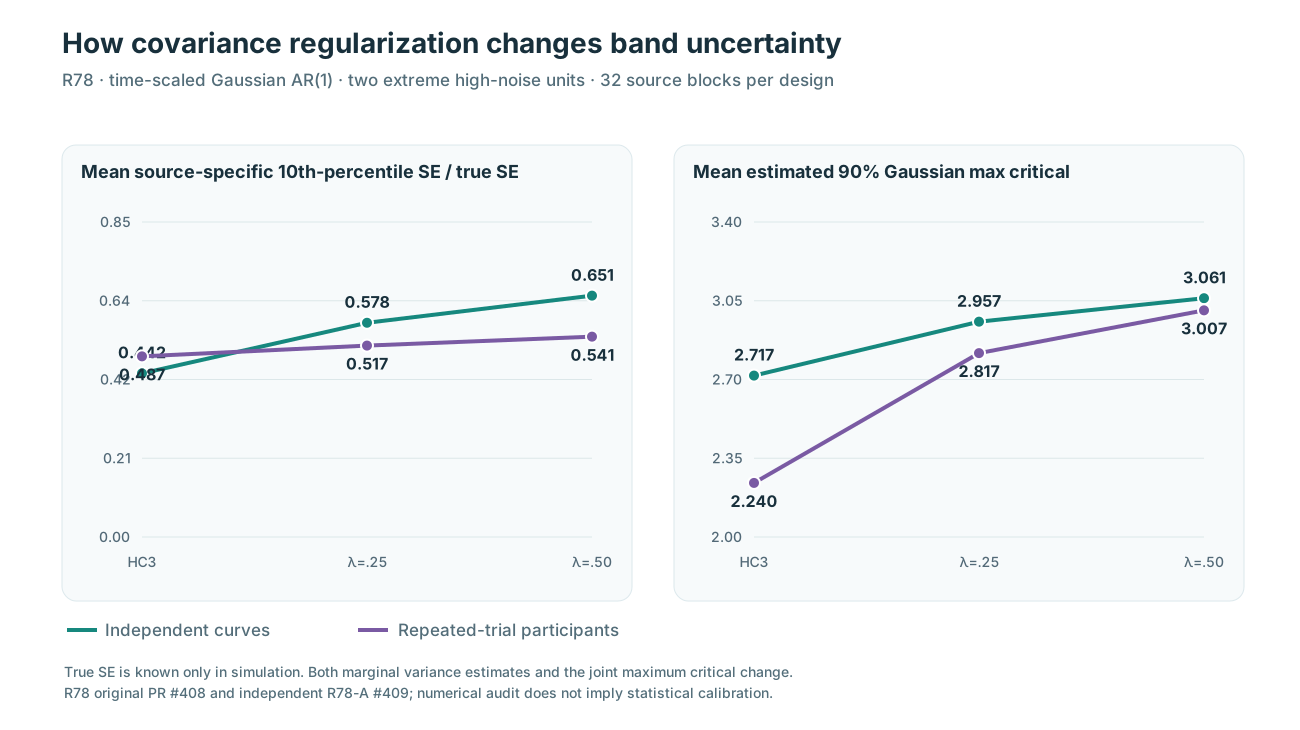
Figure 3. Two-extreme-unit, predictor-dependent Gaussian noise. The lower-tail SE diagnostic is the across-source average of each source's 10th percentile across all 62 cells of estimated marginal SE divided by simulation-known true SE. That true SE is not available to an observed-data method. The second panel plots the mean estimated Gaussian maximum-statistic reference critical for each data-estimated candidate.
| Two-anchor high-noise diagnostic | HC3 | λ=.25 | λ=.50 |
|---|---|---|---|
| Curves, source-wise SE ratio 10th percentile | 0.442 | 0.578 | 0.651 |
| Participants, source-wise SE ratio 10th percentile | 0.487 | 0.517 | 0.541 |
| Curves, Gaussian maximum critical | 2.717 | 2.957 | 3.061 |
| Participants, Gaussian maximum critical | 2.240 | 2.817 | 3.007 |
In this experiment, regularization changed both the lower tail of marginal SE ratios and the Gaussian maximum critical. The observed improvement therefore cannot be attributed only to a better covariance estimate: widening the maximum-statistic threshold also matters, and might cause overconservatism in other designs. Even with the regularized candidates, the average lower-tail SE ratio remains well below one under sparse influential support.
Independent numerical audit and what it establishes
The original R78 science workflow #39477000929 completed 12/12 dedicated scientific jobs, with 256/256 accepted source cases and zero refusals. Original immutable evidence is retained in artifact #12290295000, at scientific source checkout f438b9680d81f5e5e3e893b1ff7a0bc93383a619.
A separately implemented R78-A read-only original-archive audit #39477446946 passed 4/4 dedicated jobs and independently reproduced the 256 original X/Y source datasets, 1,278,720 original maximum-statistic values, all five source-specific quantile reference arrays, known AR(1) Gaussian variance, source-level truth classifications and SHA256 checks. The independent audit evidence is artifact #12290570185.
This audit qualifies the numerical reproducibility of the simulation result, not the frequentist calibration of an observed-data confidence-band estimator.
What must happen before inferential qualification?
The fixed candidates now have independently audited tests in more than one synthetic Gaussian covariance regime, but neither is demonstrably reliable under sparse independent high-leverage support. Next studies should target source-independent stress under stronger nonstationarity, nonseparable cross-coordinate covariance, heavier-tailed innovations, irregular observation intervals and response-dependent gaze loss, without retuning hyperparameters to select a favorable outcome. Quantifying overcoverage and refusal behavior is equally important.
The W3 inference issue #289 and missingness issue #296 remain OPEN. No experimental W3 estimator is merged to the stable package or qualified for a public nominal-90% claim, and eyetrajectoriespy 1.2 remains on release HOLD.