How rare asymmetric unit shocks affect simultaneous functional inference
Methods companion · 20 October 2026 · W3 R81
The R81 independently audited simulation provides a carefully constrained demonstration: confidence-band procedures can be numerically reproduced exactly, and an estimated covariance regularizer can improve inclusion in a synthetic design, without that being sufficient to establish nominal-90% whole-function confidence coverage.
The methodological challenge is not just heavy tails. Rare asymmetric measurement shocks can affect every time point and both gaze coordinates of an independent participant or curve.
Known simulation mechanisms are unavailable in observed data
The Bernoulli event probability p=.08, contamination amplitude .16, time/coordinate shock profile, Student-t5 degrees of freedom and generating covariance are all specified by the R81 simulator, not estimated from recorded gaze. Results do not establish that real eye-tracker contamination follows this law. W3 #289/#296 remain open and experimental estimators are unreleased.
1. A persistent unit shock is not ordinary white noise
For R81, a unit-level contamination indicator \(B_i\) is Bernoulli with p=.08. Its centered functional contribution is
Unlike independently injected sample noise, one realization affects an entire independent source trajectory and, where applicable, the same participant's three trials. The shock has zero unconditional mean but asymmetric realizations: a rare large event and a common smaller shift of the opposite sign.
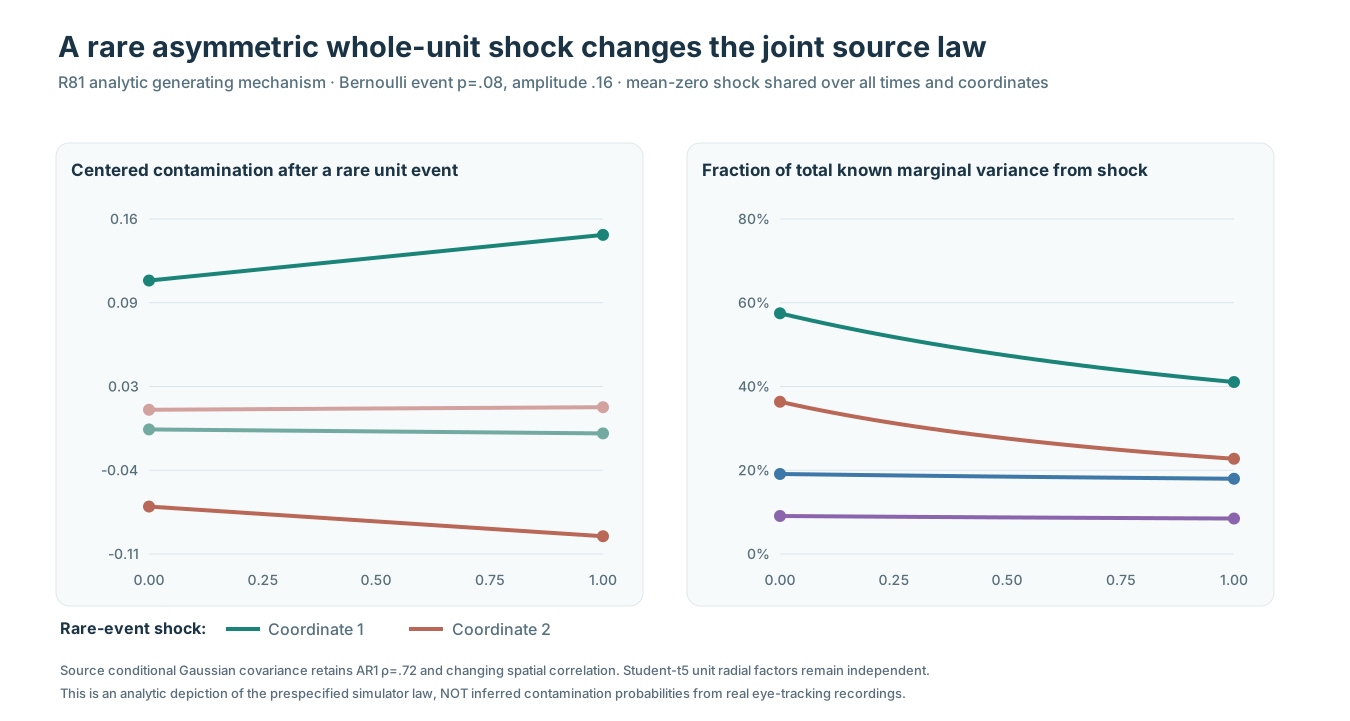
Figure 1. The rare-event trajectory and fraction of true marginal slope-source variance attributed to the contamination. This is a theoretical generating-law illustration, not an estimate of real sensor disturbances.
Independently drawn Student-t5 radial multipliers from the preceding R80 design remain present, multiplying the correlated Gaussian base. Thus R81 tests a combined heavy-tailed and skew-contamination law, not one factor in isolation. This distinction prevents attribution of any R80–R81 difference to contamination alone.
2. Mean-zero contamination can still change covariance and simultaneous criticals
Centering \(B_i\) by p protects the original population slope, but it does not remove the contamination variance:
Cross-coordinate and cross-time contamination covariances also arise because the same Bernoulli indicator multiplies the entire signed functional profile. In addition to the original nonseparable Gaussian covariance and shared Student-t5 radial shocks, R81 therefore has a rank-one functional covariance component from the rare event.
A 31-time-point × 2-coordinate simultaneous band must contain all 62 generating-slope values. Its correct source maximum-statistic reference involves the joint law across those coordinates, not merely 62 separate pointwise normal limits.
3. The source-known benchmark must include both the t scales and asymmetry
The R81 known-law reference takes a weighted sum of independent units. Given fixed source design weights \(a_i\) and known scales \(s_i\), it independently draws each replicate's unit-specific chi-square Student-t radial multipliers and Bernoulli events, combines their effects over the whole functional grid, and standardizes by the true variance including the centered contamination term.
That reference is a simulation benchmark, not a usable observed-data correction. In particular, an ordinary Gaussian reference, a single shared Student-t multiplier, symmetric event sampling or a known-SE denominator copied from R80 would evaluate a different generating mechanism.
All four data-estimated candidates were deliberately unchanged from R80: wild-HC1, baseline residual HC3 Gaussian and the two frozen λ=.25/.50 positive-definite HC3 covariance adjustments with seven-time smoothing.
4. Count independent generating source datasets, not trial samples or reference replicates
The R81 experiment generated 32 new primitive blocks, evaluated over two observational units, two leverage configurations and two variance laws, giving 256 source-condition evaluations. The correct denominator for empirical truth inclusion in any one such design/support/variance cell remains 32 independent primitive sources.
Each source retained five sets of 999 maximum-statistic draws. Those 999 draws approximate candidate criticals. They do not multiply the independent source sample size, and three repeated trials do not multiply the number of independent participants.
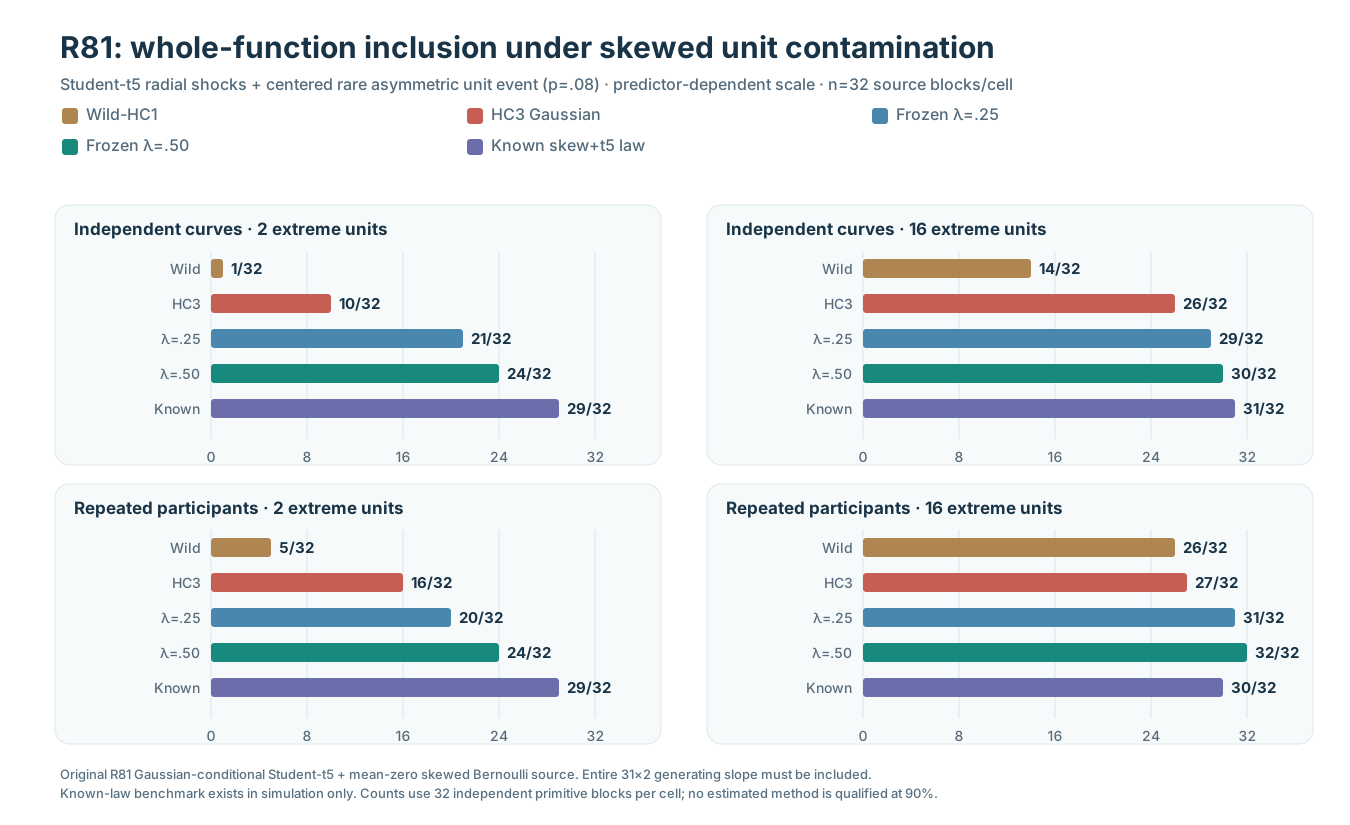
Figure 2. Under the difficult two-anchor heteroskedastic condition, frozen λ=.50 includes the full generating slope in 24/32 curves and 24/32 participants. That is 75% observed source inclusion, not nominal-90% calibration. The source-known skewed Student-t5 mixture includes 29/32 in each, which remains a finite 32-source result.
5. Estimated marginal uncertainty and whole-grid dependence interact
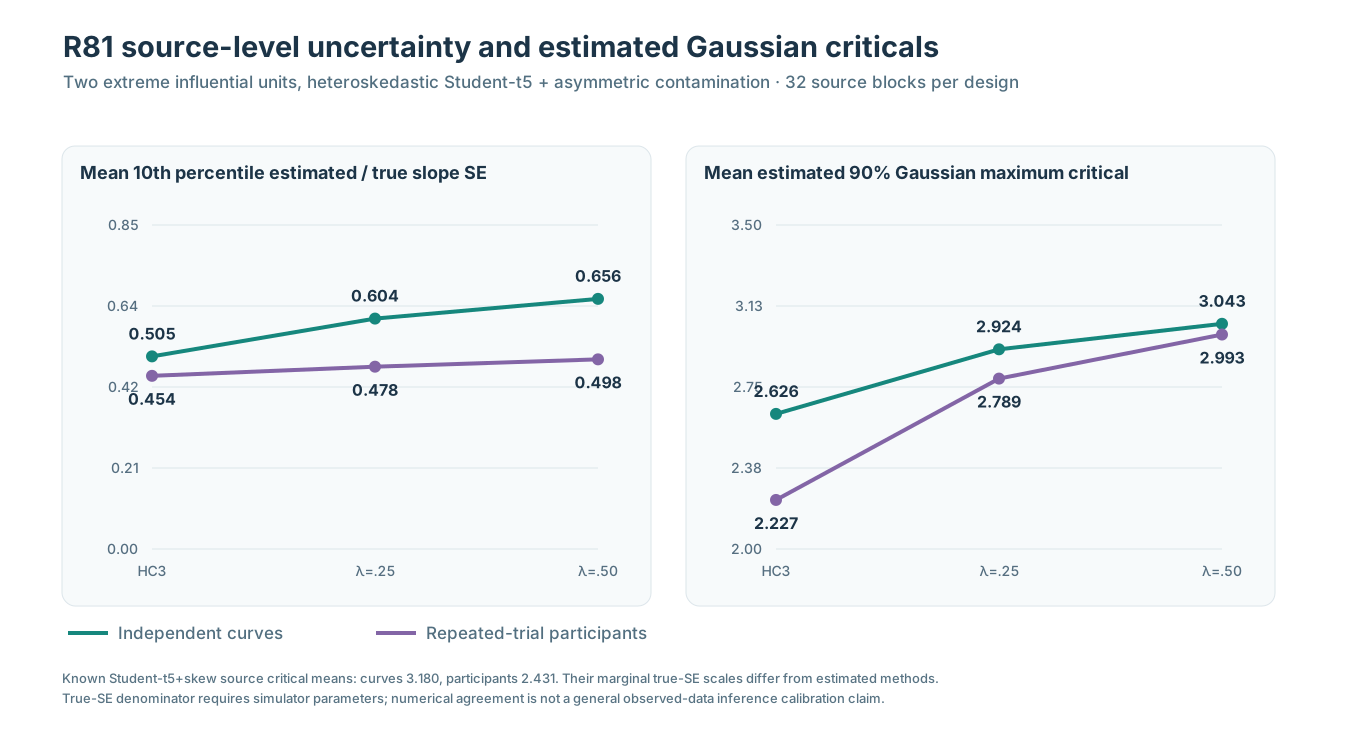
Figure 3. Mean source-specific 10th-percentile estimated/known marginal SE ratios and mean estimated Gaussian simultaneous criticals for baseline HC3 and the two fixed regularizers.
With two high-leverage heteroskedastic units, both adjustments raise some lower-tail estimated standard errors and change the critical value of the Gaussian reference. Better empirical truth inclusion cannot be equated mechanically with accurately estimated covariance: wider bands can cover the generating slope more frequently without correctly representing its sampling distribution.
This is why a defensible evaluation retains source-level inclusion events, candidate criticals, marginal scale diagnostics, pairing/discordance, source failures, and the simulator-known reference, rather than reporting only a favorable average coverage count.
6. Independent numerical reproducibility is necessary, not sufficient
The original R81 scientific workflow #39490888383 passed 12/12 scientific jobs, and the separately coded R81-A original archive audit #39491187099 passed 4/4. R81-A independently reconstructed 256 X/Y source datasets, zero source refusals, all 1,278,720 original conditional maximum-statistic values, the original true Student-t5 and asymmetric-event reference, source truth classifications and SHA256 manifest.
This supports the numerical accuracy and reproducibility of the prespecified synthetic experiment. It does not establish actual gaze errors as Student-t5, calibrate an estimated covariance in real recordings, or solve the response-dependent observation problem.
The next scientific problem with greatest immediate relevance is missing gaze as an observation process, particularly where the probability of dropout varies with true eye position, velocity, participant and trial conditions. That needs a distinct frozen experiment and independent source replay, not retroactive interpretations of the fully observed R81 results.
Read the complete R81 study · Open original source and figure ledger · Earlier R80 Student-t5 experiment