When functional confidence bands encounter skewed, contaminated heavy-tailed units
Scientific research article · 20 October 2026 · Original R81 and independent R81-A numerical audit
Research-only, not qualified nominal 90% confidence bands
These results concern fully observed, synthetic, Gaussian-conditional Student-t5 trajectories with a prespecified rare asymmetric unit shock. They do not derive from actual participant recordings. The candidate implementations remain isolated in R81 research PR #417 and independent numerical audit PR #418. W3 inference blocker #289 and response-dependent gaze-loss blocker #296 remain open; stable eyetrajectoriespy 1.1.0 is unchanged and 1.2 is unreleased.
Rationale: covariance and Student-t tails do not exhaust observational failures
The independently audited R79 study challenged the assumption of independent gaze coordinates by changing the Gaussian spatial-temporal dependence. R80 retained that conditional dependence but introduced shared Student-t5 radial shocks at the independent participant or curve level. In both cases, the previously frozen data-estimated HC3 covariance regularizations improved whole-functional-slope inclusion over the original HC3 Gaussian baseline under certain severe leverage designs, while significant undercoverage persisted.
R81 tests a different departure: a small probability of one-sided, persistent contamination of an entire unit's two-dimensional time series, in addition to the independent-unit Student-t5 process. Such asymmetry can affect tail behavior and the slope's joint sampling distribution even when its mean is centered at zero and its covariance can be calculated exactly. This is a stylized falsification of the unchanged procedures, not a model of any particular eye-tracker's calibration failure or sensor dropout.
A new, prospectively frozen generating model
The R81 design was committed before seeing the 32 new generating blocks' outcomes. For independent observational unit i, its measurement error at time t and gaze coordinate d can be written
where \(G_i\) is the R80 nonseparable, centered Gaussian functional innovation (including shared participant random effects when applicable), \(R_i=\sqrt{3/V_i}\) with \(V_i\sim\chi^2_5\) is a single positive Student-t5 radial shock shared by all trials and coordinates of that unit, and \(B_i\sim\mathrm{Bernoulli}(p)\) is an independent rare event with p=.08. The contamination amplitude is A=.16, with fixed signed trajectory shape
The two coordinates have opposing contamination effects; within a source unit, this shock persists across the entire 31 × 2 trajectory and, for participants, all three repeated trials. Centering by p ensures that the original population slope is unchanged. Nevertheless, the innovation distribution is asymmetric: rare positive \(B_i-p=0.92\) shocks contrast with the more common negative \(B_i-p=-0.08\) shocks.
The Gaussian component retains trial AR(1) correlation rho=.72, trial marginal SD \(0.04(0.70+0.60t)\) and time-varying cross-coordinate correlation \(q(t)=0.15+0.65t\). The repeated-participant design retains a shared latent Gaussian term with coordinate correlation 0.45. The independent unit scale \(s_i\) equals 1 under the constant-variance control or \(1+0.75|x_i|\) under predictor-dependent heteroskedasticity. The new Bernoulli shock is independent of the Gaussian innovations and of the Student-t5 radial scales.
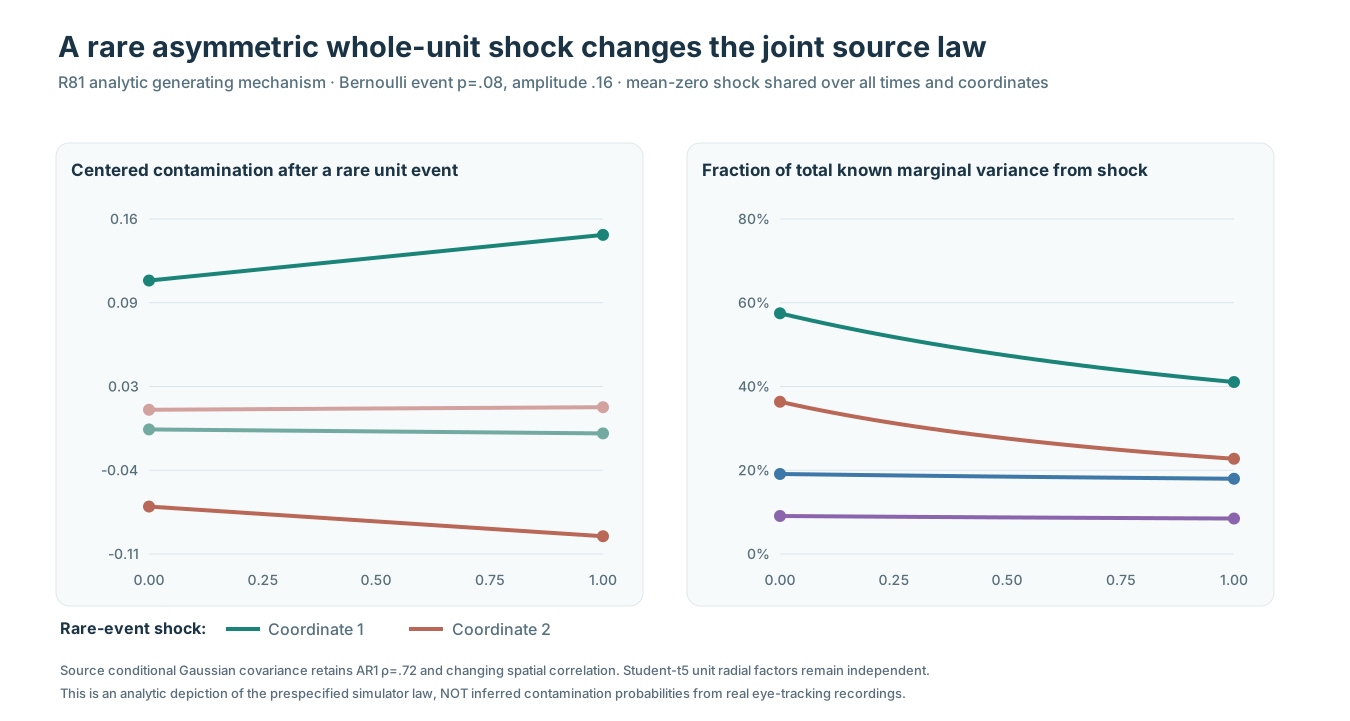
Figure 1. Analytic depiction of the generating mechanism, not a fitted contamination probability for an actual gaze recording. The rare unit shock has a time-varying signed profile, and its additional source-known marginal variance differs by coordinate and independent-unit design.
The known source-unit variance must account for the contamination:
where \(V_G\) is the variance of the R80 Gaussian-conditional Student-t5 unit process, equal to its unconditionally finite Gaussian covariance because \(E(R_i^2)=1\). The additional term is a rank-one functional covariance contribution, not merely a change to the Gaussian-conditional correlation parameters.
Each new primitive generating block was evaluated under two observation-unit designs (72 independent curves; 36 participants with three complete trials), two extreme \(x=\pm4\) independent-unit support counts (2 or 16), and two variance laws (constant or predictor-dependent). There are 256 original case-condition datasets, but only 32 independently generated primitive source blocks in each fixed design/support/variance cell. Within each primitive block, source innovations are paired across the leverage/variance treatments.
The correct source-known reference is now a two-part non-Gaussian mixture
A Gaussian covariance reference is not an exact generating-law benchmark for this simulation. R81 instead uses a source-known joint Student-t5 and skew-contamination reference. For the fitted source's fixed slope OLS weights \(a_i\) and known heteroskedasticity scales \(s_i\), each reference draw b independently generates all unit-specific Student-t5 radial factors \(R_{ib}\) and Bernoulli indicators \(B_{ib}\), then constructs
A fresh Gaussian process \(G_b(t,d)\) with the true unit covariance produces the standardized slope-error function
The reference statistic is \(\max_{t,d}|Z_b(t,d)|\) over all 62 functional slope positions. Using a global Student-t radial factor, a symmetric contamination law, the old Gaussian oracle or an SE omitting the Bernoulli variance would represent different models.
The four data-estimated candidate methods remain unchanged: the original W3 Rademacher wild-HC1 reference; residual HC3 Gaussian; and positive-definite estimated HC3 covariance regularization at λ=.25 and λ=.50, each with the original seven-time-point within-coordinate diagonal smoother. Every original dataset archives 999 maximum-statistic values for each of the five references, higher empirical 90th-percentile criticals and individual source-wise full-function truth-inclusion classifications. Reference draws are not new independent datasets; no tuning or source selection was performed after the outcomes.
Results: full-function truth inclusion
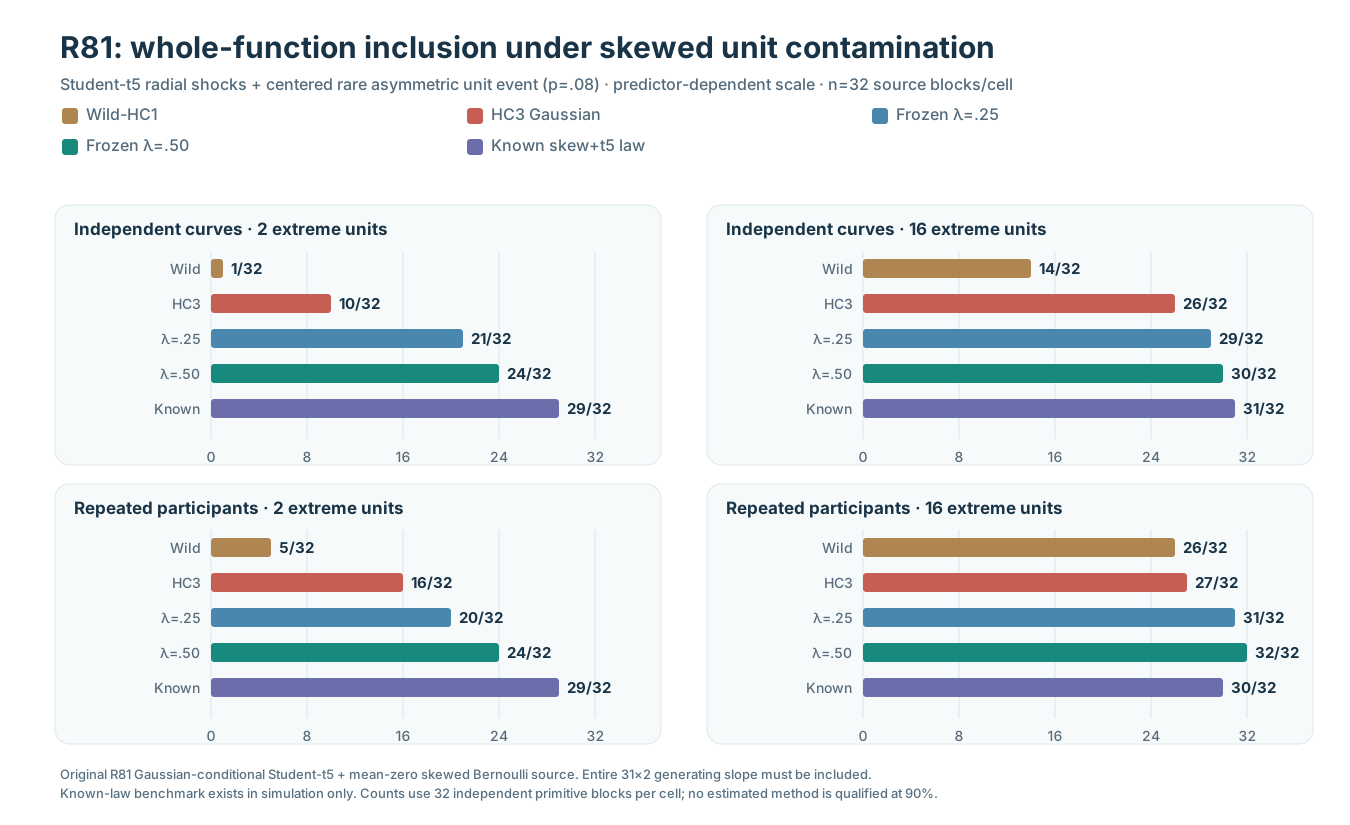
Figure 2. Each entry counts generating datasets whose entire 31 × 2 slope function is included by the nominal-90% band. Denominators are 32 independent new primitive blocks per experimental condition. The source-known mixture is a simulator-only benchmark.
| Predictor-dependent noise | Curves, 2 anchors | Participants, 2 anchors | Curves, 16 anchors | Participants, 16 anchors |
|---|---|---|---|---|
| Original W3 wild-HC1 | 1/32 | 5/32 | 14/32 | 26/32 |
| Original HC3 Gaussian | 10/32 | 16/32 | 26/32 | 27/32 |
| Frozen regularization λ=.25 | 21/32 | 20/32 | 29/32 | 31/32 |
| Frozen regularization λ=.50 | 24/32 | 24/32 | 30/32 | 32/32 |
| Source-known Student-t5 + skew mixture | 29/32 | 29/32 | 31/32 | 30/32 |
With only two extreme predictor units and predictor-dependent source variance, the original HC3 Gaussian reference includes the true full slope in 10/32 independent curves and 16/32 repeated-participant datasets. The frozen λ=.50 candidate increases inclusion to 24/32 in both designs, whereas the source-known Student-t5/skew mixture yields 29/32 in both.
Thus the fixed λ=.50 candidate still reaches only 75% empirical whole-slope truth inclusion in either primary adverse cell. This is substantial undercoverage relative to nominal 90%. A finite 29/32 inclusion count for a simulator-known source law does not establish universal calibration either, especially with only 32 primitive source replications. Under 16 independent extreme predictors, results can be higher, including 32/32 participant λ=.50 inclusion; this finite-cell frequency does not certify general 90% coverage and might reflect conservative band widening.
Prespecified constant-variance controls
The prespecified two-anchor constant-unit-variance cells gave the following complete-grid truth counts for baseline HC3, fixed λ=.25, fixed λ=.50 and source-known mixture, respectively: 23/32, 26/32, 26/32, 28/32 for curves, and 24/32, 28/32, 30/32, 30/32 for participants. Original wild-HC1 included 16/32 curves and 18/32 participants. The full 16-anchor constant-variance cells are archived in the independent source report. The design does not justify selecting only the most favorable regularizer or suppressing non-adverse comparison cells.
Marginal standard errors and joint maximum-statistic thresholds
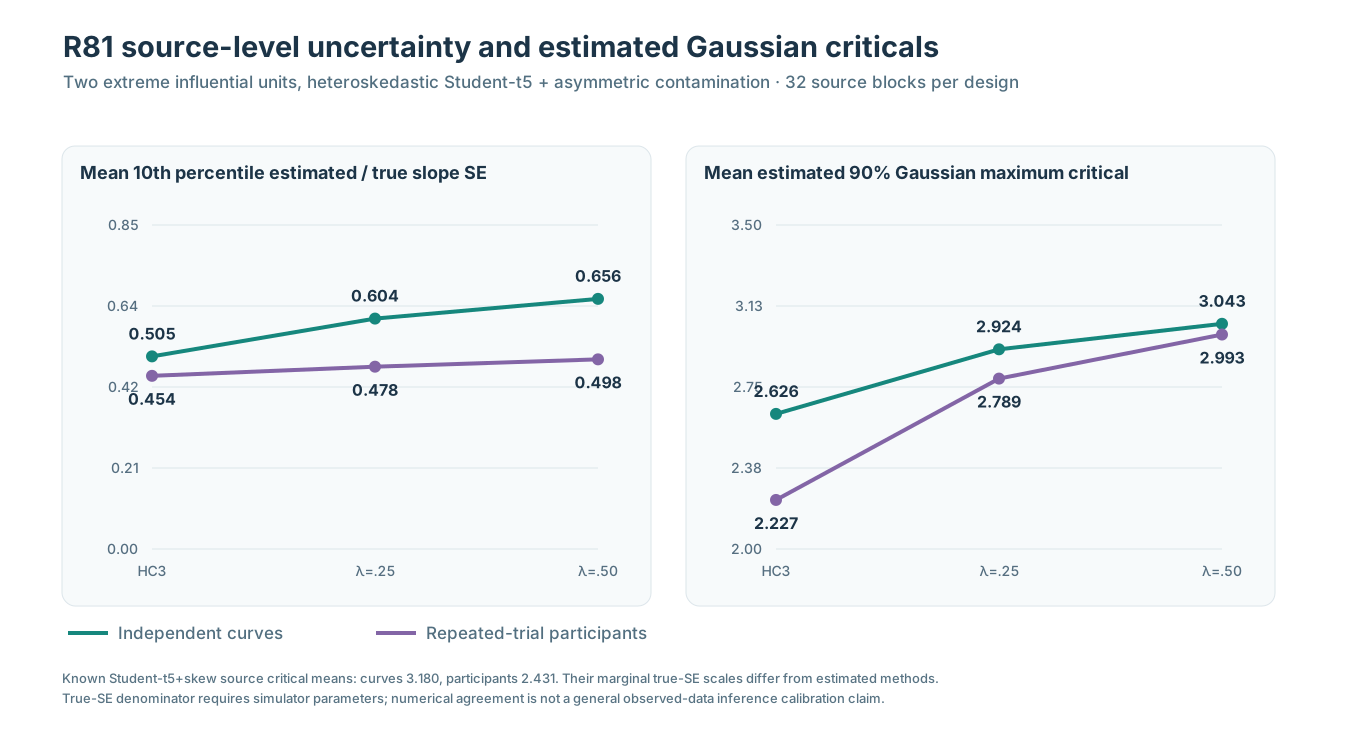
Figure 3. Adverse two-anchor heteroskedastic condition. The first panel shows the source average of each source's 10th percentile of estimated/true marginal slope SE over all 62 functional positions. The second panel shows average data-estimated Gaussian maximum-statistic criticals. Known true SE is only available to the simulator.
| Source-mean diagnostic | Original HC3 | Frozen λ=.25 | Frozen λ=.50 |
|---|---|---|---|
| Curves, estimated/true SE lower-tail ratio | 0.505 | 0.604 | 0.656 |
| Participants, estimated/true SE lower-tail ratio | 0.454 | 0.478 | 0.498 |
| Curves, estimated Gaussian maximum critical | 2.626 | 2.924 | 3.043 |
| Participants, estimated Gaussian maximum critical | 2.227 | 2.789 | 2.993 |
The simulator-known Student-t5 plus skew reference's average critical in these same cells is 3.180 for curves and 2.431 for participants. These criticals must not be compared without their associated SE scales and joint covariance laws. Changes in full-band inclusion can arise from improvements to estimated marginal variance, larger estimated maximum criticals, or both; undercoverage remains after regularization in the hard cells.
Independent numerical reconstruction
The original R81 scientific run #39490888383 passed 12/12 scientific jobs, including three Python-version source contracts, eight disjoint simulation shards and one exact-checkout SHA256 aggregate. Original artifact #12295607688 contains all 256/256 source cases, zero refusals, pinned to scientific checkout 698bf1eb80a9e856bfc2e0b5bdc362f425a75dc1.
An independently coded R81-A actual source replay #39491187099 passed 4/4 audit jobs, independently reconstructing the same 256 original X/Y source datasets and all 1,278,720 raw original conditional maximum-statistic values. The replay checked the correctly ordered unit-specific Student-t radial and Bernoulli draws, known extra contamination variance, true nonlinear maximum references, original package W3 numerical identities, candidate covariance factors, source truth-inclusion classifications and SHA256 original source identity. Separate independent numerical artifact #12296301870 preserves the report.
Those workflows establish numerical reproducibility of the stipulated simulation, not observed-data coverage calibration. Unlike a controlled source-paired R80-vs-R81 comparison, the programmes use different freshly generated source blocks; the independent experiments also change the law. Comparisons cannot be interpreted as source-paired estimates of contamination's causal effect, and the combined Student-t5-plus-Bernoulli law does not separately isolate the effects of heavy tails and skewness.
Interpretation and release boundary
The R81 result is narrower than evidence for a generally robust estimator. In the specified fully synthetic model with independent-unit Student-t5 radial noise and rare asymmetric unit shocks, fixed λ=.25/.50 regularization again improves empirical full-slope inclusion over baseline HC3 in the adverse source cells, but both methods remain below nominal 90% despite independent numerical reconstruction.
This test does not cover genuinely missing gaze samples, irregular observation times, detector-defined AOI uncertainty, actual camera calibration failure, skewness families beyond the one specified, or model selection and covariance learning in field recordings. The next decisive work should investigate response-dependent observation loss, not continue claiming estimator calibration from favorable synthetic sources.
Final R81 decision: W3 #289 and #296 remain open. No experimentally estimated W3 simultaneous-band method is qualified at nominal 90%, no inference API promotion occurs, stable release 1.1.0 remains unchanged and eyetrajectoriespy 1.2/PyPI remains on release HOLD.
Read the R81 independent-unit contamination methods companion · Full numerical evidence ledger