Reading sharp identified sets for missing outcomes
Suppose the true value \(Z\) is binary, but even an invited follow-up audit can fail to return a value. The crucial distinction is between what is observed and what has been assumed about unreturned values.
What the observed audit actually tells us
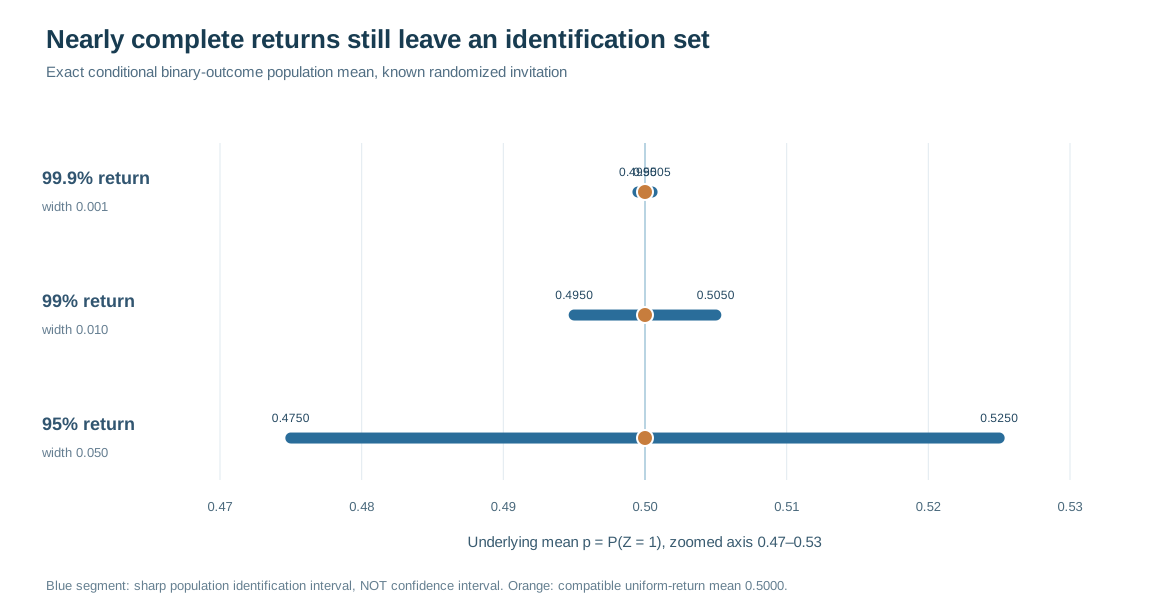
Among people/curves invited for audit, let \(q_0\) be the fraction with returned \(Z=0\), \(q_1\) returned \(Z=1\) and \(delta=1-q_0-q_1\) the fraction who do not return. The population share \(p=P(Z=1)\) can be anywhere in the exact sharp set
Why? The unreturned \(delta\) fraction could all have \(Z=0\), all have \(Z=1\), or any mixture. An invitation probability tells us how often the audit was offered, not what the nonrespondents would have said.
How an external assumption changes the answer
| Extra scientific information | Effect | Read more |
|---|---|---|
| Nothing known about actual return by outcome | Retain full interval | R93 exact observational equivalence |
| Credible external lower completion probabilities by outcome | May narrow interval; incompatible floors falsify the conditional model | R94 |
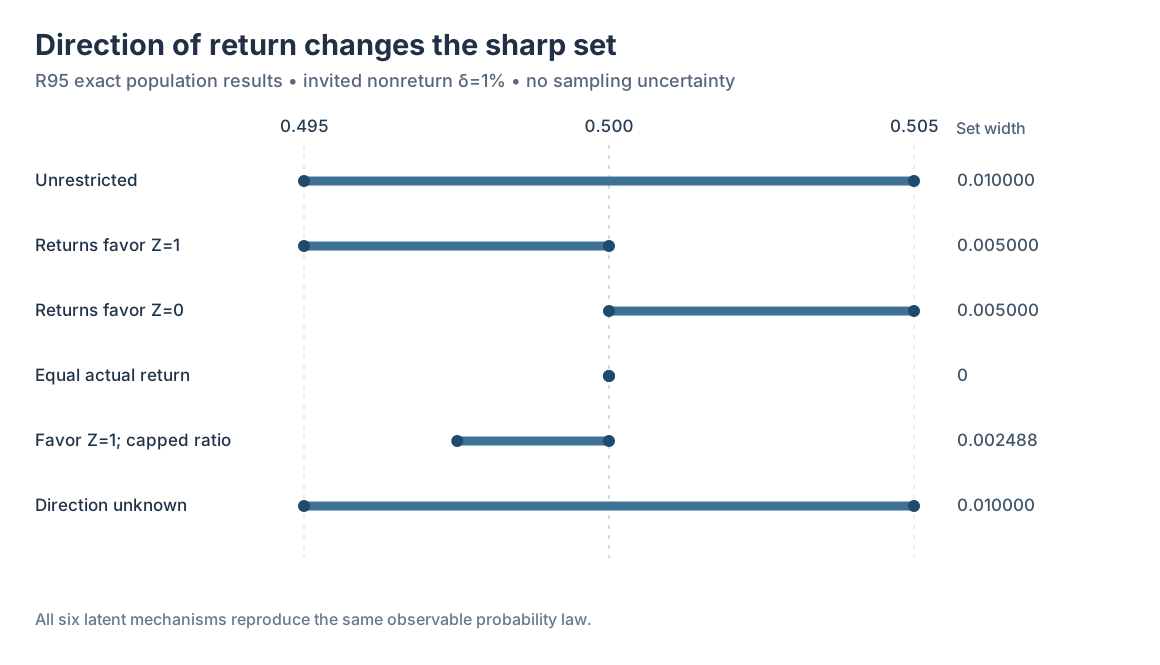
| Credible external knowledge that actual return favors \(Z=1\) | Upper endpoint becomes \(q_1/(q_0+q_1)\) | R95 |
| Monotone response, direction not known | No narrowing | R95 methods |
The assumptions require real justification from outside the observed returned-outcome likelihood. None is automatically supplied by this software.
What not to claim
An identified set describes the range of population parameter values observationally compatible with a specified model. It is not a 90% confidence interval, a sample-size-adjusted bound, a reconstruction of lost gaze, or evidence for a particular selection mechanism. R95's 54 deterministic algebraic cells are not 54 independent empirical replications.
Full methods and witnesses · R95 original/independent ledger · Scientific claim ladder