Choosing among ten functional gaze workflows
The observation design and scientific estimand come first. A workflow is an audited composition of already-qualified methods; it does not decide on preprocessing, smoothing, family, conditional variance, response denominator, fixed effects, random effects or recurrence parameters without the analyst.
Availability
These ten APIs are stable 1.2.0 module-scoped routes. Install with pip install eyetrajectoriespy==1.2.0. E1–E4 helpers remain experimental and are not part of the stable workflow API.
A ten-route comparison
| Workflow entry point | Appropriate data and question | What must remain explicit |
|---|---|---|
run_sparse_fpca_workflow() |
One sparsely observed time-varying coordinate; population mean, covariance and PACE score reconstruction | Native sampling times, noise, bandwidth source, PSD and score failures |
run_sparse_mfpca_workflow() |
Paired sparse planar x/y observations; joint modes and cross-channel covariance | Shared paired support, both dimensions, smoothing, measurement error |
run_sparse_mfpca_async_workflow() |
x/y channels observed on different time grids | Channel-specific timestamps; no hidden synchronization/interpolation |
run_sparse_multilevel_workflow() |
Sparse participant/trial repeated functions | Participant/trial grouping, decomposition level, support and fitting assumptions |
run_sparse_prediction_workflow() |
Prediction from partial sparse histories | Proper training/calibration/target separation; prediction horizon and coverage scope |
run_fpca_workflow() |
Common-grid dense functional data; dominant directions of variation | Scaling, component rule and realized retained rank |
run_function_on_scalar_workflow() |
Continuous functional response and declared scalar predictors | Covariates, response dimension, independence/cluster assumption |
run_functional_mixed_effects_workflow() |
Repeated functional responses with participant/trial hierarchy | Fixed/random basis, covariance, serial dependence, optimizer, resampling unit |
run_generalized_functional_workflow() |
Binary, grouped-binomial or count functional responses | Response family, link, binomial denominators, Poisson exposure and units |
run_recurrence_workflow() |
Dynamical recurrence of one declared trajectory | State representation, embedding dimension, delay, radius, Theiler window, RQA line limits |
All routes are imported from eyetrajectoriespy.workflows, not the root package. See the implementation guide for the exact API contract and product qualification for installed-wheel evidence.
A practical decision sequence
- Check support: is the raw observation actually common-grid, irregular-but-projectable, sparse paired x/y, or coordinate-specific asynchronous?
- Define the response: continuous gaze position, derived function, partially observed future path, binary/count response, or delay-embedded trajectory?
- Respect hierarchy: are curves independent, or are repeated trials nested within participants? Never treat every sample as a separate independent person.
- Declare scientific choices: noise and bandwidth, FPC retention, covariates, random effects, family, denominator/exposure, calibration design or recurrence parameters.
- Match uncertainty to its target: conditional sparse-score uncertainty is not full fitted-population uncertainty; grouped conformal coverage is not a per-person scientific guarantee; fixed-covariance bootstrap conditions on covariance estimates.
- Inspect failures and sensitivity: retain observations rejected, steps skipped, numeric warnings, and alternative defensible predeclared specifications.
Visual orientation
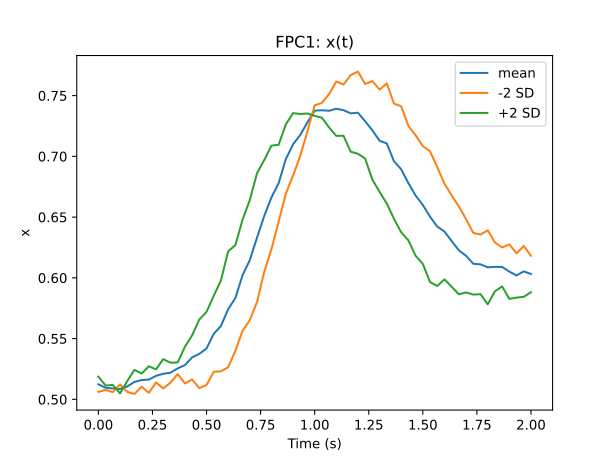
- Common-grid FPCA
- Time-varying predictor effects
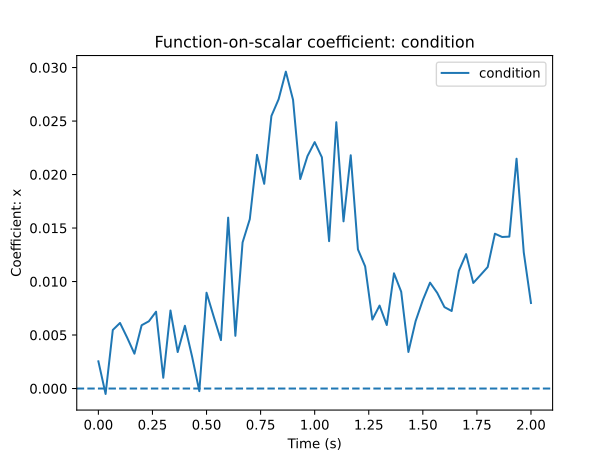
Read regression interpretation
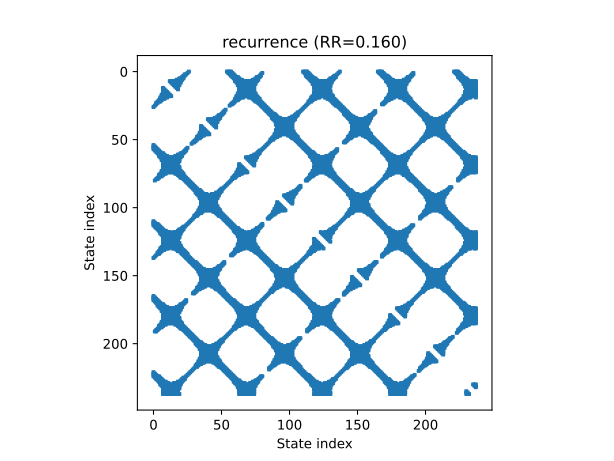
- Recurrence of reconstructed state
When not to use an orchestration route
- A native sparse PACE fit is not justified by dense curves with artificially removed samples merely to fit the sparse API.
- Asynchronous planar samples should not be silently paired at interpolated timestamps to force a paired route.
- Function-on-scalar regression without a repeated-measures model may not answer the scientific question when participant-specific functional effects are central.
- Recurrence plots are descriptive nonlinear-state representations; parameters matter, and visually structured diagonals are not evidence of causal influence.
- A workflow result is not an automatically validated causal or predictive claim.
Installation prerequisite
pip install eyetrajectoriespy==1.2.0 installs these routes. Import run_*_workflow() from eyetrajectoriespy.workflows, not the frozen package root.
Minimal stable 1.2.0 illustration
from eyetrajectoriespy import simulate_planar_trajectories
from eyetrajectoriespy.workflows import (
    FPCAWorkflowConfig,
    run_fpca_workflow,
    workflow_reporting_text,
    workflow_summary_frame,
)

trajectories = simulate_planar_trajectories(
    n_participants=18,
    trials_per_participant=1,
    n_time=61,
    random_state=2201,
)
result = run_fpca_workflow(
    trajectories,
    config=FPCAWorkflowConfig(
        n_components=2,
        scaling="dimension_sd",
    ),
)
print(workflow_reporting_text(result))
print(workflow_summary_frame(result))
The example is synthetic and mirrors the qualified 1.2 documentation gallery setup. It illustrates contract usage and audit output, not an estimator-recovery experiment. Continue to bundle export before interpreting a substantive study.