Transparent workflow orchestration in 1.2
Version 1.2 introduces a typed orchestration layer under
eyetrajectoriespy.workflows. The workflow layer composes already-qualified
scientific primitives; it is not an auto-analysis system and does not replace
the underlying fit_*, diagnostic, reporting or plotting functions.
The governing rule is:
workflow = explicit decisions + ordered composition + reporting + provenance.
Import surface
Stable 1.2.0 module-scoped API
Install with pip install eyetrajectoriespy==1.2.0. The ten run_*_workflow() routes are stable module-scoped APIs under eyetrajectoriespy.workflows, not root exports. Twelve E1–E4 helpers under workflows.experimental remain unstable.
Published 1.2.0 workflow APIs remain module-scoped:
from eyetrajectoriespy.workflows import (
    FPCAWorkflowConfig,
    run_fpca_workflow,
)
They are deliberately not promoted into the package root. This keeps the existing stable root namespace unchanged while giving the workflow layer its own auditable versioned contract.
Available workflows
The published stable 1.2.0 surface contains ten orchestration entry points:
| Route | Workflow |
|---|---|
| sparse univariate FPCA/PACE | run_sparse_fpca_workflow() |
| paired sparse planar MFPCA | run_sparse_mfpca_workflow() |
| asynchronous sparse planar MFPCA | run_sparse_mfpca_async_workflow() |
| sparse participant/trial decomposition | run_sparse_multilevel_workflow() |
| sparse partial-trajectory prediction | run_sparse_prediction_workflow() |
| common-grid FPCA | run_fpca_workflow() |
| observed-grid function-on-scalar regression | run_function_on_scalar_workflow() |
| Gaussian functional mixed effects | run_functional_mixed_effects_workflow() |
| generalized functional regression | run_generalized_functional_workflow() |
| delay-embedded recurrence/RQA | run_recurrence_workflow() |
Every workflow returns a frozen typed result retaining the primitive scientific
result object, ordered WorkflowStepRecord values, decision provenance,
manuscript-oriented reports and tidy tables.
No hidden preprocessing
A PreprocessingPlan is always explicit and ordered. In the current 1.2
candidate, the scientific workflows require an empty plan because no generic
transformation executor has been qualified.
This is intentional. Interpolation, smoothing, registration, resampling, normalization and coordinate transforms can change the estimand or observation model. Perform them explicitly upstream with the relevant package API and retain their provenance before starting a workflow.
Sparse routes
Sparse FPCA and paired sparse MFPCA allow exactly one bandwidth source: analyst-specified fixed values or the existing audited selector configuration. The asynchronous and multilevel routes do not expose selectors that have not been independently qualified.
Sparse prediction requires separate proper-training, calibration and target inputs. No random role split is performed by the workflow.
Dense and regression routes
The dense FPCA workflow records the requested component rule and the realized retained rank separately. Function-on-scalar regression never infers a mixed-effects model. The mixed-effects workflow keeps basis dimensions, random-effect structure, residual correlation, REML/ML choice and optimizer explicit.
The generalized workflow requires family; it does not infer a response
family. Grouped-binomial denominators, Poisson exposures and exposure units
remain separate analyst-declared inputs.
Recurrence workflow
The W4 recurrence route makes the main recurrence specification explicit:
from eyetrajectoriespy.workflows import (
    RecurrenceWorkflowConfig,
    run_recurrence_workflow,
)

result = run_recurrence_workflow(
    trajectories,
    config=RecurrenceWorkflowConfig(
        curve="P01|1",
        dimensions=("x", "y"),
        embedding_dimension=2,  # m
        delay=2,                # tau
        radius=0.12,            # epsilon
        theiler_window=2,
        min_diagonal_length=2,
        min_vertical_length=2,
    ),
)
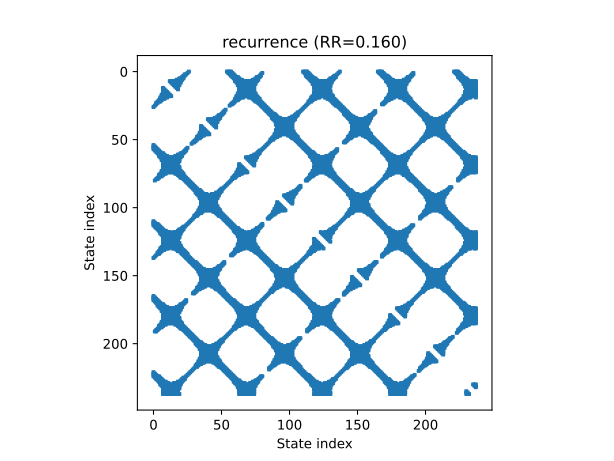
The workflow performs delay embedding, fixed-radius recurrence construction and RQA in that order. It does not select the embedding dimension (m), delay (tau), recurrence radius (epsilon), the Theiler window or line thresholds. Use the existing diagnostic and sensitivity APIs when several specifications are scientifically defensible.
Reporting and audit frames
from eyetrajectoriespy.workflows import (
    workflow_decisions_frame,
    workflow_reporting_text,
    workflow_steps_frame,
    workflow_summary_frame,
)

print(workflow_reporting_text(result))
print(workflow_summary_frame(result))
print(workflow_steps_frame(result.steps))
print(workflow_decisions_frame(result.decisions))
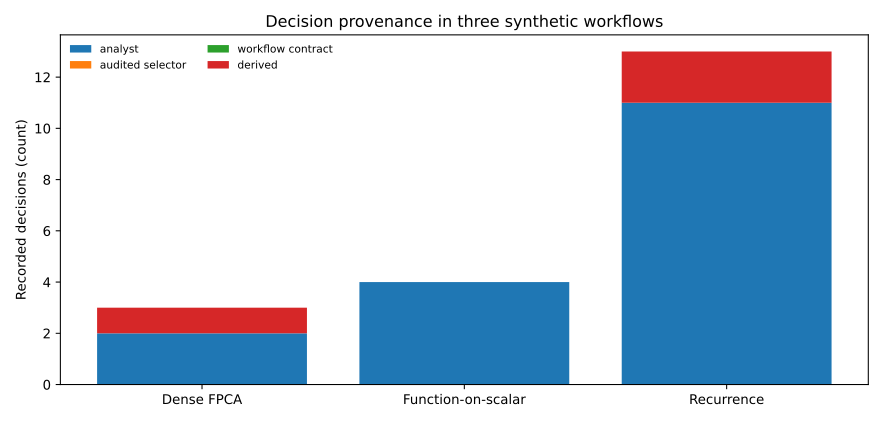
Decision records distinguish analyst, audited_selector,
workflow_contract and derived sources. A derived value is never
relabeled as an analyst choice.
Workflow figures
Workflow plotting is also explicit:
from eyetrajectoriespy.workflows import plot_workflow_result

ax = plot_workflow_result(
    fpca_workflow,
    plot="fpca_component",
    component=0,
    dimension="x",
)
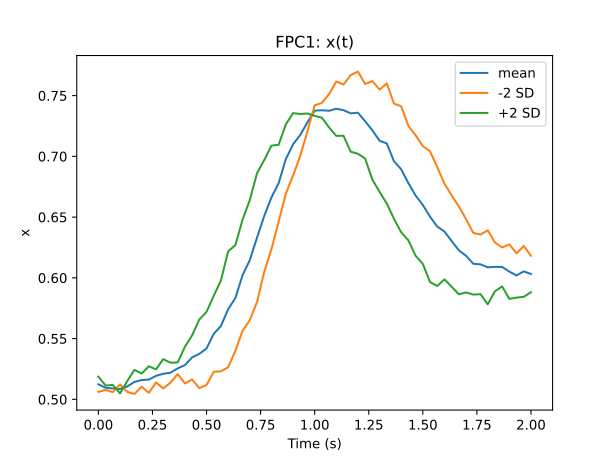
The dispatcher delegates to canonical package plotting functions. It does not choose a component, coefficient, dimension or plot type automatically. Routes without a qualified canonical workflow plot fail explicitly rather than receiving an invented substitute.
Workflow decision provenance (synthetic example)
Workflow execution order (synthetic example)
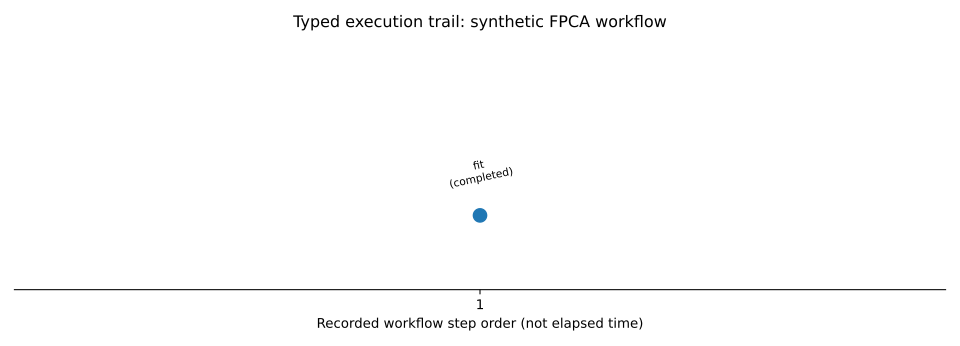
These audit plots are regenerated from workflow metadata using deterministic synthetic fixture inputs. They document recorded decisions and ordering, not estimator validity, runtime benchmarks or comparison of scientific quality. See reproducibility-bundle article and figure interpretation.
Reproducibility bundles
from eyetrajectoriespy.workflows import export_workflow_bundle

export_workflow_bundle(result, "analysis-bundle")
A workflow bundle retains configuration, decisions, ordered steps, provenance, environment metadata, portable scientific state, reports, tables and SHA-256 checksums. Opaque backend-native fields are marked explicitly by the portable result layer rather than silently serialized with pickle.
Stability boundary
The machine-readable candidate boundary is stored in
WORKFLOW_API_AUDIT.json and checked by
scripts/validate_workflow_api_audit.py. For 1.2, the workflow layer remains
module-scoped and does not expand the established package-root API.