External observation validation changes what MNAR models can learn
Methods companion · 21 October 2026 · W3 R84
R83 varied five hypothetical outcome-dependent selection coefficients over the same observed trajectory and correctly concluded that the data alone do not identify which MNAR coefficient generated the missingness. The new R84 experimental study asks what happens when the analyst receives actual new information: independently recovered values for a random subset of outcomes that were originally missing.
External recovery is simulated, not an available feature of the eye tracker
R84 does not demonstrate that a gaze sample genuinely lost by an eye tracker can subsequently be reconstructed or measured. The random recovery mechanism is externally supplied by the complete-data simulator. It must not be presented as an imputation algorithm, an identified real-data MNAR estimator, or a validated 90% confidence-band method. W3 #289 and #296 remain open, stable 1.1.0 unchanged, version 1.2 unreleased.
1. Three fundamentally different operations
An assumed MNAR coefficient modifies model weights but does not add responses. An imputed value is a guess based on a model rather than a new measurement. An independently ascertained missing outcome is actual extra response information that the original observation process did not provide.
R84 simulates only the third operation as a controlled study. The original MAR/MNAR masks remain fixed. A new independent random field externally reveals 0%, 25% or 50% of otherwise missing values. Its positive selection probability is known by design. At zero recovery, R84 returns no selection-parameter estimate, not δ=0.
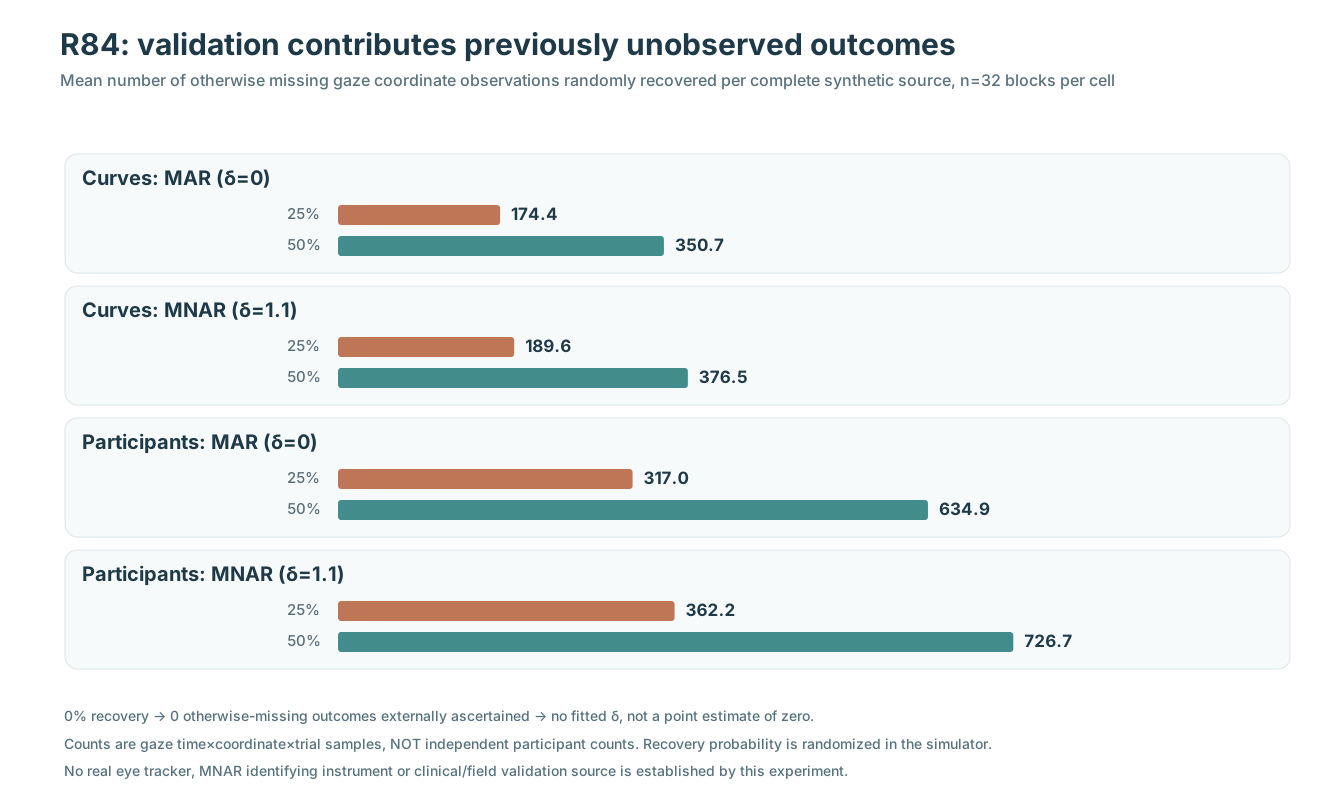
Figure 1. These are newly observed gaze coordinate/trial values per original generated dataset, not new independent participants. Nothing analogous is established for an actual eye tracker.
2. Learning a restricted scalar parameter requires a measurement and a model
The selection process is frozen as logistic in recorded predictor, time and trial, plus one scalar coefficient δ multiplying a bounded function of the response residual. MAR has true δ=0; MNAR has true δ=1.1. This truth is known only to the synthetic generator.
R84 first fits the response conditional-mean pilot using originally visible Y only, separately over time and coordinate. It then uses both original visible outcomes and independently recovered missing values to calculate a weighted selection score. Recovered missing outcomes receive inverse recovery probability weight \(1/r\).
The score is solved for one scalar δ within frozen bounds [−4,4], with refusal of invalid information or nonconvergence. A distinct independently implemented bisection solver confirms numerical agreement with the original Newton solver. Neither procedure fits a sampling covariance nor provides intervals or whole-trajectory uncertainty.
This can make a specified parametric selection coefficient estimable conditional on the validity of the external-recovery and pilot/selection models. It cannot identify the full class of possible outcome-dependent missingness laws. If the apparent recovery were merely generated by an imputation model, it would not provide the same independent information.
3. The controls matter
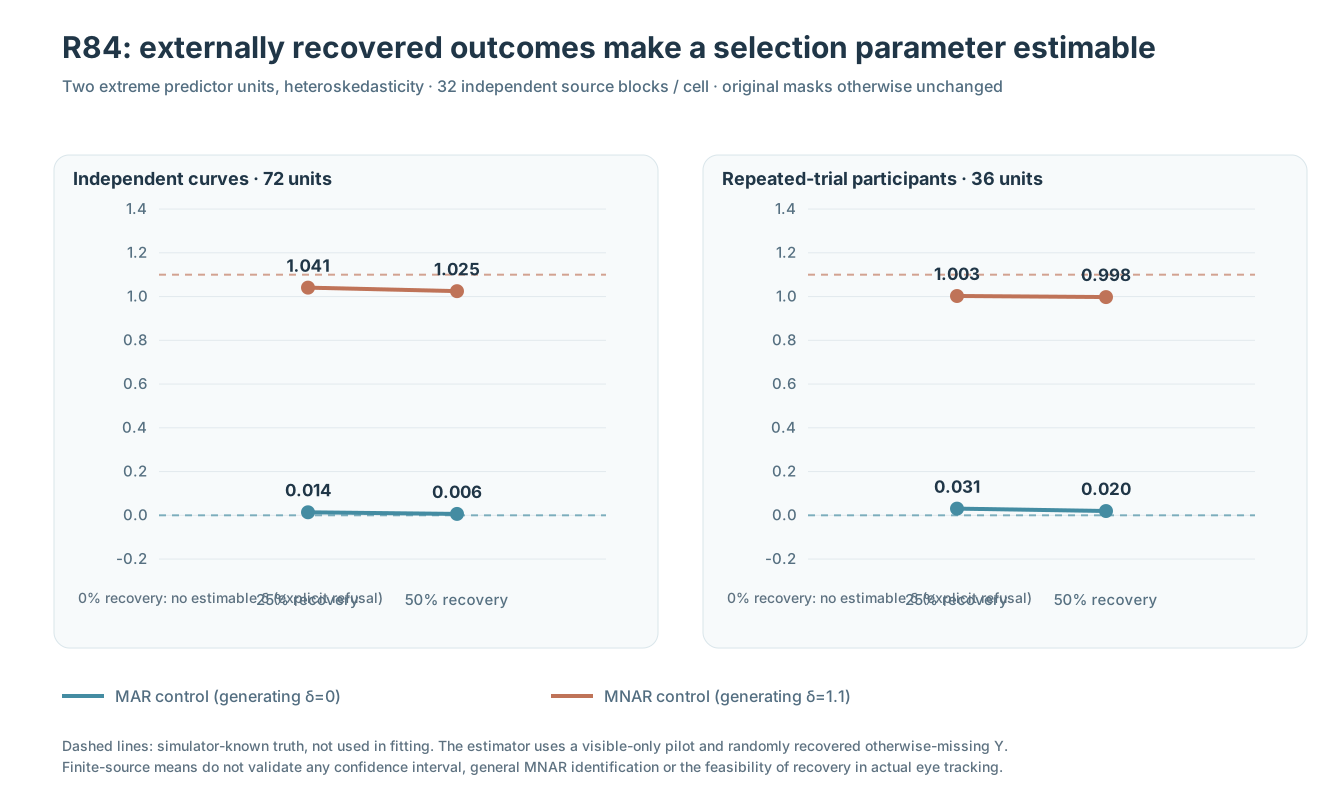
Figure 2. In the two-anchor heterogeneous-noise cells, newly recovered outcomes let the fitted scalar selection model distinguish its MAR δ=0 negative control from the generating MNAR δ=1.1 positive control. The five assumed coefficients used in R83 are not source-identified estimates; R84 is testing a different information setting.
The original R84 source mean MNAR δ estimates with 25/50% recovery are about 1.041/1.025 for curves and 1.003/.998 for participants, while MAR source means remain near zero. No fitted estimate exists at 0%.
These results do not demonstrate unbiasedness. The actual generating selection mean is hidden from fitting, whereas R84 uses an estimated visible-only mean; model misspecification and finite independent-unit source variation remain possible.
4. More recovered values do not guarantee smaller realized error
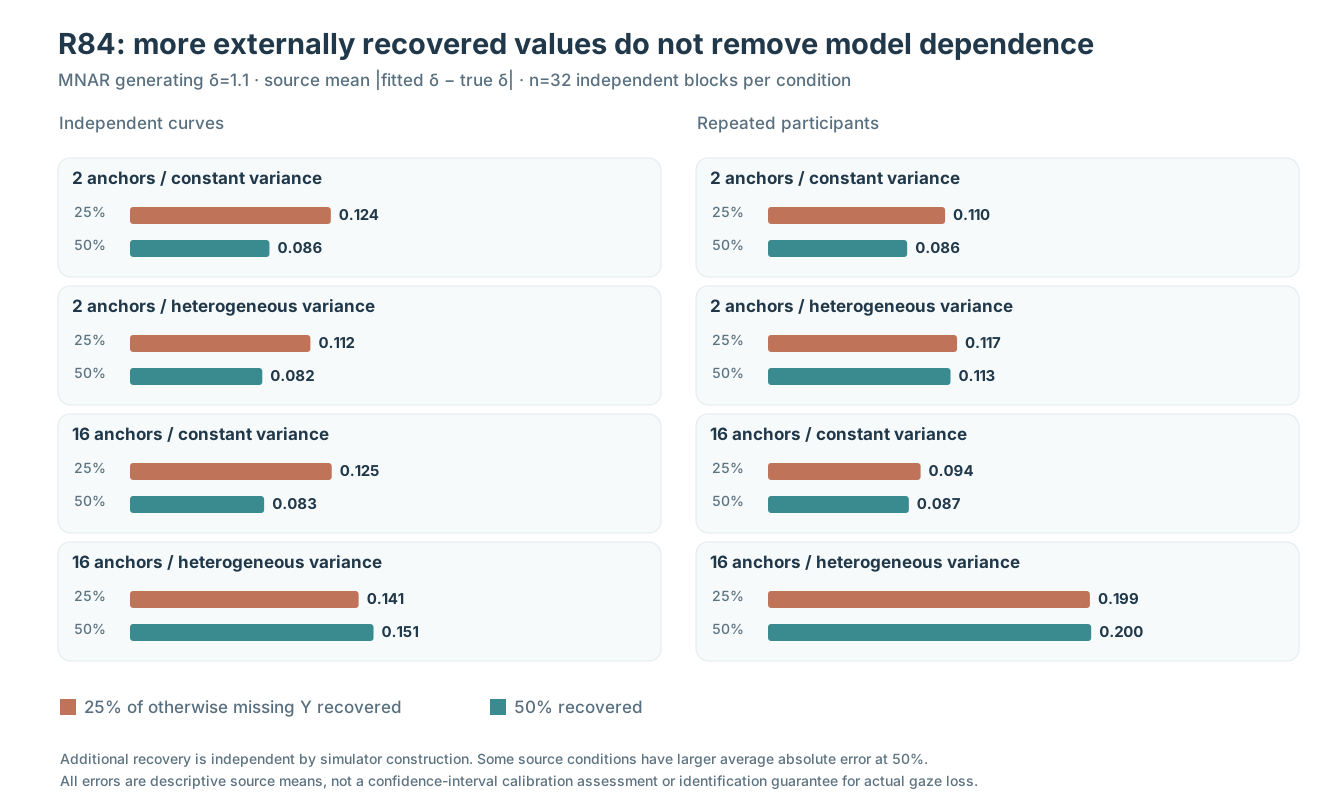
Figure 3. Finite-source mean absolute δ errors are usually smaller in the 50% recovery arm than in the 25% arm, but not uniformly. Under 16 extreme predictor units with predictor-dependent heteroskedasticity, mean absolute error increased slightly in both curves and participants at 50% recovery.
This is not paradoxical evidence that external information is undesirable. Conditional weighting, a deliberately fitted pilot model, finite sample variations, nonlinear bounded scores and a limited n=32 new generating blocks per fixed condition can alter realized errors. Without a validated variance estimator and additional source designs, R84 cannot make statistical precision guarantees.
5. Independent experimental units and honest provenance
The original synthetic experiment comprises 32 genuinely new primitive blocks per fixed condition, 256 complete X/Y source-condition datasets, 512 paired MAR/MNAR masks and 1,536 selection/recovery diagnostic records. The masks and recovery arms reanalyse the same source, not 1,536 independently sampled eye-tracking experiments.
Original R84 science #39581392688 passed 12/12 dedicated jobs. R84-A independently coded actual original archive audit #39582618020 passed 4/4 jobs and verified all source identities, paired masks, nested recovery draws, visible-only pilot fits and weighted selection parameter roots.
The results are numerical evidence concerning one artificially specified external-validation design. No real auxiliary measurement source, MNAR identifiability from ordinary incomplete recordings, or statistically calibrated functional confidence band is established.
Full R84 research article · Original numerical evidence and three plots · R83 nonidentified sensitivity study