W3 R84: independent actual source/ascertainment evidence and original figure ledger
Scientific research evidence · 21 October 2026 · synthetic independent recovery of otherwise missing Y only
Conditional scalar model learning, NOT field MNAR identification or 90% inference
R84 supplies truly external synthetic source observations for randomly selected originally missing values. The ordinary eye tracker and stable function-on-scalar API have no way to recover these values. The model assumes a fixed parametric selection form and uses a visible-only pilot, with no confidence interval or simultaneous band. W3 #289/#296 OPEN, stable 1.1.0 unchanged, v1.2/PyPI RELEASE HOLD.
Original and independent immutable evidence
| Acceptance criterion | Independently validated result |
|---|---|
| Prospectively frozen original R84 experiment | Research draft PR #427 |
| Actual original source workflow | #39581392688: 12/12 science jobs successful |
| Original SHA256 source evidence | Artifact #12336507240 |
| Frozen original science PR-merge checkout | 6170c5b5941f55a5083cf57dc11293a229d2f9e1 |
| Independently coded research audit | R84-A draft PR #428 |
| Mandatory independent actual source archive replay | #39582618020: 4/4 independent jobs successful |
| Independent audit evidence | Artifact #12338291302 |
| True new primitive generating blocks per cell | 32 |
| Complete X/Y source-condition datasets | 256 |
| Original paired selection masks | 512: MAR (true δ=0) and MNAR (true δ=1.1) |
| Nested recovery levels | 0%, 25%, 50% of otherwise missing gaze coordinate/trial outcomes |
| Original and independent diagnostic rows | 1,536, not independent replications |
| Independent numerical estimators | Original deterministic Newton score and separately implemented bounded bisection |
| Zero external recovery | No fitted δ and no δ estimation error (NULL, not zero) |
| Public missingness behavior | Original native regression refuses incomplete common-grid gaze |
| Inference or release decision | No MNAR identification generally; no interval/band, no version 1.2/PyPI release |
The new source RNG streams were prospectively fixed at 202610218480 (complete X/Y source), 202610218481 (original MAR/MNAR masks), and 202610218482 (independently randomized external recovery). The original source family retains correlated Gaussian functional trial innovations, independent-unit Student-t5 radial shocks and rare signed asymmetric unit shock.
The visible-only mean pilot never uses newly rescued outcomes or generating truth. The scalar selection-model likelihood receives Y only for originally visible or independently recovered missing samples. The true generating δ is used only for source performance evaluation, not model fitting.
Figure 1 — identified-information contrast and source controls
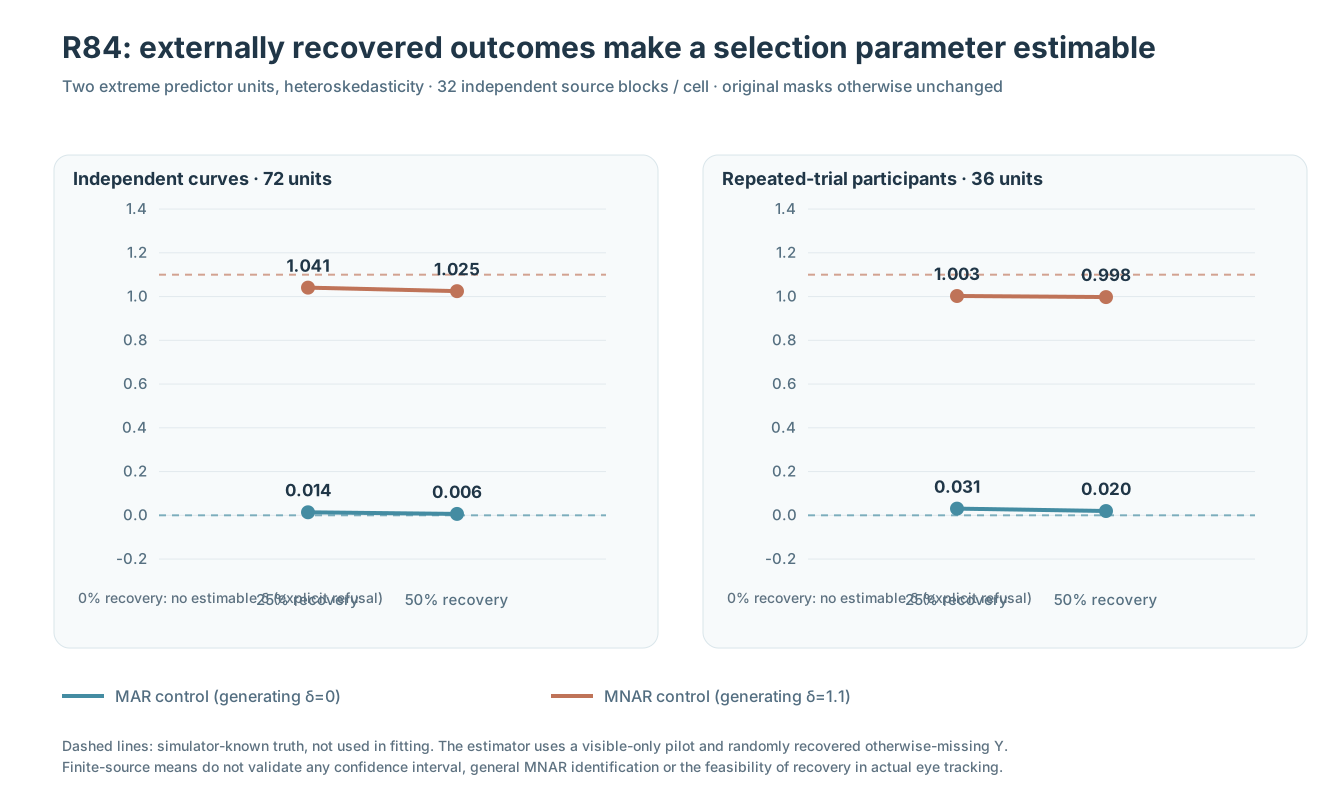
Figure 1. Source-mean fitted parameter under the primary two-extreme independent-unit, predictor-heteroskedastic condition. Dashed true-source δ values are for simulation validation only.
| Source condition | True δ | 0% recovered | 25% recovery: mean fitted δ | 50% recovery: mean fitted δ |
|---|---|---|---|---|
| Curves, MAR | 0 | Not fitted | .013817 | .006390 |
| Curves, MNAR | 1.1 | Not fitted | 1.040799 | 1.024667 |
| Participants, MAR | 0 | Not fitted | .030567 | .019544 |
| Participants, MNAR | 1.1 | Not fitted | 1.002535 | .997599 |
All positive-recovery cells above used 32 independently generated sources and had 32 converged scalar coefficient fits. A converged point estimate is not proof that the model was correctly specified, nor a confidence interval.
Figure 2 — all eight prespecified MNAR source condition errors
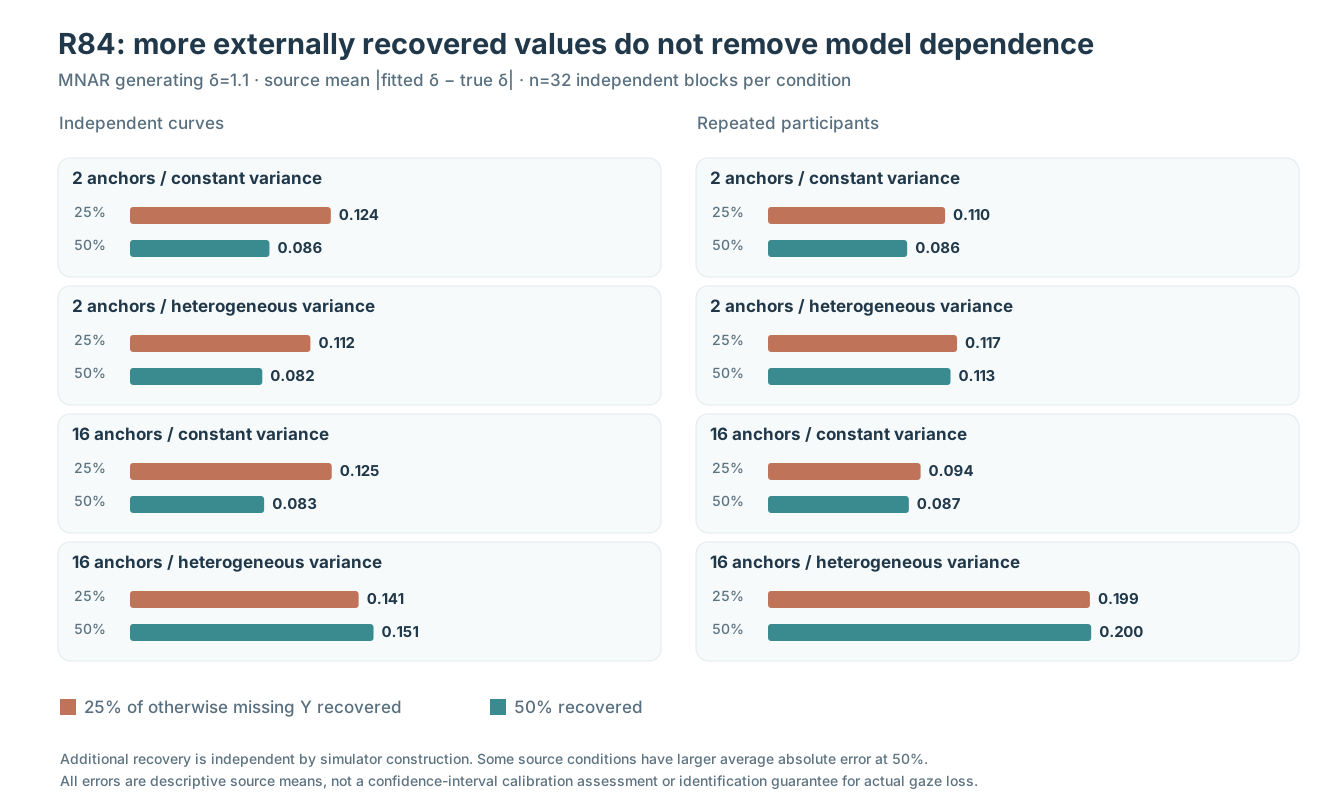
Figure 2. Absolute fitted δ minus true simulator MNAR δ=+1.1, averaged over 32 genuinely new independent generating blocks in each cell.
| True source design | Extreme signed units | Source variance law | 25%: mean abs δ error | 50%: mean abs δ error |
|---|---|---|---|---|
| Curves | 2 | Constant | .124218 | .086253 |
| Curves | 2 | Heteroskedastic | .111574 | .081827 |
| Curves | 16 | Constant | .124788 | .082971 |
| Curves | 16 | Heteroskedastic | .141423 | .150632 |
| Participants | 2 | Constant | .109547 | .086078 |
| Participants | 2 | Heteroskedastic | .116945 | .112901 |
| Participants | 16 | Constant | .094400 | .087128 |
| Participants | 16 | Heteroskedastic | .199109 | .199912 |
Higher recovery often reduces source-mean realized absolute error but is not uniformly beneficial in every small finite-source cell. That is compatible with noisy recovery, source-level dependence and the visible-only pilot being an imperfect conditional-mean specification; the experiment has no interval or consistency guarantee.
Figure 3 — independently measured formerly unobserved Y
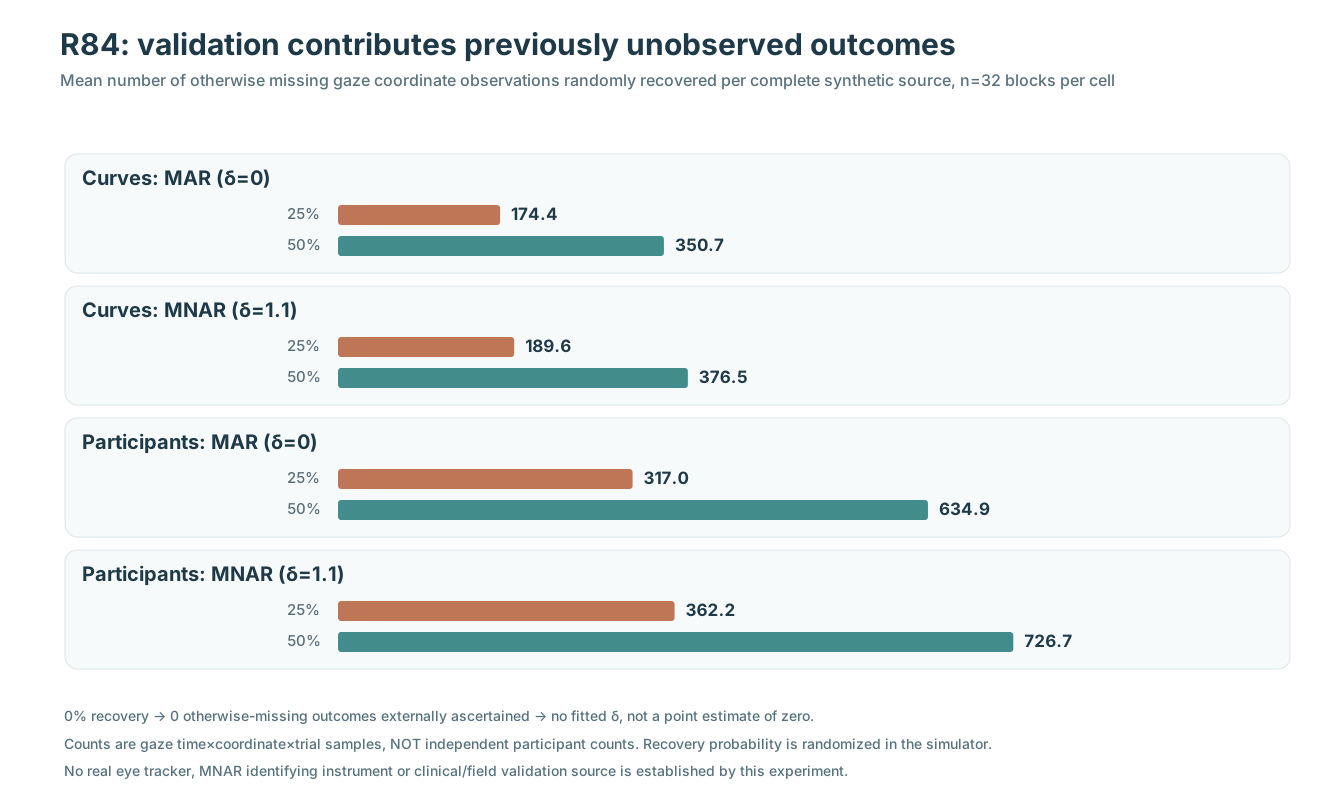
Figure 3. New observed coordinate/time/trial values supplied to a synthetic selection estimator, not additional independent people.
| Two-anchor heteroskedastic source | Mean missing values recovered, 25% | Mean missing values recovered, 50% |
|---|---|---|
| Curves, MAR | 174.4375 | 350.7188 |
| Curves, MNAR | 189.5938 | 376.5000 |
| Participants, MAR | 317.0000 | 634.8750 |
| Participants, MNAR | 362.1563 | 726.7188 |
For each original complete source, the 25%-recovered otherwise missing observations are a subset of the 50%-recovered observations through one independent recovery uniform field. 0% supplies no new outcomes, so neither the MAR nor MNAR δ is fitted at all.
Scientific conclusions that remain unsupported
The archive reproducibly answers whether a particular parametric selection score, using a visible-only pilot and additional independent synthetic missing-response ascertainment, yields informative scalar fitted δ values in these source conditions. It does not show that lost gaze can be externally remeasured, that random ascertainment can be implemented on a real participant's historical gaze, or that the recovered-outcome model remains valid with covariate-dependent validation, misclassified samples, unknown recovery fractions or a misspecified MNAR family.
The conditional scalar coefficient is not the complete time×coordinate functional slope and it supplies no full-function inference covariance. No nominal 90% calibration, source-independent interval coverage, or nonparametric MNAR identification is established, even though all original synthetic source diagnostics have been independently recreated.
Read the R84 scientific article · Methods companion · Previous R83 five-assumption sensitivity experiment