Scientific evidence dashboard — unreleased 1.2
Evidence is not inferential qualification
Stable PyPI: 1.1.0. Development research: unpublished. Source simulations and CI provide reproducible experimental evidence, not proof that reported p-values, credible intervals or predictive intervals are valid across real eye-tracking designs. Research implementation code stays in draft branches, not in stable 1.1.0 or the public-main default.
Additional R86 independently audited randomized audit of secondary validation failures — 21 October 2026: Fresh 32 independent primitive blocks/fixed cell produced 256 complete synthetic X/Y source conditions, 512 first-stage MAR/MNAR original masks and 4,608 original secondary/third-stage audit diagnostics. Original science #39639148930 12/12 dedicated jobs PASS; actual independent R86-A archive #39640120223 4/4 PASS. A randomized 25%/50% audit among secondary validation failures supplies newly observed Y and allows fitting one stipulated second-stage logistic recovery model; 0% audit explicitly refuses gamma and audit-estimated first-stage delta. In adverse original MAR truth delta=0, no-audit naïve fitted delta ~+.66 curves and participants, while 25% audit-estimated fits near zero; under MNAR source truth delta=1.1, audit-estimated means near 1.0 (curves) and .98 (participants). Synthetic identification diagnostic only, not a real gaze remeasurement mechanism, 90% bands or released inference. R86 article/plots · full immutable evidence. #289/#296 OPEN, stable 1.1.0 unchanged, v1.2 HOLD.
Additional R85 independently audited selective external validation falsification — 21 October 2026: New 32 independent primitive blocks per fixed cell yielded 256 source X/Y, 512 original MAR/MNAR masks, 2,560 alternative secondary-ascertainment weighting strategies. Original science #39629520741 12/12 PASS, independent R85-A original source replay #39630863879 4/4 PASS. Under original MAR true δ=0, incorrectly random-weighted latent-selective external validation gives fitted mean δ +.664 independent curves and +.630 participants; simulator oracle about −.019/−.005. Under original MNAR true δ=1.1, naïve latent recovery estimates 1.671/1.523 versus oracle 1.028/.950. This is secondary selection falsification, not identifying general MNAR, a feasible external sensor or 90% band inference. R85 article and original figures · source evidence. #289/#296 OPEN, v1.2 HOLD.
Additional R84 externally ascertained missing-Y checkpoint — 21 October 2026: New 32 independent primitive blocks/cell yielded 256 X/Y source conditions, 512 original MAR/MNAR paired masks, 1,536 nested 0%,25%,50% external-outcome recovery diagnostics. Original science #39581392688 12/12 PASS, separately coded R84-A exact original source audit #39582618020 4/4 PASS. At 0% recovery no δ fitted. Primary two-anchor heteroskedastic MNAR source with true δ=1.1 produced fitted source-mean δ 1.0408/1.0247 curves and 1.0025/.9976 participants at 25%/50% new external ascertainment. The true MAR δ0 control remains near zero. This demonstrates conditional parametric point estimation using simulated extra information, NOT general MNAR identification, real gaze recovery, any interval or nominal-90% band. R84 article/plots · numerical immutable provenance. W3 #289/#296 OPEN; stable 1.1.0 unchanged, v1.2 HOLD.
Additional R83 independently audited MNAR sensitivity checkpoint — 21 October 2026: Original R83 science #39575847765 12/12 dedicated successful, independent R83-A true source replay #39576738539 4/4 successful, reconstructing 256 fresh Student-t5+skew X/Y, 1,024 paired complete/MCAR/MAR/MNAR observation masks and 3,328 pointwise sensitivity/reference results with 32 genuinely independent primitive source blocks/cell. Five assumed δ values -1.1 to+1.1 applied to the SAME observed source, under two extreme predictors in MNAR yielded mean absolute endpoint slope differences .00453 independent curves and .00841 repeated participants, conditional on support. This is nonidentified MNAR selection sensitivity, not a correction, band, or valid nominal-90% coverage; simulator-only oracle not observed. R83 article + original plots · source audit. #289/#296 OPEN, v1.2 RELEASE HOLD.
Additional R82 original-source observation-process checkpoint — 21 October 2026: R82 source #39571308151 12/12 dedicated science PASS; separately coded R82-A original-archive replay #39572315409 4/4 independent PASS, reconstructing 256 fresh X/Y source conditions and 1,024 complete/MCAR/MAR/MNAR masks, pointwise support/refusal and descriptive slope checks with 32 independent primitive blocks per fixed cell. With two independent influential curve predictors and heteroskedastic MNAR, 83.1% of coordinate samples remain, but 33.56 of 62 functional positions are refused under the preregistered both-sign extreme-anchor feasibility gate. Stable public regression still rejects incomplete trajectories; separate naive pointwise available-case OLS is only descriptive, not a valid 90% confidence method or MNAR correction. Scientific research article · Source and figure ledger. #289/#296 OPEN; stable 1.1.0/API untouched, 1.2 release HOLD.
Additional R81 independent-unit rare asymmetric contamination checkpoint — 20 October 2026: Original R81 #39490888383 12/12 source-science jobs successful; mandatory independently implemented R81-A real archive #39491187099 4/4 successful. 256/256 freshly generated Student-t5 + centered Bernoulli asymmetric unit-level source cases, zero refusals, 1,278,720 original conditional maximum values individually reconstructed. In the two-anchor heteroskedastic condition, complete 31×2 known-slope inclusion under fixed λ=.50 was 24/32 independent curves and 24/32 repeated participants; the true non-Gaussian generating-law source reference yielded 29/32 in both. The actual independently sourced units are 32 primitive generating blocks per cell, and no candidate proves general nominal-90% calibration. R81 study/figures · numerical provenance. W3 #289/#296 OPEN; stable release unchanged, 1.2 HOLD.
Additional R80 Student-t5 source-innovation checkpoint — 20 October 2026: Original R80 science #39487449656 12/12 PASS and separately coded R80-A actual original source replay #39487811433 4/4 PASS, verifying 256/256 freshly sourced independent-unit Student-t5 Gaussian mixture X/Y arrays, 0 refusals and all 1,278,720 raw maximum reference statistics, including the correct non-Gaussian source-known slope reference. Under two independent extreme predictor units and heteroskedasticity, frozen λ=.50 whole 31×2 generating slope inclusion was 23/32 independent curve and 24/32 participant sources, not general nominal-90% calibration. Original inference candidates unchanged; R80 article and plots · source/figure ledger. Issues #289/#296 OPEN, 1.2 release HOLD.
Additional R79 nonseparable covariance checkpoint — 20 October 2026: Under frozen time-varying cross-coordinate Gaussian correlation q(t)=.15+.65t, unchanged frozen λ=.25/.50 HC3 regularization candidates were independently tested with 32 genuinely new primitive blocks per cell, across 256 factorial source cases. R79 original workflow #39483619384 12/12 science PASS and R79-A original archive audit #39483939543 4/4 PASS, reproducing all 1,278,720 raw conditional maximum values and 256/256 source cases with zero refusals. Under two independent extreme predictor units and heteroskedasticity, λ=.50 31×2 slope truth inclusion was 24/32 independent curves and 20/32 repeated-trial participants, not calibrated nominal-90% inference. Scientific article · Research vector plots/source provenance. W3 #289/#296 OPEN; release 1.2 HOLD.
Additional R78 temporal covariance checkpoint — 20 October 2026: Frozen R77 HC3 regularization candidates were falsified under new fully observed time-scaled Gaussian AR(1) trial innovations. R78 original simulation 12/12 scientific jobs passed, and R78-A independent original source audit 4/4 jobs passed, including all 256/256 source X/Y, zero refusals and 1,278,720 original reference maxima. Under high-noise two-anchor leverage, fixed λ=.50 whole-slope truth inclusion was 22/32 curves and 19/32 repeated participants, not generally calibrated 90% coverage. Read the scientific article and figures · Audit-method companion. W3 blockers #289/#296 OPEN; version 1.2 release HOLD.
Additional R77 research checkpoint — 20 October 2026: Two prospectively frozen data-estimated HC3 covariance-regularization strengths (λ=.25/.50) were compared against unchanged HC3, wild-HC1 and simulation-known Gaussian whole-band references. Original 256-source R77 12/12 science and independent 1,278,720-reference-value R77-A replay 4/4 audit passed, with zero source refusals. Under extreme predictor dependence and heteroskedastic Gaussian errors, baseline HC3 truth inclusion of 1/32 independent curves and 9/32 repeated-participant sources increased to 24/32 for each under fixed λ=.50; 24/32 is 75%, not validated nominal-90% coverage. Article and original source plots. W3 blockers #289/#296 remain open, release HOLD.
Additional W3 inference checkpoint — 20 October 2026: R71–R76 Gaussian simultaneous-band experiments establish source-verified failure cases under high leverage and predictor-dependent variance. R76 original science passed 12/12 jobs; R76-A replayed all 512/512 original sources, zero refusals and 1,534,464 archived maximum-statistic values under a separate 4/4 independent audit. Increasing independent influential-unit support improved observed HC3 inclusion in some tested configurations but did not qualify general nominal-90% inference. Read the W3 source/plot ledger · R76 scientific article · W3 blocker #289.
Evidence checkpoint: October 10, 2026. Counts below refer to actual source-run attempts, not distinct human participants. When two methods share a test dataset, the test dataset is the independent simulation unit.
| Research gate | Original source run | Actual method fits | Critical evidence | Qualification |
|---|---|---|---|---|
| F1 sparse group inference | #37977625803, artifact 11640464273 |
6,000, 0 failures | 4,000 null and 2,000 fixed moderate-effect alternatives, 199 permutations each; observed null rejection 4.4–5.2% at nominal 5% across four tested regimes, moderate-effect detection 14.2–19.2% | Limited evidence, not general qualification |
| B6/B7 independent NUTS | #37988738287, artifact 11645572128 |
3 PyMC posterior fits, no divergences | Genuine separate PyMC likelihood works; intervals overlap, but native covariance chains mix inadequately | Blocked: #255 |
| B6/B7 identifiable diagnostics | #37992812846, artifact 11647146899 |
3 independent posterior comparisons | B6 covariance native R-hat/ESS 1.357/5 versus PyMC 1.001/183; async B7 covariance native 1.718/3 versus PyMC 1.006/249 | Blocked: #255 |
| B6/B7 longer-chain original Gibbs, elliptical slice and independent NUTS | #38039822342; B6 artifact 11665746776, paired B7 11665707552, asynchronous B7 11665607799 |
9 actual posterior fits on 3 newly prior-generated datasets; 0 exceptions; SHA256 audit passed | Native midpoint covariance bulk ESS 45.6/11.7/19.9 (B6/paired/async); score-marginal ESS 13.4/8.5/6.8; independent NUTS 399.6/705.7/699.2, all NUTS 0 divergences; no per-method fit times | Native covariance not qualified; NUTS promising, not coverage-qualified. Blocker #255 open |
| B6/B7 four-chain independent NUTS R1 | #38047872726, six source-audited artifacts (see study) | 6 independent four-chain NUTS fits (2 per rank-one design), 0 fitting errors; audit passed | All 6 passed exploratory identified-functionals screen, worst R-hat 1.0058, lowest bulk ESS 707, minimum BFMI 0.770, zero divergences; 6–15 functionals per dataset; no rank-two or rank-SBC evidence | Promising reference computation only; nominal coverage and publication remain blocked by #255 |
| B6/B7 rank-two dense-Gaussian/Woodbury mathematical reference | #38087129154, original artifacts 11681893932, 11682179563, 11681983569 |
4 mathematical cases run on Python 3.11–3.13; 0 contractual failures | Dense observed-data Gaussian equals independent rank-2 Woodbury within specified tolerance under paired/asynchronous layouts, orthogonal rotation, near ties (near-tied stress out of prior) | Mathematics qualified for tested identities only; PyMC graph, gradients, sampler and SBC absent. #255 open |
| B6/B7 rank-two actual PyMC log posterior and gradients | #38095088126; source artifacts 11685812328, 11685872136, 11685108432, 11685956885 |
4 real PyMC graph and AD evaluations (paired/asynchronous × matched-prior/near-tied), 30 derivatives per case; 0 contract errors | Worst absolute full log-posterior discrepancy 8.53×10⁻¹⁴ and scaled gradient discrepancy 1.11×10⁻⁸ against independent dense Gaussian and numerical differentiation; proper isotropic normal priors, rotation invariance | Actual graph mathematics verified in tested cases only; subsequent R3 rank-two NUTS sampled two datasets but achieved only 1/2 screens; SBC and coverage not done. #255 open |
| B6 rank-one same-dataset longer-budget R2 | #38095220518, original SHA artifact 11686220901 |
One targeted refit of original replicate 1, NOT an additional SBC dataset; four chains × (1200 warmup + 800 retained) | Worst R-hat improved 1.0158 → 1.00531249; min bulk ESS improved ~543 → 1,260.40; no divergences; all six identified functionals pass, source refit 1,419 seconds | Sampling-budget sensitivity diagnosis only; original pilot still 3/4 screens passed, SBC/coverage not qualified. #255 open |
| B6/B7 rank-two actual four-chain NUTS R3 | #38096271285, paired 11686840512, async 11686377461, source audit 11686793076 |
2 new rank-two datasets, both fits succeeded (4 simulated participants each), 0 sampler exceptions; 1/2 screens passed | Paired worst R-hat 1.00539, min bulk ESS 454 and 0/15 failures; asynchronous worst R-hat 1.01397, min bulk ESS 326, 6/15 failed mean functionals. 0 divergences in both | Rank-two posterior computation observed, not generally qualified; intervals and SBC remain uncalibrated. #255 open |
| B6 prior-SBC stage-0 rank-one pilot | #38087405506, original aggregate artifact 11683762021 and 4 individual case artifacts |
4/4 full independent NUTS fits, 0 fitting errors; 1 of 4 failed exploratory screen | Prespecified primary midpoint truth ranks (mean) 1,198/912/124/324 and (variance) 1,395/953/1,353/1,132 (of 1,600 draws each). Both intervals include truth 4/4; one dataset has worst R-hat 1.0158 despite zero divergences | Infrastructure pilot only: no SBC rank uniformity or nominal coverage claims. #255 open |
| B6/B7 joint-loading ESS | #38000101053, artifact 11649475504 |
36 (18 independently generated datasets × 2 methods), 0 failures | No fit passed identifiable-covariance R-hat ≤1.01 and bulk ESS ≥400; no consistent mixing improvement | Negative comparator, not promoted |
| F5 independent-baseline unknown AR(1) | #37987935105, artifact 11643259568 |
2,520, 0 failures | Strong-AR(1) null false positives reduced, but iid/weak-AR(1) conservatism and AR(2) misspecification remained | Blocked: #256 |
| F5 baseline-size uncertainty ablation | #37992161919, artifact 11645662411 |
3,600 (600 independent test datasets × 6 paired conditions), 0 failures | Strong-AR(1) plug-in false positive 24/12/9% for training n=40/80/160; uncertainty propagation 3/1/5%; true-AR(2) under uncertainty propagation 27/12/15% | Blocked: #256 |
| F5 independently trained AR(2) stress | #38000177988, artifact 11648842221 |
1,500 (750 independent test datasets × 2 methods), 0 failures | Under true AR(2), null 15% AR(1) vs 9% AR(2); MA(1) 0% vs 11%; within-test nonstationarity 94% false rejection for both | Blocked: #256 |
B6/B7 long-chain completed posterior pilot: native covariance mixing still unqualified
The nine-fit source-verified study uses three new prior-generated rank-one datasets, not nine independent subjects or nine independent posterior-truth replications. Identifiable covariance posterior fit outcomes:
| Design | Original Gibbs R-hat / bulk ESS | Score-marginal elliptical slice R-hat / bulk ESS | Independent NUTS R-hat / bulk ESS |
|---|---|---|---|
| B6 univariate | 1.090 / 45.6 | 1.205 / 13.4 | 1.006 / 399.6 |
| B7 paired | 1.293 / 11.7 | 1.425 / 8.5 | 1.001 / 705.7 |
| B7 asynchronous | 1.159 / 19.9 | 1.601 / 6.8 | 1.000 / 699.2 |
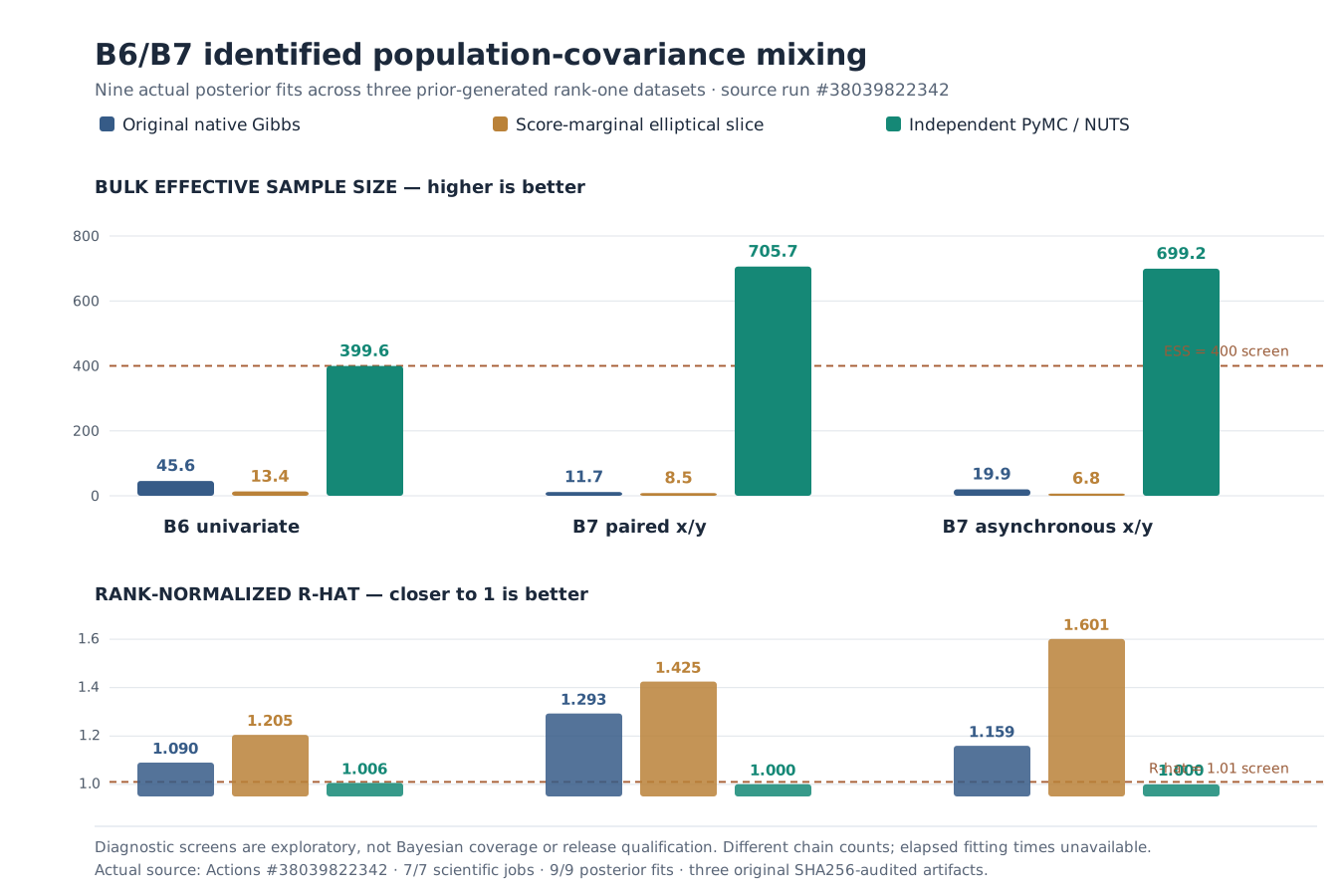
The prespecified exploratory covariance mixing screen (rank R-hat ≤1.01 and bulk ESS ≥400) was met only by both B7 NUTS studies. B6 NUTS had ESS 399.6, effectively at—but formally below—the threshold. All three NUTS runs reported zero divergences. The native covariance chains remained poorly mixed in every design; fitted posterior means being similar to NUTS does not make those native results reliable. All reported 90% intervals happened to contain their single generated truth; this is not an estimate of repeated-sampling coverage. These absolute ESS values also cannot establish runtime efficiency because native uses four chains and NUTS two, with no per-method timing recorded.
Scientific blocker #255 remains unresolved; independently converged four-chain posterior references, rank-2 and SBC/coverage simulations remain necessary.
F1: limited null calibration, modest sensitivity
| Sparse regime | Observed null rejection (1,000 independent datasets) | Fixed moderate-effect rejection (500 datasets) |
|---|---|---|
| Balanced | 49/1,000 (4.9%) | 79/500 (15.8%) |
| Clustered two trials | 51/1,000 (5.1%) | 91/500 (18.2%) |
| Unequal heteroscedastic | 52/1,000 (5.2%) | 96/500 (19.2%) |
| Very sparse | 44/1,000 (4.4%) | 71/500 (14.2%) |
The results do not identify useful power across other sample sizes, effect shapes, missingness mechanisms, nuisance covariance choices or participant-exchangeability structures. Do not promote this as a generally calibrated test based only on one simulation grid. Method and source figure.
Bayesian convergence: identifiable covariance, not raw sign-ambiguous factors
| Quantity | Independent PyMC rank R-hat / bulk ESS | Native Gibbs rank R-hat / bulk ESS |
|---|---|---|
| B6 midpoint population covariance | 1.001 / 183 | 1.357 / 5 |
| B7 paired midpoint x/y covariance | 1.002 / 281 | 1.062 / 34 |
| B7 asynchronous midpoint x/y covariance | 1.006 / 249 | 1.718 / 3 |
The PyMC reference is not fully qualified either: bulk ESS <400 in these cases, and R-hat on identified quantities does not guarantee valid credible-interval coverage. The native sampler remains a serious scientific blocker. Independent comparison, negative sampler experiment.
F5: falsification matters more than the best-looking model
At nominal 5%, independently trained AR(1) vs AR(2) mean-null rejection counts per 100 independent datasets were iid 0 vs 1, strong AR(1) 3 vs 3, true AR(2) 15 vs 9, stationary MA(1) 0 vs 11, and dependence changing within the test 94 vs 94. The 9/100 nominal-rate estimate has a wide exact Monte Carlo interval (approximately 4.2–16.4%). Inflated true-null rejection makes higher alternative-rejection proportions unsuitable as calibrated power comparisons.
AR(2)/nonstationary falsification · Baseline duration.
Unresolved gates
| Work | Independent validation still required |
|---|---|
| Bayesian B6/B7 | Rank-one computational screening replicated; rank-two graph validated in four mathematical cases; first rank-two NUTS pilot 1/2 screens passed, many-dataset SBC, repeated nominal coverage and held-out predictive calibration remain |
| F5 | A theoretically defensible dependence-robust null with stationary assumptions, external diagnostics, transportability constraints, nonstationary counterexamples and larger independent null simulations |
| F1 | Sample-size/effect-size power surfaces, missingness/covariance stress, permutation exchangeability and independent comparators |
| F2/F3/F4/F6 | Target/coordinate provenance, official Eye-Tracking-BIDS validator and real-data checks, constrained AOI estimator validation, weighted geometry verification |
| Real recordings | Independent dense, asynchronous sparse and repeated-participant examples with source data, failure cases, reproducible outputs and appropriate permissions |
The 1.2 release and all scientific promotion flags remain false. Public documentation of these findings changes none of those gates.