W3 R79: source provenance and original nonseparable covariance figures
Research evidence ledger · 20 October 2026 · fully synthetic, Gaussian and unreleased
Numerical verification, not statistical qualification
The original and independent numerical audits validate computational reproduction of source data and reference arrays, not general nominal-90% coverage. No real sensor, non-Gaussian, dropout or MNAR data are tested. W3 science blocker #289 and missingness blocker #296 remain OPEN, version 1.2 release HOLD.
Figure 1: generating-law nonseparable covariance
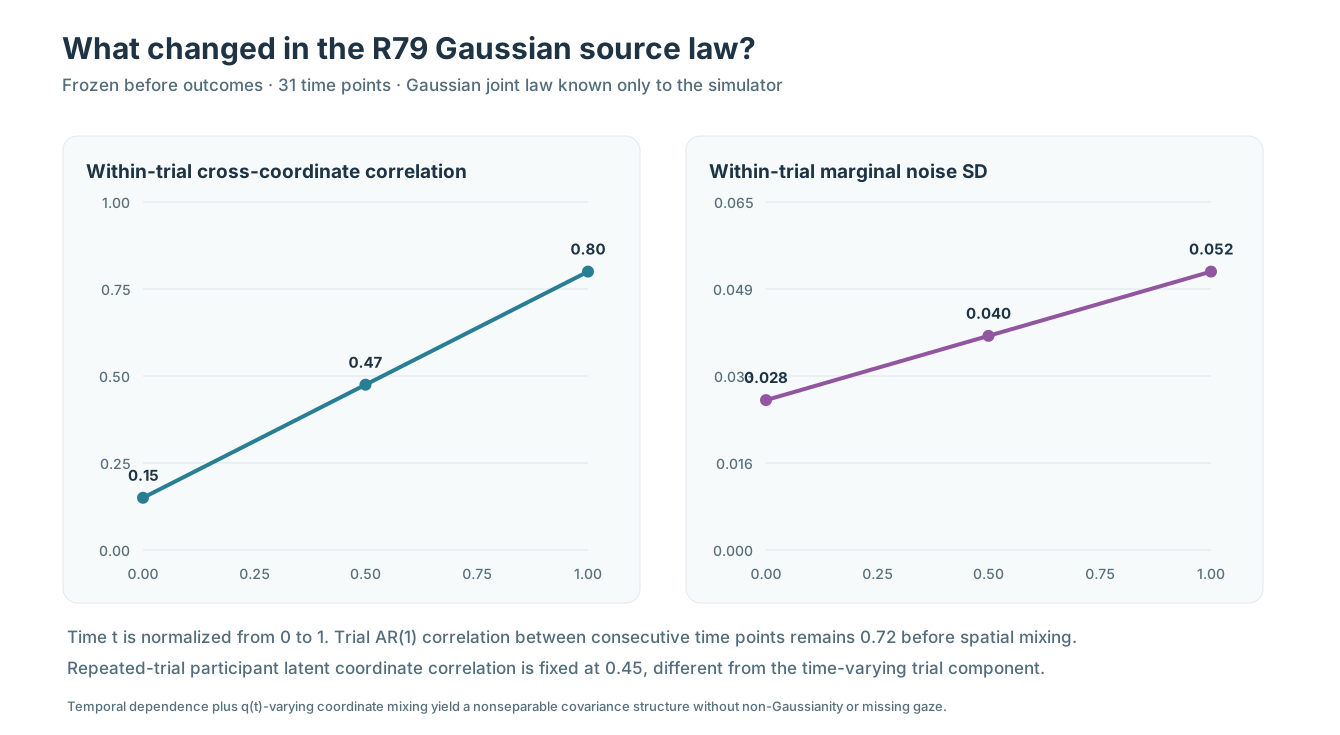
Read the R79 scientific article. R79 uses within-trial base Gaussian temporal AR1 rho .72, true trial marginal SD .04(.70+.60t), and explicitly varies within-time coordinate correlation q(t)=.15+.65t. In the repeated-trial participant configuration, dimension-specific subject latent normals have fixed coordinate correlation .45. All generating-law parameters are simulation known only.
Figure 2: source-level whole-slope-function inclusion
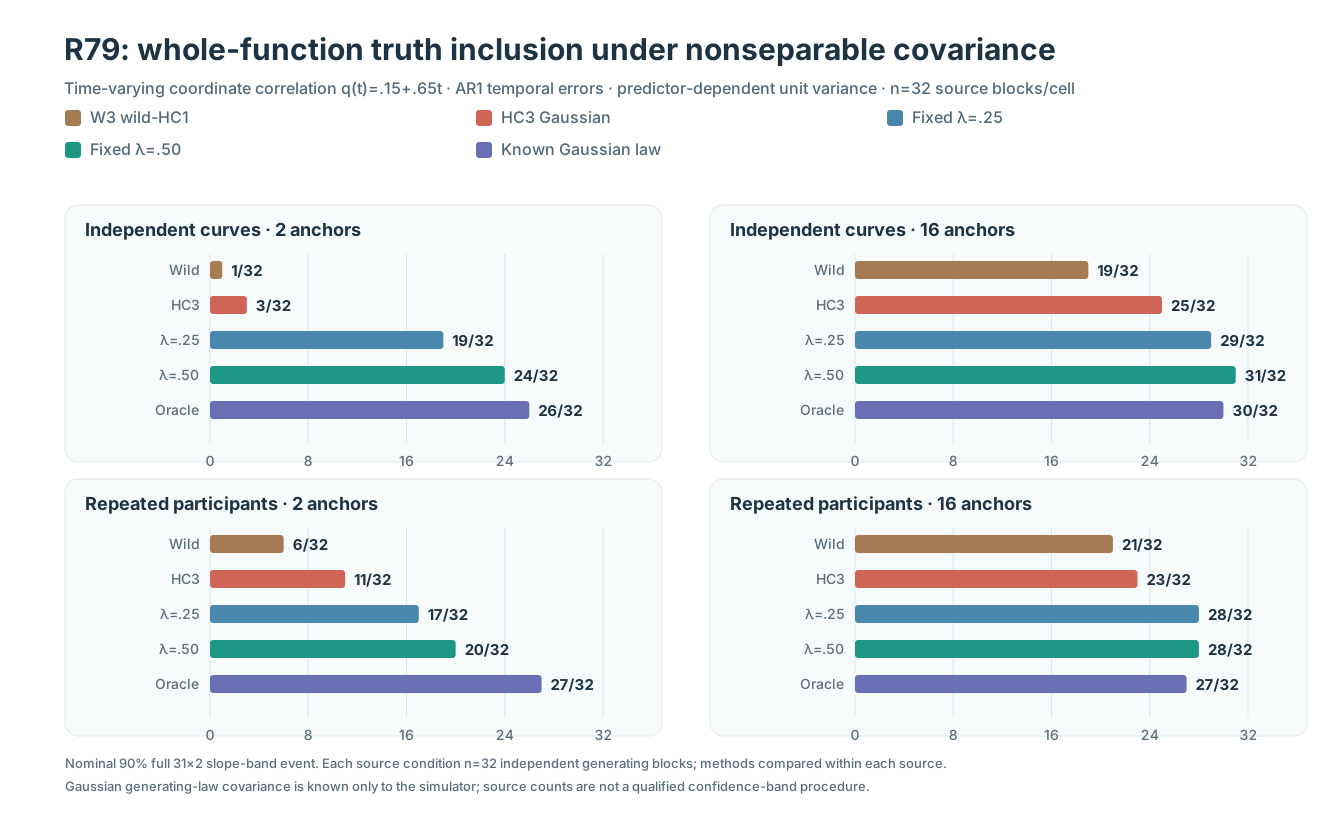
The denominator for every plotted condition is 32 genuinely new independent primitive generating blocks, not the 256 factorial cases and not 999 conditional Gaussian/wild draws.
| Predictor-dependent variance | Curves: 2 anchors | Curves: 16 anchors | Participants: 2 anchors | Participants: 16 anchors |
|---|---|---|---|---|
| Unmodified W3 wild-HC1 | 1/32 | 19/32 | 6/32 | 21/32 |
| Data-estimated HC3 Gaussian | 3/32 | 25/32 | 11/32 | 23/32 |
| Fixed HC3 regularization λ=.25 | 19/32 | 29/32 | 17/32 | 28/32 |
| Fixed HC3 regularization λ=.50 | 24/32 | 31/32 | 20/32 | 28/32 |
| Source-known Gaussian benchmark | 26/32 | 30/32 | 27/32 | 27/32 |
The constant-variance falsification cells are also part of the original complete archive. With only two independent x=±4 extremes, curves HC3, λ=.25, λ=.50 and source-known benchmark include the truth in 16, 21, 25 and 28 of 32 cases, respectively. Corresponding repeated-participant counts are 20, 26, 26 and 30. With sixteen anchors, the source-aggregated counts remain available for both laws; no result-dependent source case exclusion was made.
Figure 3: source-wise marginal-SE lower tails and Gaussian critical
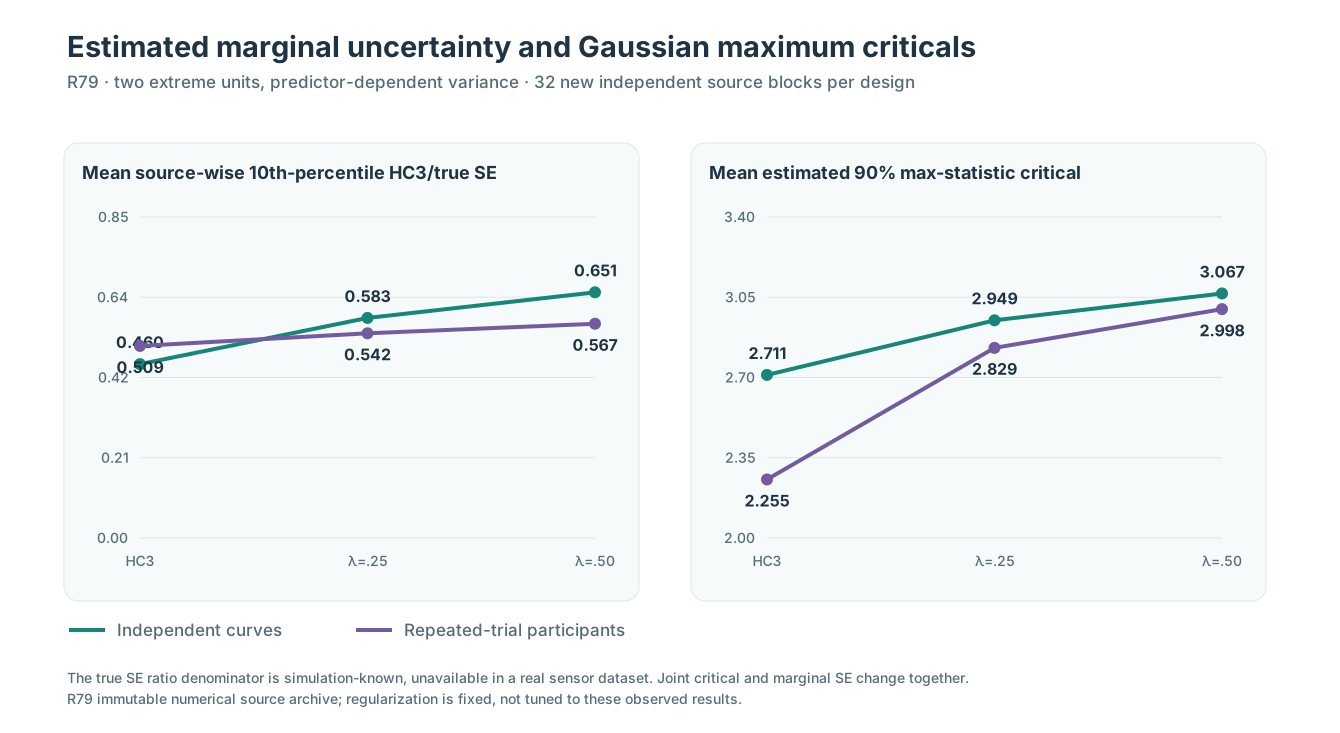
For the primary heteroskedastic two independent extreme units condition, the source-averaged within-grid 10th percentile of candidate marginal estimated/true slope SE ratios and the source-averaged Gaussian reference criticals are:
| Condition | HC3 | Fixed λ=.25 | Fixed λ=.50 |
|---|---|---|---|
| Curves estimated/true marginal SE low tail | 0.460424 | 0.582731 | 0.650528 |
| Participants estimated/true marginal SE low tail | 0.508616 | 0.542073 | 0.567355 |
| Curves estimated Gaussian critical | 2.711283 | 2.949399 | 3.066560 |
| Participants estimated Gaussian critical | 2.255382 | 2.829268 | 2.998212 |
The known Gaussian true slope SE is not available for actual recording datasets and is used here only for diagnosis. The two frozen regularization strengths change both the estimated marginal SE and the correlation/critical-value reference. These plots cannot be interpreted as a universal confidence-band algorithm comparison.
Original and independent source numerical evidence
| Evidence | Verified provenance |
|---|---|
| Prospective experiment | R79 draft PR #411; frozen source-law and estimator specifications |
| Original scientific source job | R79 workflow #39483619384: 12/12 scientific jobs passed |
| Immutable original source archive | Artifact #12292856827 |
| Pinned original simulation checkout | 15bcbe55d42579c9788cd94b9516850b6eabc1b2 |
| Mandatory separately coded replay | R79-A draft PR #412 |
| Independent source audit workflow | #39483939543: 4/4 dedicated jobs passed |
| Independent audit report | Artifact #12291983970 |
| Original source case success/failure | 256/256 complete; zero numerical refusals |
| True independent study source denominator | 32 new generating blocks per design/support/variance cell |
| Original conditional maximum-statistic archive | 256 cases × 5 references × 999 draws = 1,278,720, independently reconstructed |
| Whole-grid inclusion outcome | Binary inclusion of all 31×2 generating functional slope coordinates, one event per independent source dataset |
| Five original inferential references | Original wild-HC1; estimated HC3 Gaussian; fixed source-observable λ=.25 and λ=.50; simulator-known Gaussian joint source law |
| Scientific qualification | No general 90% simultaneous confidence validity; no real-gaze/non-Gaussian/MNAR evidence; no public inference API |
The SVG assets are vector re-expressions of the independently audited original simulation summary and analytic generating law, not newly estimated model fits. Because R78 and R79 were generated using different primitive source blocks, any across-study figure comparisons must not be misrepresented as paired source effects.
Full R79 article · Methods companion on two-dimensional gaze covariance · Previous R77–R78 ledger