Independent computational checks and F5 dependence reference — research only
Unpublished 1.2 methods. Not part of stable 1.1.0; scientific qualification and release authorization remain false.
B6/B7 computational correctness
The full B6/B7 long-chain comparison run #37969903148 completed 96/96 actual Gibbs fits (48 independent prior-generated datasets paired across 160/70 and 1200/600 warmup/draw schedules). Exact PR #253 CI passed 30/30. Even the longer fits had R-hat substantially above 1.01 and bulk effective sample sizes in the single digits for many identifiable population parameters. Therefore convergence is not qualified.
This tranche adds independent conditional algebra checks using directly stacked observation-row Gaussian regression to validate, without reuse of the sampler's sufficient statistics:
- population-mean posterior precision and mean in B6;
- rank-2 loading posterior precision including row-major Kronecker ordering;
- B7 asynchronous x/y score posterior with different channel observation counts and distinct channel noise;
- B7 loading precision across sparse participant observations;
- Gaussian precision-Cholesky draw moments against analytic covariance.
Passing these checks would establish conditional algebra correctness only, not joint posterior convergence. It neither demonstrates adequate mixing in the mean/loading/latent-score funnel nor proves frequentist coverage. After this check, the next Bayesian work remains reparameterized/ collapsed models, independent NUTS reference, chain-wise scalar SBC ranks and independent held-out recovery. No analytic conditional test alone qualifies Bayesian inference.
F5 experimental AR1 innovation-permutation comparator
The first wave's dependent F5 weak-block bootstrap showed nominal 5% null rejection 100% / 42.67% / 2.33% at block lengths 2/4/8, respectively, under stationary AR(1) phi=0.8, 300 independent nulls each. See blocker #256.
A distinct comparator at
eyetrajectoriespy.research.functional_changepoints_ar1_reference
now generates a stationary scalar-AR(1) null by permuting entire fitted
innovation vectors without replacement, and then reconstructing
ordered whole curves using an externally specified scalar phi.
This keeps gaze function-time coordinates and correlated 3D/2D channels
together, and performs no timestamp interpolation. The original
detect_ordered_functional_changepoint(...dependence="weak_block")
remains unchanged.
Critical identification limitation: test-series-only estimation
of phi is often downward biased for 36 curves and can be anti-conservative.
The new inferential comparator therefore requires a prespecified/independent
baseline phi or the actual known phi in a simulated experiment. It is
not an operational calibrated test for unknown dependence. The
separate estimate_scalar_functional_ar1() returns only a descriptive
coefficient and explicitly rejects inferential qualification.
Scientific comparison protocol: entirely fresh master seed 20261120 (not the empirical validation data from 20261009), 200 independently generated true null and 100 one-break alternative datasets for each true phi 0, .35, .8; the old weak-block (block 4, independent mode for phi=0) and the new oracle-known-phi comparator are run on the same 900 generated trajectories for a total of 1,800 tests, 199 bootstraps each. All failed fits, case-level seeds, exact Monte Carlo binomial intervals at alpha=.01,.05,.10, and SHA256 evidence are retained.
This experiment is an oracle validity check for a stronger conditional model, not a comparison that can justify routine use with unknown real-world dependence. Even satisfactory oracle null rejection must be followed by independently estimated phi uncertainty, non-AR1 dependence, sample-size and innovation-sensitivity tests before any inference qualification.
Engineering and release boundaries
The 13,600-attempt research-empirical-calibration-wave1.yml workflow has
been changed from pull-request/docs-triggered execution to manual
workflow_dispatch only. This avoids rerunning the immutable original
study for a documentation or ledger update. A new scientific study
requires a separate declared protocol and source head, not a silent replay.
The exact source-ledger in
EMPIRICAL_SCIENTIFIC_QUALIFICATION_20261009.json records the
96-fit long-chain convergence failure and the limits of these changes.
Stable/root exports are unchanged. Protected main stays unchanged
and the 1.2 research candidate is not authorized for publication.
Newly recovered F5 empirical comparison — actual independent data
Exact source run #37975560959
fit 1,800 F5 tests, with zero model exceptions. The source final
post-fit audit failed because pd.read_csv converted the scientific
"null" truth label to missing; the source artifact
11639020647 remained immutable. The descendant
recovery workflow #37976469318
passed, retained result artifact 11638977236, verified all source
SHA256 checksums, all 900 matched datasets and all 12 scenario summaries,
and refitted zero models.
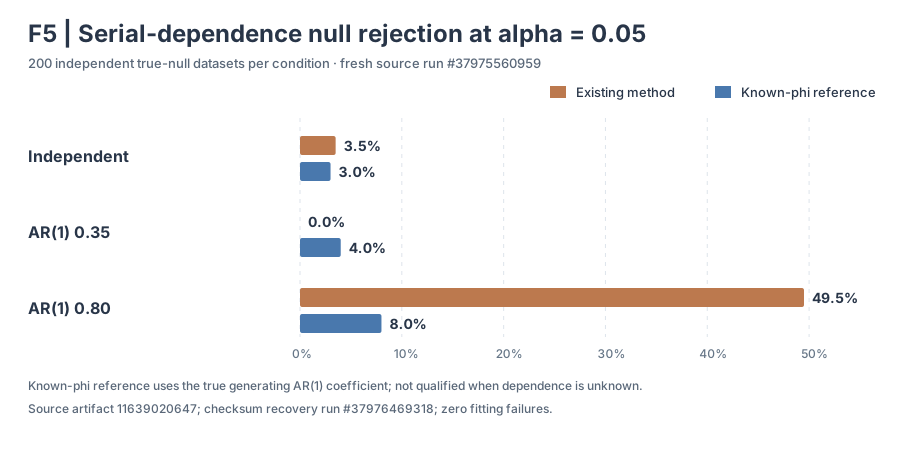
At alpha 0.05, 200 independent fresh no-change datasets per regime:
| Generator | Prior experimental method | New reference with known oracle phi | Exact 95% MC interval for reference |
|---|---|---|---|
| iid Gaussian phi=0 | 7/200 (3.5%) | 6/200 (3.0%) | 1.11–6.42% |
| weak Gaussian AR1 phi=0.35 | 0/200 (0%) | 8/200 (4.0%) | 1.74–7.73% |
| strong Gaussian AR1 phi=0.80 | 99/200 (49.5%) | 16/200 (8.0%) | 4.64–12.67% |
Under the deliberately strong one-break synthetic alternative, both comparator methods rejected 100/100 per regime. No modest effect sizes or multi-break localization qualification follows.
Scientific interpretation: the independent conditional-AR1 comparator improves false-positive behavior over the legacy block-4 bootstrap on these specific regimes. It does not achieve demonstrated nominal calibration: strong-AR1 8% has substantial MC uncertainty and the procedure used the actual known generating phi, which cannot generally be supplied for observed human gaze data. Its model assumes a single shared stationary scalar AR1 coefficient and iid whole-function innovation vectors, not arbitrary residual nonstationarity, device artifacts or hierarchical trials. The original dependent F5 test therefore remains scientifically blocked under issue #256.
Next scientific evidence must include independently baseline-estimated phi uncertainty (with no leakage from the test sequence), non-AR1 dependence stress and adequately replicated true nulls. Do not choose coefficients or bootstrap schemes merely to make the same simulated null rejection match 5%.