F5: unknown dependence from a disjoint stationary baseline — research only
Experimental reference implementation. Not a qualified inferential test, nor a replacement for the legacy functional CUSUM bootstrap.
Why a third research prototype?
The original weak-block bootstrap reported false-positive rates of
99/200=49.5% under true Gaussian AR(1) \(\phi=.8\) at nominal
\(\alpha=.05\). The known-true-\(\phi\) comparator lowered this to
16/200=8.0%, but it requires a nuisance parameter that real
eye-tracking users cannot generally know. Original fitted 1,800-test
evidence is retained in artifact 11639020647, checksum-recovered in
run #37976469318.
The new independent-baseline experimental method accepts a separate
stationary, ordered TrajectorySet with distinct participant IDs.
It estimates its scalar AR(1) coefficient, innovation distribution and
sampling uncertainty solely from that held-out baseline, not from the
tested sequence.
This separation protects the nuisance model from a change point present in the tested sequence, but requires an important real-world assumption: the independent baseline and test observations must follow a common stationary dependence law and comparable sensor/measurement conditions. This is not automatically available in ordinary eye-tracking studies.
Prespecified computational design
- Validate matched functional coordinate grid, dimensions and unique, disjoint participant IDs. Reject repeated participants, missing grids or baselines shorter than 24 curves.
- Fit a single stationary scalar AR(1) coefficient from the independent baseline, using centered whole-curve lagged least squares.
- Fit centered, whole-curve innovation residual vectors on the independent baseline. Never calculate innovation vectors from the test series.
- Run at least 99 baseline-only parametric bootstrap refits to approximate coefficient bias and estimation uncertainty. Refit coefficient in each simulated baseline. The bias-adjusted coefficient distribution is approximate and not a validated posterior.
- Generate at least 99 fully independent null trajectories by drawing one baseline-estimated coefficient and resampling baseline innovation vectors, preserving functional time/channel covariance within each innovation. Compute the unchanged whole-functional maximum CUSUM scan.
- Calculate the Monte Carlo upper-tail p-value with the \((1+k)/(B+1)\) adjustment. Return split location, null statistics, nuisance estimates/uncertainty and explicit false scientific qualification flags.
No oracle coefficient is supplied; the model is still a restrictive scalar stationary AR(1) and the bootstrap distribution is an uncalibrated approximation. A true change can also affect temporal noise; this implementation is for no-change dependence baselines, not within-trial eye movement event detection.
New-data scientific stress study
A distinct seed namespace 20261204 gives 900 independently
generated baseline/test dataset pairs: five processes ×
120 true no-change + 60 one-break alternatives. Every baseline has
80 ordered curves, and each disjoint test set has 36 curves. Methods:
- Baseline-estimated unknown-\(\phi\) AR(1) comparator, with 119 baseline nuisance-bootstrap refits and 149 null simulations.
- The original block-length-4 weak-block method (independent permutation under i.i.d. data).
- The true oracle-\(\phi\) comparator for the four processes whose generator is genuinely scalar AR(1), for benchmarking only. Never use the oracle result as a practical method.
Scenarios: i.i.d. Gaussian, weak AR(1) \(\phi=.35\), strong AR(1) \(\phi=.8\), heavy-tailed AR(1) \(\phi=.65\), and deliberately misspecified AR(2) (lag coefficients .64 and .24). The AR(2) method is a misspecification stress, not a valid AR(1) setting. The sinusoidal one-break shift is fixed in advance at 0.12 amplitude, which must not be interpreted as a general power curve.
All 2,520 actual F5 test attempts, their separate data-generating
seeds, failures, p-values, descriptive baseline coefficients, nominal
alpha .01/.05/.10 results, exact binomial Monte Carlo intervals,
and SHA256 checksums will be retained. Run
science-f5-independent-baseline-unknown-phi.yml once upon
opening the draft PR; it will not rerun for ordinary documentation
updates.
Limits and scientific qualification
The proposed baseline procedure is not supported for repeated participants, unknown nonstationarity, unequal device variance, heterogeneous within-recording serial dependence, or arbitrary autoregressive/moving-average structures. Its nuisance-bootstrap coefficient uncertainty is a first approximation, not theoretically proven unconditional size control. The simulation includes non-AR(1) and heavy-tail stress precisely to identify violations. Even a favorable Monte Carlo rate would require an independently validated coefficient uncertainty interval, longer baselines, a broader autoregressive and functional-dependence design, and a new independent validation study before declaring nominal 5% inference.
Until this evidence exists:
unknown_phi_statistical_calibration_qualified=false,
non_AR1_calibration_qualified=false,
scientific_inference_qualified=false, and
release_authorized=false.
Neither protected main, stable 1.1.0 nor the published website is
modified by this draft experiment.
Completed 2,520-fit first-wave results — conditional improvement, no qualification
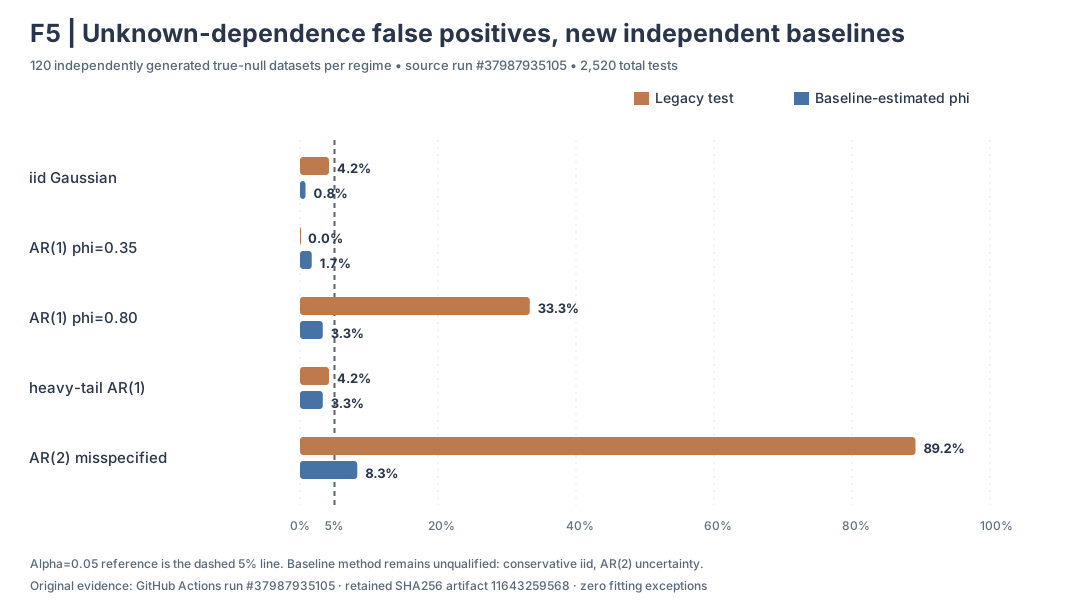
The source workflow #37987935105
ran 2,520 actual F5 tests on 900 independent baseline/test
dataset pairs (five scenarios ×120 true nulls +60 artificial
one-break alternatives), and reported zero fit exceptions.
Retained original artifact 11643259568; each attempt, simulator
seed, baseline estimated coefficient, uncertainty bounds and
p-value is available in the source archive.
The study source branch head was
c5fa4eaac180577959ad6cbcb7fbf169185b828f, before
the documentation/evidence integration commits.
| True-null generator | Legacy original (block4 except iid) | Independent-baseline estimated φ | Oracle-known φ, where defined |
|---|---|---|---|
| Iid Gaussian | 5/120 = 4.2% | 1/120 = 0.8% | 5/120 = 4.2% |
| AR(1) φ=.35 | 0/120 = 0% | 2/120 = 1.7% | 3/120 = 2.5% |
| AR(1) φ=.8 | 40/120 = 33.3% | 4/120 = 3.3% | 4/120 = 3.3% |
| Heavy-tail AR(1) φ=.65 | 5/120 = 4.2% | 4/120 = 3.3% | 3/120 = 2.5% |
| Misspecified AR(2) | 107/120 = 89.2% | 10/120 = 8.3% | Not defined |
At nominal α=.05 the independent-baseline method has lower false-positive rejection than the previous weak-block method in the tested strong AR1 and misspecified AR2 settings. For iid data, however, the estimated-coefficient null is notably conservative (0.8%), and the weak AR1 null is also below nominal (1.7%). The AR2 point estimate of false-positive probability is 8.3%; its exact 95% Monte Carlo interval (4.07%–14.79%) is wide, so the observed result alone does not establish statistically significant miscalibration relative to 5%.
Under the one-break alternatives, the new baseline method rejected 45/60 = 75.0% (strong AR1), 60/60 = 100% (weak AR1), 56/60 = 93.3% (heavy-tailed AR1), 22/60 = 36.7% (misspecified AR2), and 60/60 = 100% (iid Gaussian). Strong-AR1 oracle-known-φ rejection was 54/60 = 90%, and the misspecified AR2 legacy procedure rejected 59/60 = 98.3% while falsely rejecting 107/120 true nulls—hence high apparent alternative rejection cannot be interpreted as valid statistical power.
Scientific decision: the independent-baseline prototype has reduced the most dramatic spurious-rejection behavior, but unknown-dependence F5 significance is not qualified. Conservatism for low serial dependence, possible AR2 inflation, baseline transferability, short baseline uncertainty, hierarchical eye-tracking data, and the formal null distribution all remain unresolved. These are empirical conditional results, not a universal 5% test or a release/promotion basis.