W3 R83 original and independently audited MNAR sensitivity evidence ledger
Research-only numerical provenance · 21 October 2026
Five sensitivity values do NOT identify MNAR or qualify inference
The five outcome-dependent selection coefficients are hypothetical externally specified assumptions. True selection parameters and conditional response mean are available only in simulation. R83 supplies descriptive pointwise weighted least-squares results, no validated confidence intervals or general nominal-90% simultaneous bands. Issues #289/#296 stay open; stable 1.1.0 API unchanged, unreleased v1.2/PyPI HOLD.
Evidence identity and replication count
| Contract | Actual evidence |
|---|---|
| Prospectively frozen original source and hypotheses | Research-only draft PR #423 |
| Original dedicated science workflow | #39575847765, 12/12 successful dedicated jobs |
| Original source SHA256 archive | Artifact #12333573581 |
| Original source checkout | 4aaf792457c789b3fafd218e3dd94ae46af47e86 |
| Separately implemented numerical audit | R83-A research draft PR #424 |
| Original archive replay workflow | #39576738539, 4/4 dedicated independent jobs successful |
| Separately retained audit report | Artifact #12334118238 |
| New genuinely independent primitive source blocks | 32 per fixed unit-design/predictor-support/variance cell |
| Original complete X/Y source conditions | 256 (32×2×2×2) |
| Paired original complete/MCAR/MAR/MNAR masks | 1,024 (four per original X/Y source condition) |
| Independent audited descriptive source-analysis records | 3,328 (13 per source; NOT 3,328 independent replications) |
| Five MNAR sensitivity assumptions | δ=−1.1, −.55, 0, +.55, +1.1 |
| True simulation-only MNAR reference | Original δ=+1.1 with simulator-known true conditional mean, NOT a field-data model |
| Native public regression | Missing gaze correctly refused, not imputed |
| Real missingness inference | Not calibrated, no supported MNAR estimator, interval, or release |
The complete generating law is the R81-family independent-unit shared Student-t5 radial and centered rare asymmetric unit shock on a nonseparable two-coordinate Gaussian functional process. R83 uses new seed streams source 202610218380 and observation 202610218381, distinct from R82. The original mask uniforms are paired across complete/MCAR/MAR/MNAR mechanisms within a source.
Figure 1 — observed-only assumption sensitivity
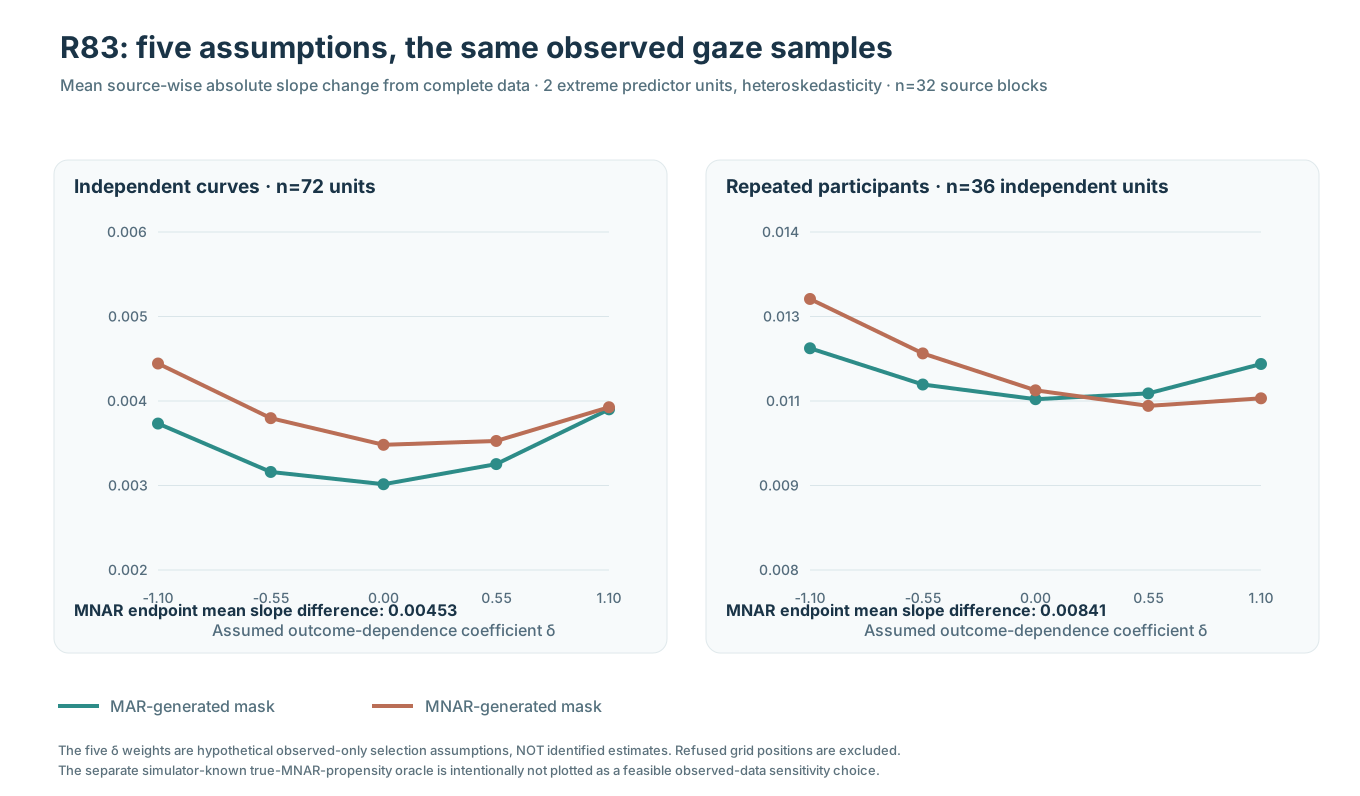
Figure 1. Mean source-specific absolute pointwise slope shift from complete data, among estimable positions, for two influential units and predictor-dependent source variance.
| Frozen assumed δ | Curves, MAR mask | Curves, MNAR mask | Participants, MAR mask | Participants, MNAR mask |
|---|---|---|---|---|
| −1.10 | .003733 | .004444 | .011936 | .012811 |
| −0.55 | .003160 | .003797 | .011293 | .011845 |
| 0 | .003015 | .003481 | .011032 | .011190 |
| +0.55 | .003253 | .003527 | .011135 | .010913 |
| +1.10 | .003901 | .003926 | .011657 | .011048 |
Within the identical MNAR mask, comparing slope functions under the two endpoint assumptions at grid positions estimable under both yields mean source absolute endpoint spread 0.004530 for curves and 0.008409 for participants. This is neither an inferential interval nor a causally identified selection effect. The source-known true-propensity oracle's mean shift from complete was .004475 curves and .011453 participants; its error does not necessarily have to be the smallest finite-source realized error.
Figure 2 — original observation retention and independent signed-anchor support
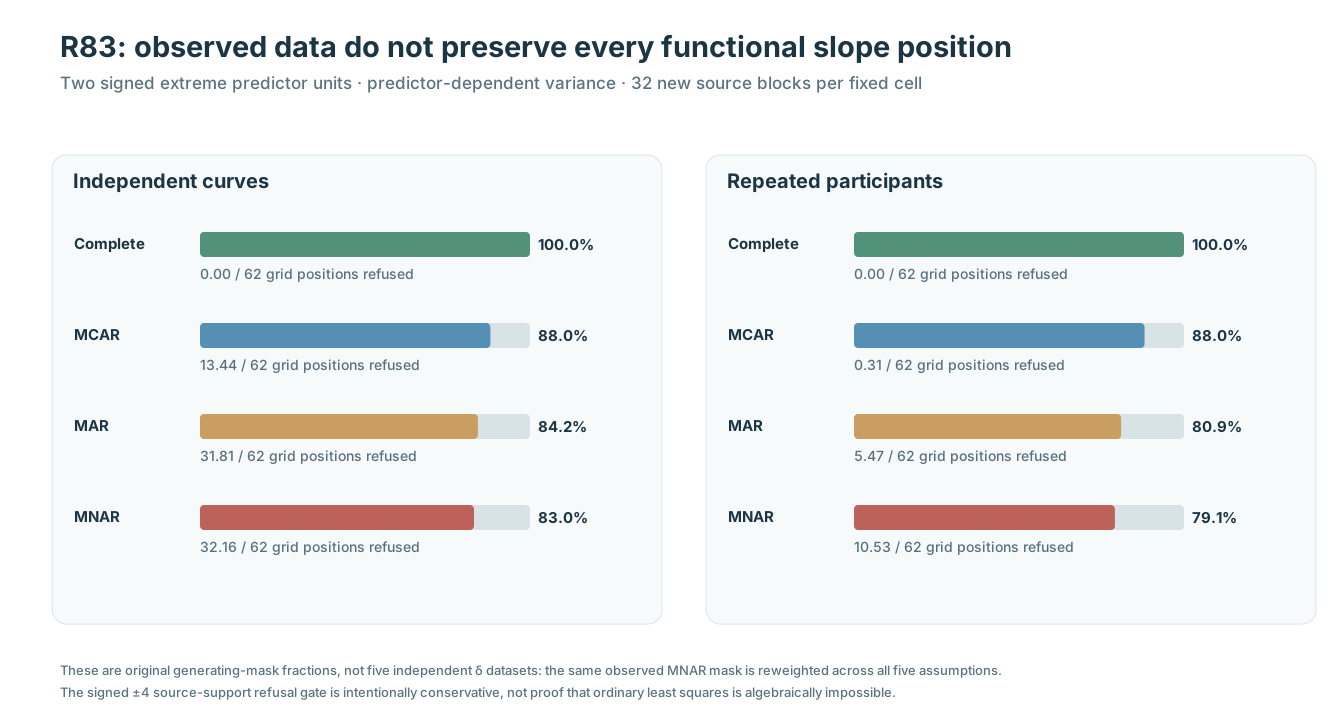
Figure 2. All sensitivity values applied to a given mask have the same observed fraction and underlying independent-unit support. Under two extreme predictor units and heteroskedasticity:
| Original source mask | Curves: fraction retained | Curves: mean refused grid /62 | Participants: fraction retained | Participants: mean refused /62 |
|---|---|---|---|---|
| COMPLETE | 1.0000 | 0.00 | 1.0000 | 0.00 |
| MCAR | .8800 | 13.44 | .8805 | .31 |
| MAR | .8423 | 31.81 | .8094 | 5.47 |
| MNAR | .8304 | 32.16 | .7906 | 10.53 |
The diagnostic refuses each of 62 grid positions without n≥8 independent units, rank-two pointwise design and both signed ±4 original predictor anchors. The oracle and weighting cannot restore unavailable signed extremes.
Figure 3 — weights and cluster information
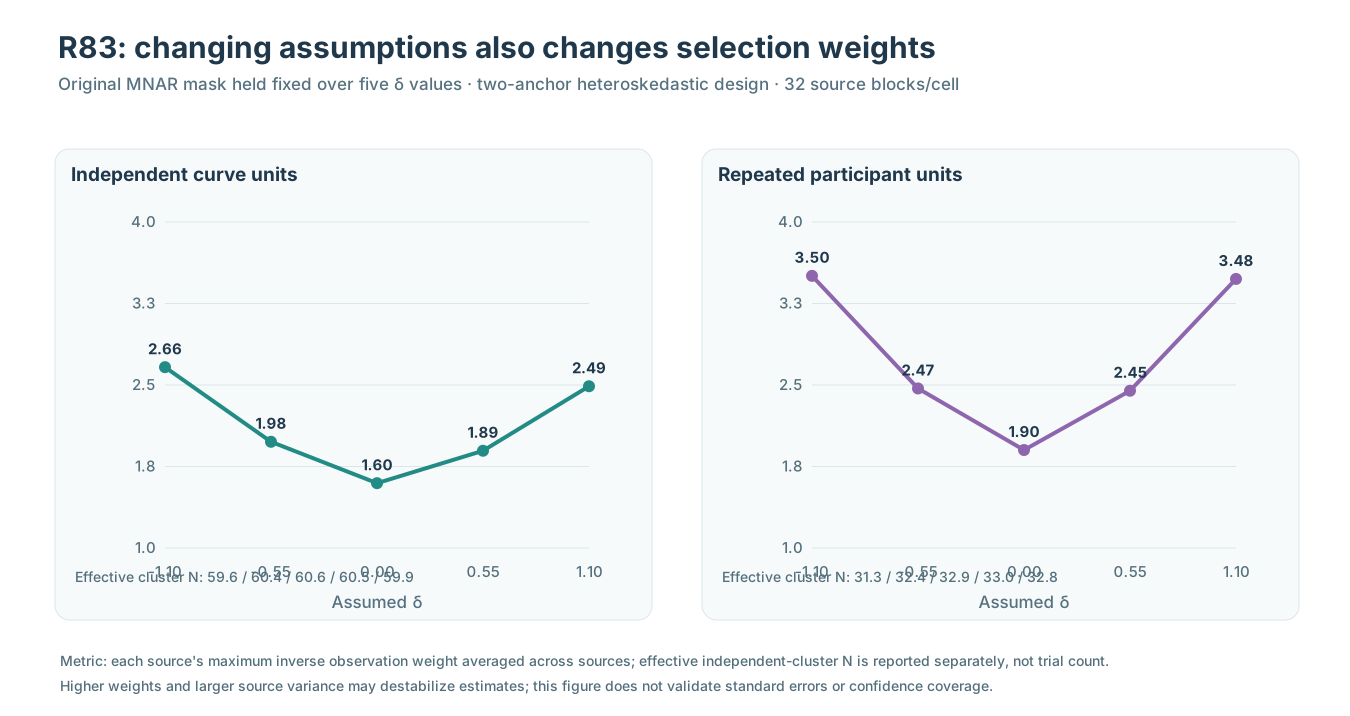
Figure 3. The missingness mask remains fixed, but weights change under the hypothetical δ. In the primary adverse MNAR condition:
| δ | Curves: mean max inverse observation weight | Curves: mean effective independent cluster n | Participants: mean max weight | Participants: mean effective cluster n |
|---|---|---|---|---|
| −1.10 | 2.664 | 59.55 | 3.504 | 31.33 |
| −0.55 | 1.977 | 60.39 | 2.468 | 32.36 |
| 0 | 1.597 | 60.64 | 1.902 | 32.86 |
| +0.55 | 1.895 | 60.50 | 2.447 | 33.02 |
| +1.10 | 2.489 | 59.89 | 3.476 | 32.76 |
Independent curve design has n=72 units; repeated-trial participant design has n=36 units. These are descriptive effective-cluster and maximum weight summaries, not calibrated uncertainty estimators.
Complete prespecified eight-cell MNAR diagnostic summary
The table reports the MNAR mask only, the δ=0 observed-only pointwise slope absolute shift from the matched complete source, and the source mean within-mask absolute endpoint slope spread for δ=−1.1 versus +1.1 on jointly estimable positions.
| True independent design | Extreme units | Error variance | MNAR observed fraction | Refused grid /62 | δ=0 mean absolute shift | Endpoint δ slope spread |
|---|---|---|---|---|---|---|
| Curves | 2 | Constant | .8334 | 31.69 | .001692 | .001396 |
| Curves | 2 | Heteroskedastic | .8304 | 32.16 | .003481 | .004530 |
| Curves | 16 | Constant | .8064 | 0.00 | .001594 | .001235 |
| Curves | 16 | Heteroskedastic | .8021 | 0.00 | .006367 | .005656 |
| Participants | 2 | Constant | .7941 | 8.69 | .003491 | .003095 |
| Participants | 2 | Heteroskedastic | .7906 | 10.53 | .011190 | .008409 |
| Participants | 16 | Constant | .7361 | 0.00 | .002066 | .002176 |
| Participants | 16 | Heteroskedastic | .7282 | 0.00 | .007858 | .008502 |
These quantities are conditioned on the mechanism-specific estimable grid, not comparable as if they were complete functional confidence-band coverage or between-law causal treatment effects. The archive separately retains all source X/Y and mask checksums, individual pilot fits, 62-grid support/refusal matrices, source absolute/signed slope errors, MCAR and MAR controls, oracle truth diagnostics, inverse weights, and original release-withheld qualification flags.
Scientific boundary and publication decisions
The independent R83-A original evidence audit reproduced each original source, each paired missingness mask and 3,328 weighted or complete-data pointwise diagnostic records, including checksums and refusal accounting, using an independent sufficient-statistic weighted-slope implementation. It establishes numerical reproducibility of this chosen simulation law and hypothetical selection family.
It does not establish that δ or the missing-outcome selection mechanism can be learned from actual gaze data; it does not provide a justified sensitivity interval with confidence guarantees, participant-cluster standard errors, valid missingness-dependent full-function uncertainty or general 90% simultaneous coverage. A simulator-known true-propensity oracle remains infeasible in field data.
No estimator code/API merge; #289/#296 OPEN, stable eyetrajectoriespy 1.1.0 unchanged, unreleased 1.2/PyPI RELEASE HOLD.
Full R83 scientific article · Methods companion · R82 observation-process source ledger