W3 functional regression: verified known-truth evidence (24 blocks)
Simulated scientific benchmark, not human eye-tracking validation
The source data are computer-generated with fixed, known functional coefficients. The experiment verifies the tested workflow and error under two stipulated generative designs; it does not establish p-value validity, confidence-interval coverage, causal identification, or generalization to real eye-tracking samples.
Original result
The original scientific workflow #38173426113
saved artifact 11715355738, containing case-ledger.json, evidence.json,
source-truth-recovery.svg, the source commit and SHA256 checksums.
The downloaded archive was independently checked against all four original
SHA256 entries. Original source artifact records the PR-merge commit
baf3a7dbcc83a94d4b9684eb1e15da111739625d; the corresponding
research PR implementation was at 9126f6bb8af5a7e32a86e21c4cc6397dc5bf9d98.
| Metric | Independent curve-level | Participant-level (3 repeated trials) |
|---|---|---|
| Independent generating blocks | 24 | 24 |
| Successfully fitted workflows | 24 of 24 | 24 of 24 |
| Source trajectories per dataset | 72 | 108 |
| Independent inference units per dataset | 72 curves | 36 participants |
| Mean RMSE of estimated condition function | 0.0088577 | 0.0270639 |
| Largest observed RMSE | 0.0104314 | 0.0455377 |
| Largest absolute deviation from independent OLS | 5.55 × 10⁻¹⁶ | 5.55 × 10⁻¹⁶ |
| Prespecified exploratory RMSE criterion (≤0.12) | 24 of 24 passed | 24 of 24 passed |
The 48 fitted cases are not 48 independent generating blocks: each replicate index is paired across the two source-design variants.
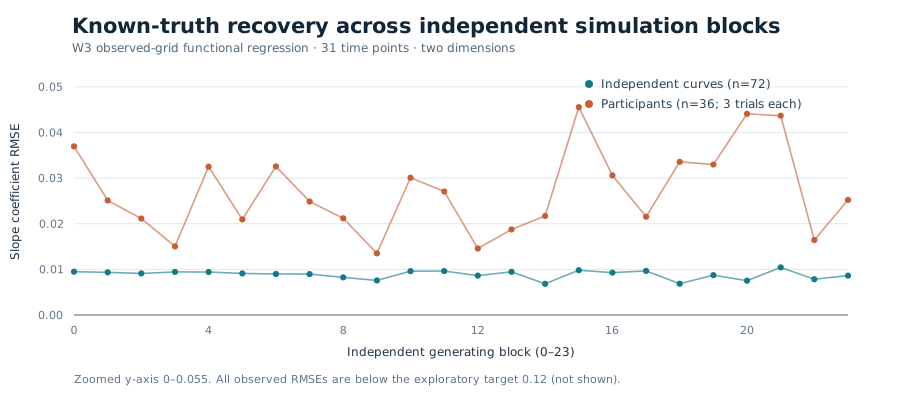
Original source-ledger visualization redrawn from the 48 verified case-level RMSE values (rounded to seven decimal places). The vertical scale is deliberately zoomed to 0–0.055 to distinguish the observed values; the exploratory target of 0.12 is off-scale and is not drawn. This is not an accuracy comparison between estimators: both designs use the same OLS model but different independent units and noise structures.
Scientific interpretation
The coefficient functions are known before model fitting. An independent
numpy.linalg.lstsq computation on the specified design matrix and
manually constructed participant-averaged responses serves as a numerical
oracle, rather than relying only on the package's direct estimator.
At every coefficient, time point, and dimension the workflow agreed with
this oracle to numerical precision. Recovery errors relative to known truth
are not zero when independent noise or participant effects are present.
The repeated-trial case contains a smooth participant-level random intercept; condition is participant-constant and each participant's three trajectories are averaged first. No claim is made that treating the 108 trials as independent units would produce correct inference.
Limitations: This study does not test robust HC1 standard error calibration, wild-bootstrap simultaneous bands, nominal interval coverage, sparse observation, nonignorable missingness or real eye-tracking device quality. Exploratory RMSE threshold selection is not a hypothesis test. See the prespecified protocol and the downloadable original scientific artifact for verification.
The stable distribution remains 1.1.0; 1.2.0rc2.dev0
remains unpublished development code and all publication safeguards remain
disarmed.