B6/B7: exact score-integrated joint loading elliptical-slice research
Experimental opt-in only. Native Gibbs defaults and published stable 1.1.0 are unchanged. This programme follows the independently validated score-marginal likelihood in the PyMC/NUTS reference and the observed native covariance R-hat/ESS failures. It does not assert scientific posterior calibration.
Numerical transition
Under the fixed-rank Gaussian factor model, for each independently observed participant i and native coordinate channel d, let G_id = B_id.T B_id, c_id = B_id.T y_id, mu_d be mean coefficients, L_d the Gaussian-prior loading matrix, and sigma_d fixed observation noise. Integrating all participant scores z_i ~ N(0,I), the loading-dependent marginal log-likelihood is
This excludes terms constant in loading for a fixed mean, not terms needed for Bayesian comparison across different values of the mean. The B6 (single-channel) and B7 (joint planar, paired/asynchronous native timestamps) likelihoods use the same independent participants, original Gram matrices and observation noise, without interpolation. Unlike per-channel L|mu,z,Y Gibbs, the joint elliptical-slice step targets L|mu,Y with all scores integrated. Its elliptical prior direction preserves the unchanged multivariate Gaussian loading prior exactly, without tuning an acceptance probability.
After joint loading update, the existing exact score-integrated population mean conditional is drawn (when the pre-existing option is selected), followed by independent Gaussian participant-score conditionals z|mu,L,Y. This partial-collapse sequence maintains the joint target. The prior mu,L,z, factor rank, coordinate basis, likelihood, and stable non-ESS defaults are unchanged. Extensive coverage and independent posterior agreement are not yet established.
First-wave test design
- Independent dense multivariate Gaussian likelihood differential tests for B6 rank 1, B7 rank 1, and B7 rank 2, so there is a separate mathematical reference rather than solely testing against the native sampler.
- Python 3.11–3.13 reference, invalid-argument, deterministic ESS, paired/asynchronous and nonpublication-gate checks.
- 36 actual fitted native posteriors, derived from 18 new independent known-prior datasets: B6 rank 1, B7 rank 1 paired and B7 rank 1 asynchronous × six truth replicates × two options (existing exact collapsed-mean Gibbs versus joint score-marginal loading ESS).
- Two chains, 350 warmup sweeps + 250 posterior draws per fit, with preregistered R-hat, bulk and tail ESS on the identifiable midpoint mean and covariance, failure counts, known truth and marginal 90% interval inclusion. ESS work counts are captured; no failed cases are discarded.
- Original per-design case CSVs, scientific ledgers and SHA256 checksums are retained and subsequently cross-audited before interpretation.
This is a small diagnostic mixing pilot. Its 90% truth inclusion counts are not nominal credible-interval coverage evidence. R-hat ≤ 1.01 and bulk ESS ≥ 400 are predeclared per-chain functional diagnostic screens, not grounds for release qualification or architecture promotion. Fitting success, posterior mean similarity or source CI passing do not certify convergence. The independent full PyMC/NUTS posterior comparisons remain a separate reference.
Gates
score_marginal_loading_ess_experimental_opt_in=false by default; score_marginal_loading_ess_scientifically_qualified=false, posterior_mixing_scientifically_qualified=false, and release_authorized=false. Keep scientific blocker #255 open until independent SBC and rank-two functional covariance validation after adequate sampling are completed.
First-wave empirical mixing results (36 actual fits)
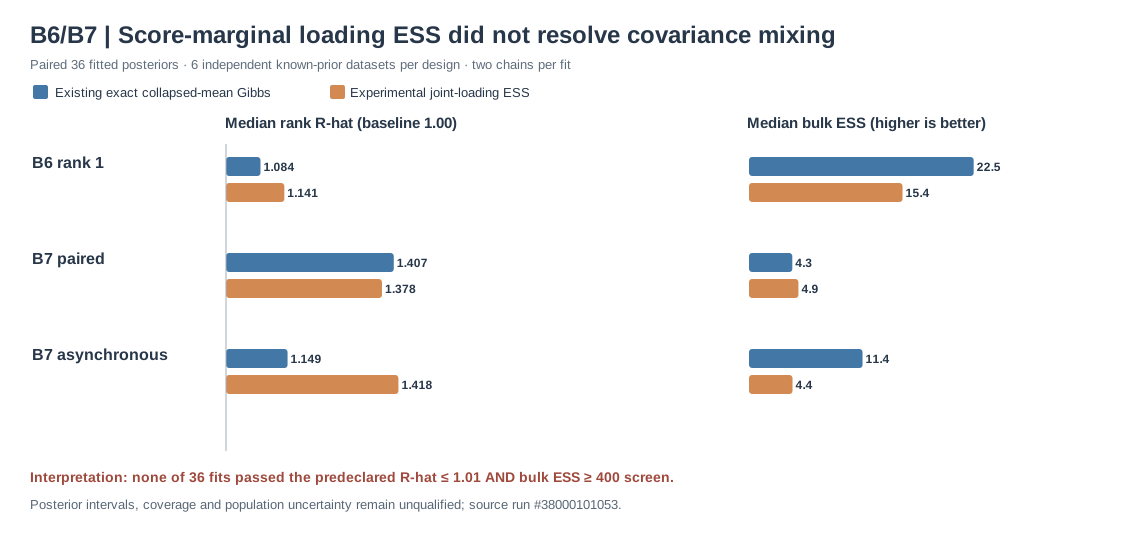
The corrected original science workflow #38000101053 completed all 36 true native fitting attempts (three designs × six independent matched prior-generated datasets × two methods), with zero errors in the three actual fitting shards. The unit-test matrix independently verified the marginal Gaussian algebra on Python 3.12 and 3.13 at the time of this evidence update; Python 3.11 and source-combined audit were still pending. Source design-specific artifacts: B6 11649540044, paired B7 11649325340, asynchronous B7 11648876398.
| Design | Original collapsed mean: median covariance R-hat / bulk ESS | Joint score-marginal loading ESS: median covariance R-hat / bulk ESS |
|---|---|---|
| B6 rank1 | 1.084 / 22.5 | 1.141 / 15.4 |
| B7 rank1 paired | 1.407 / 4.3 | 1.378 / 4.9 |
| B7 rank1 asynchronous | 1.149 / 11.4 | 1.418 / 4.4 |
No individual fitting dataset passed the prespecified joint identified covariance mixing screen (rank R-hat <= 1.01 and bulk ESS >= 400). The opt-in joint loading ESS therefore did not reliably improve covariance mixing. It exhibited a slight paired-B7 improvement and worse B6/asynchronous behavior within this limited data-generating design. The 90% posterior covariance intervals contained their known truth in 6/6 versus 5/6 (B6), 5/6 versus 4/6 (B7 paired), and 5/6 versus 5/6 (B7 asynchronous), in the order original versus new ESS. These n=6 counts are descriptive, not valid frequentist posterior coverage evidence.
Scientific decision: retain this exact transition as an optional research comparator with its default False. Do not adopt it as a mixing remedy, select its hyperparameters based on these results, or certify population uncertainty. Investigate the actual posterior geometry and noncentering/parameter expansion against the independent NUTS posterior, with longer chains and rank-invariant diagnostics. Release and inferential gates remain false.