B6/B7 R1: six four-chain independent NUTS references — experimental evidence
Diagnostic success is not posterior-interval qualification
Published stable: eyetrajectoriespy 1.1.0. This page documents six synthetic, prior-generated datasets fit by a separately implemented, unpublished experimental Bayesian reference. The original research code remains on draft PR #271. A green source workflow, well-mixed chains, and isolated truth-inclusion checks do not establish nominal credible-interval coverage, rank-two validity, production readiness or a 1.2 release.
Original completed source experiment
The exact-head scientific run #38047872726, on research commit ca20b142dc5f3e28bd314cd5a65b74fee27567bd, completed 10/10 scientific jobs, six out of six actual PyMC/NUTS posterior fits, zero fitting failures, and a checksum-verified cross-shard evidence audit. The full PR head also passed 26/26 engineering workflow groups. These are six independent datasets, not a six-draw posterior-calibration study or a human-participant sample.
Each design—B6 sparse univariate, B7 paired planar, and B7 asynchronous planar—has two new independently prior-generated rank-one datasets (18 synthetic participants each). Every reference fit uses four chains, 1,200 tuning iterations, 800 retained iterations per chain, the matched score-marginalized Gaussian likelihood and priors, and no native Gibbs posterior transitions.
The prespecified population diagnostics cover six B6 functionals or fifteen B7 functionals per dataset at the evaluation grid quarter, midpoint, and three-quarter: population means, variances, and where applicable x/y cross-covariances. Raw factor-loading sign diagnostics are not the inferential target.
Identifiable population convergence
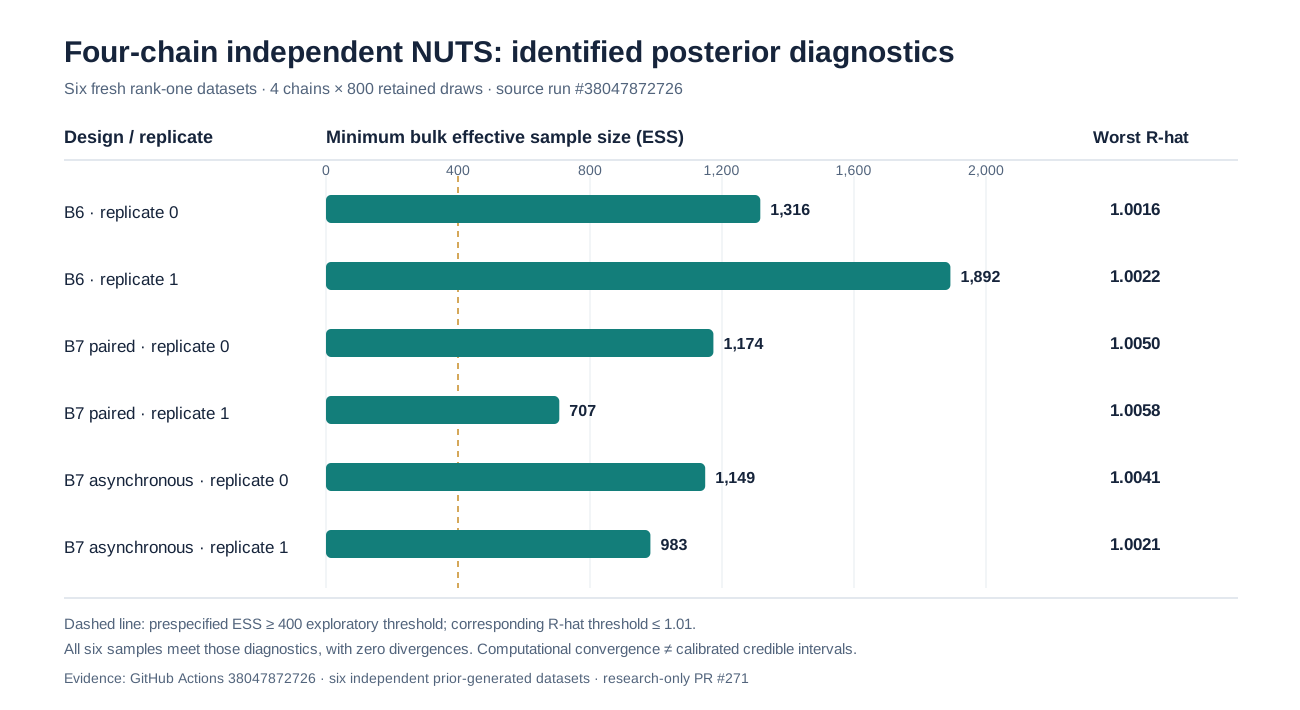
| Generating design | Dataset replicate | Worst rank R-hat | Minimum bulk ESS | Minimum tail ESS | Divergences | Exploratory screen |
|---|---|---|---|---|---|---|
| B6 univariate rank 1 | 0 | 1.0016 | 1,316 | 1,470 | 0 | Pass |
| B6 univariate rank 1 | 1 | 1.0022 | 1,892 | 1,510 | 0 | Pass |
| B7 paired rank 1 | 0 | 1.0050 | 1,174 | 1,265 | 0 | Pass |
| B7 paired rank 1 | 1 | 1.0058 | 707 | 923 | 0 | Pass |
| B7 asynchronous rank 1 | 0 | 1.0041 | 1,149 | 1,125 | 0 | Pass |
| B7 asynchronous rank 1 | 1 | 1.0021 | 983 | 1,430 | 0 | Pass |
Rounded results are recalculated from the individual original ACTUAL FOUR CHAIN CASE JSON records printed by the six scientific jobs. The worst R-hat is the maximum, and minimum ESS the minimum, across the prespecified identified functionals within each dataset. An exploratory screen requires rank R-hat ≤ 1.01, bulk and tail ESS ≥ 400, BFMI ≥ 0.3 and zero divergences. All six fits passed; minimum observed chain-energy BFMI was approximately 0.770. The sampler also recorded actual ArviZ spectral MCSE, chain-mean comparisons and within-chain half shifts. There is no qualification flag promoted by these diagnostics.
Truth inclusion is not nominal coverage
The original case evidence reports whether each function-specific marginal 90% posterior interval includes one generating truth. Two B6 datasets each had 5 of 6 functionals include truth; the B7 paired datasets had 14/15 and 15/15; both asynchronous B7 datasets had 15/15. Those 72 dependent function-specific intervals arise from only six independent datasets, so their pooled inclusion frequency is not a 90% coverage estimate. Their correlation across time, outputs and participants prevents treating them as independent Bernoulli trials. A few missed true values are entirely compatible with valid intervals and also insufficient to prove validity.
This four-chain evidence supports a more credible rank-one reference computation for the studied functionals, not a final posterior or scientific uncertainty contract. It differs from the earlier nine-fit native Gibbs / elliptical-slice / two-chain NUTS pilot, which showed poor covariance mixing in both native samplers. R1 does not directly compare computational efficiency with native Gibbs and does not establish that their posterior targets differ.
Execution cost and audit boundaries
The retained source records include full fit wall-clock time including compilation, tuning and sampling, from approximately 13–45 minutes per fit, and identifiable ESS per full-fit second. They do not provide a native-versus-NUTS compute-matched benchmark or measured peak process memory; the reference used two compute cores per job with four chains. Do not interpret this as a performance superiority claim over the native implementations.
| Dataset | Original GitHub Actions evidence artifact |
|---|---|
| B6, replicate 0 | 11668966823 (four-chain-B6_rank1-0) |
| B6, replicate 1 | 11668806792 (four-chain-B6_rank1-1) |
| B7 paired, replicate 0 | 11669205610 (four-chain-B7_rank1_paired-0) |
| B7 paired, replicate 1 | 11669865251 (four-chain-B7_rank1_paired-1) |
| B7 asynchronous, replicate 0 | 11669408373 (four-chain-B7_rank1_asynchronous-0) |
| B7 asynchronous, replicate 1 | 11669423841 (four-chain-B7_rank1_asynchronous-1) |
Artifacts are available through the original source-run page while GitHub retains them. The figure is constructed only from the six exact-source diagnostic summaries and is not a new fitting experiment.
Scientific decision: keep the gates closed
The next independent scientific gates remain rank-two posterior likelihood and diagnostic checks; prior-generating rank-based simulation calibration across many fresh datasets; repeated-simulation 90% interval coverage at controlled Monte Carlo error; posterior predictive calibration; matched-compute runtime and memory comparison; and independent real-data studies. These should be prespecified and retain failed fits and nonconverged draws. There is no justification yet for silently selecting a production NUTS backend, retiring native Gibbs, or exposing experimental covariance uncertainty as validated inference.
Scientific blocker #255 remains open; F5 dependence blocker #256 is unaffected. Research source PR #271 remains separate from protected main. Release and scientific-promotion flags remain false.