B6/B7 exact partially collapsed Gaussian population mean Gibbs
Unpublished 1.2 research. No inference qualification, stable API promotion, protected-main merge or release authorization.
The B6/B7 first 400-refit prior-truth study showed substantial undercoverage of nominal 90% population intervals. A 96-fit longer-chain study (1,200 warmup/600 retained draws) still had many R-hat ≈ 1.2–1.6 and minimum ESS around 3–6, even for identifiable population summaries. An exact reversible MH factor-scale proposal subsequently proved mathematically valid but showed no consistent mixing improvement in 72 real paired fits. See scientific blocker #255.
Mathematical rationale: eliminate mean/score conditional coupling
For sparse B6 participant observations:
The exact conditional distribution of the mean after integrating all participant scores is
This is still the same model and prior posterior. Rather than inverting an observation-sized matrix, Woodbury gives these terms using the existing raw-observation Gram matrices and their cross products:
For B7, the mean is a joint 2q-dimensional vector in x-then-y channel order. Each participant's shared latent score creates nonzero cross-channel precision blocks after integration:
The joint precision subtracts \(H_iT_i^{-1}H_i^\top\) from the two-channel block-diagonal observation precision. Thus B7 does not approximate x/y as independent or interpolate disjoint observation timestamps.
Valid Gibbs update order
The opt-in sampler now applies these conditionals in a valid partially-collapsed sequence: loadings given old mean and scores, mean given loadings with scores integrated out, then participant scores given the newly sampled mean and loadings.
This ordering matters; casually inserting a collapsed step before the old conditional loadings would not be the same Gibbs transition and could fail to preserve the joint posterior.
New optional argument:
collapsed_population_mean_update=True in the experimental
B6/B7 fitter only. Its default remains False; explicitly False
and omission must yield bit-identical original posterior draws.
Factor ranks, priors, fixed observation noise and observation models
remain unchanged. Every evidence object exposes
collapsed_mean_inferential_qualification=False.
Independent math proof checks and empirical study
tests/test_bayesian_partially_collapsed_mean.py compares the
Woodbury precision and right-hand side to independently formed
dense marginal Gaussian likelihoods, including B7 with
different x/y observation counts, cross-channel precision,
and real native asynchronous refits.
A dedicated study, executed once on the draft PR's initial
opening, runs 72 real paired full Gibbs fits on 36 new
matched-prior independent datasets, six per six scenario combinations,
each with and without the collapsed-mean update.
The pilot uses 400 warmup sweeps, 200 retained draws/chain,
and reports invariant R-hat/ESS, failures and scalar posterior
coverage without promoting a result. Same participant observations,
noise, rank and priors are used for the two samplers, and new independent
master seed 20261126 is separate from prior study seeds.
Scientific interpretation boundary: correct conditional posterior algebra is necessary but not sufficient for full posterior mixing. If this trial improves diagnostics, further independent NUTS, rank-based SBC and hundreds of longer-chain posterior coverage refits are still required. If it fails, document the negative evidence, do not advertise the opt-in route as an inference fix, and retain the original blocker. All statistical and 1.2 release flags remain false.
Actual first paired posterior experiment: qualified algebra, better mixing in some cases
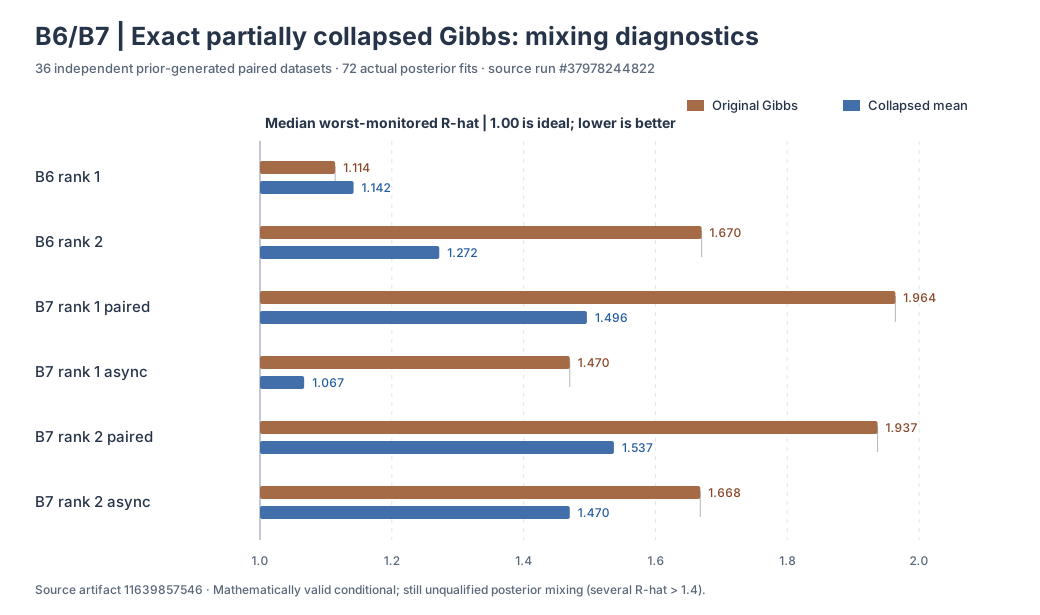
Workflow #37978244822
completed 72/72 actual Gibbs refits, six independent prior-generated
datasets per each of six B6/B7 scenarios, each refitted under original
and collapsed-mean kernels (36 independent dataset pairs). All three
Python 3.11/3.12/3.13 independent dense Gaussian marginal algebra
jobs passed, and all real Gibbs fits completed with zero failures.
Retained source artifact: 11639857546.
Median worst monitored R-hat (lower is better) and median minimum bulk ESS (higher is better) from identifiable population summaries were:
| Scenario | Worst R-hat original → collapsed | Minimum bulk ESS original → collapsed |
|---|---|---|
| B6 rank 1 | 1.114 → 1.142 | 12.68 → 13.43 |
| B6 rank 2 | 1.670 → 1.272 | 3.46 → 6.29 |
| B7 rank 1 paired | 1.964 → 1.496 | 2.90 → 4.03 |
| B7 rank 1 asynchronous | 1.470 → 1.067 | 4.07 → 15.35 |
| B7 rank 2 paired | 1.937 → 1.537 | 2.92 → 3.81 |
| B7 rank 2 asynchronous | 1.668 → 1.470 | 3.42 → 4.19 |
The exact partially collapsed procedure substantially improves several difficult scenarios, especially the rank-1 asynchronous planar population mean. This is a genuine computational finding, but most rank-2 and paired settings retain very poor R-hat/ESS; the proposed new Gibbs route remains scientifically unqualified. The collapsed route is opt-in and the legacy/default sampler remains unchanged.
Empirical 90% coverage in this pilot has only six dataset replicates per regime and cannot justify a population-coverage conclusion. In particular, even a median R-hat close to 1.07 does not certify convergence of all the high-dimensional covariance functionals. A separate independent posterior NUTS implementation/reference, parameter-mixing study, rank-based SBC and hundreds of longer-chain coverage refits are still required. The scientific blocker #255 remains open and no 1.2 release is authorized.