Spatial accuracy is not event reconstruction
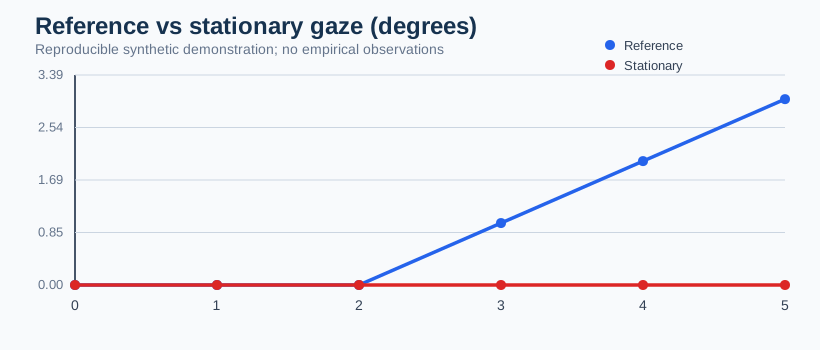
Research implementation, October 2026. Reference angles and labels must come from an independent, suitably synchronized source.
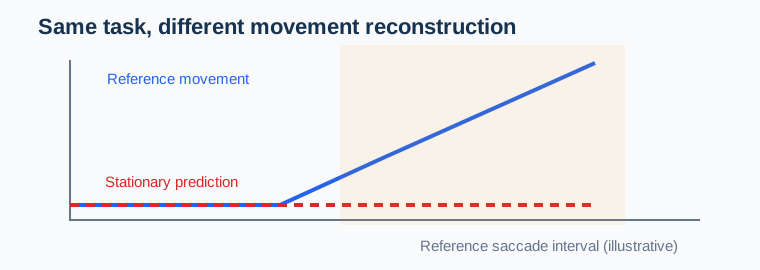
The experimental function event_reconstruction_audit() requires matched timepoints, participant/trial identity, gaze coordinates in degrees and reference fixation/saccade intervals. It reports mean and median angular error, fixation-centroid error, saccade-amplitude error and saccade-direction error.
Run an intentionally bad model
import pandas as pd
from research.october_2026.event_reconstruction import event_reconstruction_audit

reference = pd.DataFrame({
    "participant_id": ["P1"] * 6,
    "trial_id": ["T1"] * 6,
    "time_s": [0, 1, 2, 3, 4, 5],
    "x_deg": [0, 0, 0, 1, 2, 3],
    "y_deg": [0] * 6,
    "event": ["fixation"] * 3 + ["saccade"] * 3,
})
predicted = reference.drop(columns=["event"]).copy()
predicted["x_deg"] = 0  # Invalidly stationary model
result = event_reconstruction_audit(reference, predicted)
print(result["event_geometry"])
An apparent low average spatial error does not justify scanpath or saccade validity. A stationary predictor has zero reconstructed saccade amplitude and undefined direction. Undefined direction is retained as missing rather than replaced by an arbitrary zero.
Original reproducible plot
import matplotlib.pyplot as plt
fig, ax = plt.subplots(figsize=(7, 3))
ax.plot(reference.time_s, reference.x_deg, "-o", label="Reference")
ax.plot(predicted.time_s, predicted.x_deg, "--s", label="Stationary estimator")
ax.axvspan(3, 5, alpha=0.1, label="Reference saccade")
ax.set(xlabel="Synthetic time (s)", ylabel="Horizontal gaze (degrees)")
ax.legend()
fig.tight_layout()
confidence_threshold_audit() additionally reports acceptable-error fractions for a vendor score separately by participant. These empirical descriptive fractions are not calibrated cross-participant probabilities. Scores require real target-validation error records before any QC interpretation.
Outstanding validation
Real reference-gaze datasets, calibration geometry, participant-disjoint uncertainty, event-boundary detection agreement and external-device checks are required before scientific promotion. The displayed curves are illustrative, not empirical gaze measurements.
Publication and qualification status (21 October 2026)
This page and its original synthetic figures are merged into the GitHub documentation source. The worked research modules are under research/october_2026/ and are not automatically included in installed PyPI wheels or exported as stable package APIs. Their empirical accuracy, device transfer and inferential calibration are not implied by a green CI test or a successful website build.
The explicit outstanding scientific acceptance criteria and eligible real-data benchmarks are tracked in research-to-release issue #41. This source-only research contribution is separate from the existing stable package version, and a new maintenance release must not claim these experiments as installed features.