AOI robustness reporting bundle
A reporting bundle turns one sensitivity result into a reviewable evidence package rather than a single summary paragraph. The bundle should preserve the analysis plan, branch audit, assignment summaries, model outputs, failures, provenance, report text, and the figures used to interpret robustness.
Recommended file set
| File | Purpose |
|---|---|
analysis-plan.yml |
prespecified perturbation/model/failure plan |
perturbation-audit.csv |
planned branches, completion status, geometry failures |
assignment-stability.csv |
unchanged/new/lost/reassigned summaries |
assignment-table.csv |
observation-level branch assignments |
assignment-frequency.csv |
empirical assignment frequencies across declared branches |
model-results.csv |
branch-level coefficient, interval, convergence, and N |
inference-stability.csv |
term-level robustness summary |
failures.csv |
retained geometry/model failures |
provenance.json |
source/AOI hashes, preprocessing, detector, model, software, caveat |
report.md |
compact manuscript-oriented narrative |
aoi-*.svg |
geometry, assignment, and coefficient diagnostics |
manifest.json |
stable paths, roles, byte sizes, and SHA-256 hashes |
Why bundle the evidence?
A coefficient trajectory alone does not show whether a branch failed, whether model N changed, whether an assignment became ambiguous, or whether the analysis plan changed after results were inspected. The bundle keeps those layers together.
Use the bundle for:
- manuscript supplements;
- reviewer/editor responses;
- internal analysis handoff;
- release evidence;
- replication packages.
Deterministic manifest
The worked Python example writes manifest.json without timestamps. Each file except the manifest itself has a stable role, byte count, and SHA-256 hash. Re-running the same writer on identical inputs therefore yields the same manifest.
The manifest is not a scientific validity certificate. It verifies bundle identity and file integrity; interpretation still depends on the declared AOI envelope, data quality, estimator, and study design.
Recommended figure set
A compact reviewer/manuscript bundle usually needs three visuals:
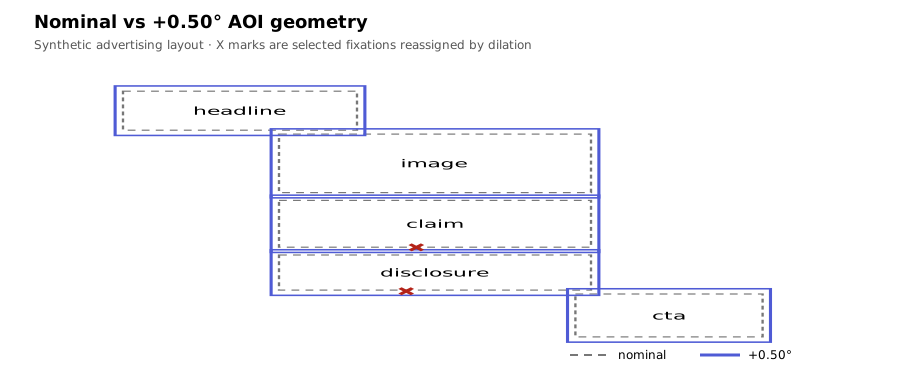
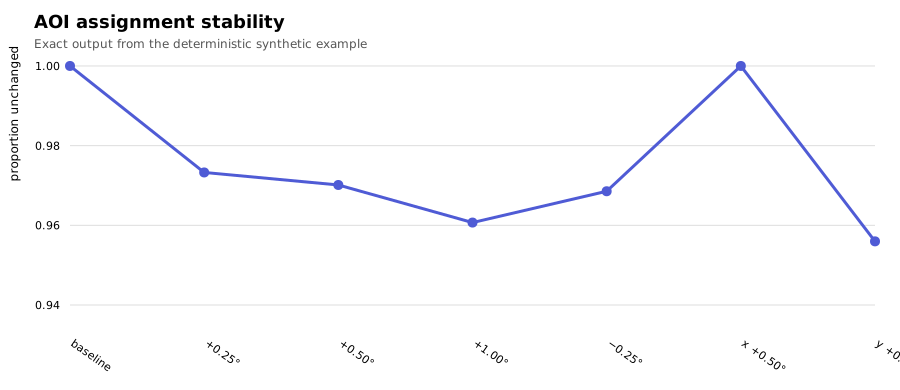
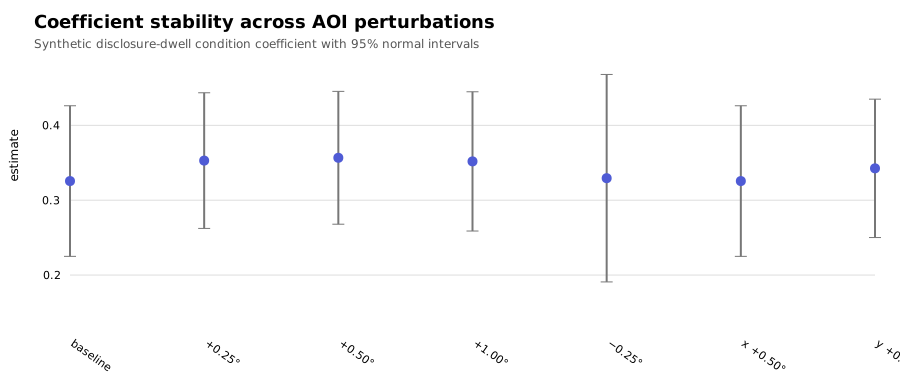
Add the robustness surface when two-dimensional perturbations are substantively important rather than automatically including every available plot.
Reviewer-facing reading order
- Read
analysis-plan.ymlto see what was fixed before branch results. - Inspect
perturbation-audit.csvandfailures.csvfor non-evaluable branches. - Inspect
assignment-stability.csvand the geometry/assignment figures. - Inspect
model-results.csvandinference-stability.csv, including model N. - Read
provenance.jsonfor preprocessing, detector, model, and software context. - Use
report.mdas the narrative summary, not as a substitute for the tables above.
Interpretation
A complete, internally consistent bundle supports a claim such as “stable within the declared perturbation envelope.” It does not establish that the nominal AOI boundaries are objectively correct, that calibration error is negligible, or that the statistical conclusion is true with some probability.
Limitations
- File hashes prove identity, not scientific correctness.
- A bundle cannot rescue an implausible perturbation plan.
- Geometry sensitivity does not replace detector, calibration, missingness, or model-diagnostic sensitivity.
- Large observation-level tables may need privacy review before external sharing.
- If the analysis plan changes, preserve both plan versions and document the amendment.
Continue to the worked reporting bundle, analysis plan, reporting guidance, troubleshooting, and API reference.