Worked example: AOI perturbation sensitivity
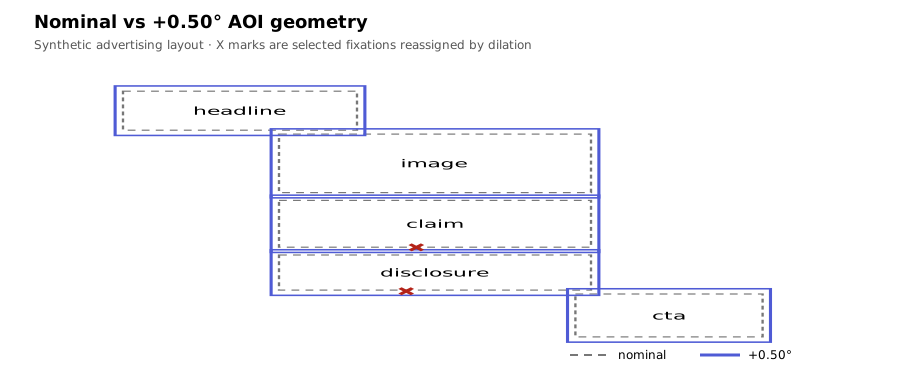
This fully synthetic example uses a five-region advertising/interface layout:
The executable source is examples/aoi_perturbation_sensitivity.py. No private or empirical participant data are used.
Perturbation plan
The example evaluates the nominal AOIs plus:
- +0.25° dilation;
- +0.50° dilation;
- +1.00° dilation;
- −0.25° through erosion;
- +0.50° horizontal translation;
- +0.50° vertical translation.
grid = ep.create_aoi_perturbation_grid(
    dilations=[0.25, 0.50, 1.00],
    erosions=[0.25],
    translations_x=[0.50],
    translations_y=[0.50],
    unit="deg",
    screen_width_px=1024,
    screen_height_px=768,
    viewing_distance=60,
    physical_screen_size=(53.1, 29.9),
    boundary_policy="allow",
)
Run assignment, features, and the fixed model callback
result = ep.run_aoi_sensitivity_analysis(
    fixations,
    aois,
    grid,
    x_col="x",
    y_col="y",
    observation_id_col="obs",
    participant_col="participant",
    trial_col="trial",
    duration_col="duration",
    time_col="time",
    observation_level="fixation",
    overlap_policy="ambiguous",
    model_callback=explicit_ols_callback,
)
The same illustrative disclosure-dwell model is used for every branch. The perturbation framework does not select or change the estimator.
What the example recomputes
- dwell;
- fixation count;
- first fixation;
- disclosure inspection;
- row-level AOI assignments;
- participant/trial/AOI stability;
- coefficient estimates, intervals, direction, and convergence.
Visual diagnostics
Geometry and reassigned fixations
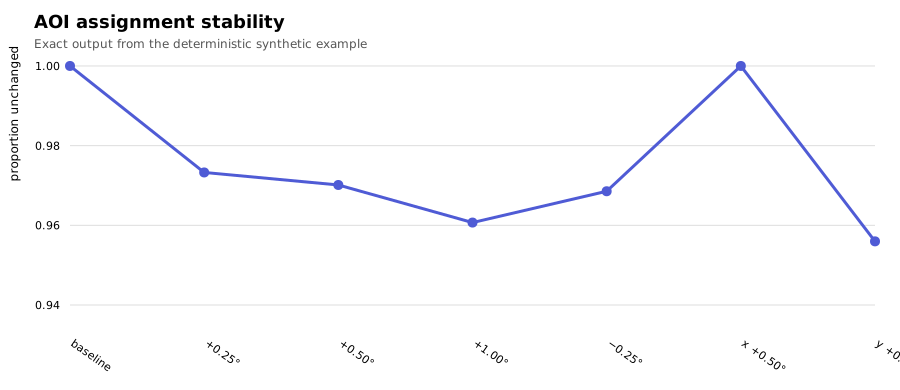
Assignment stability
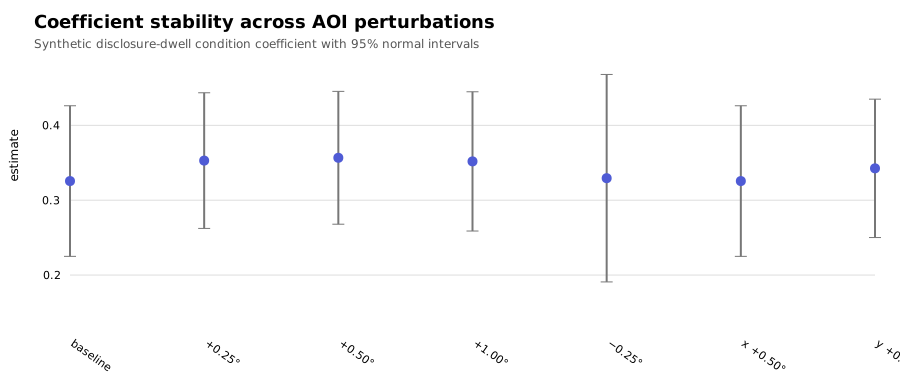
Coefficient stability
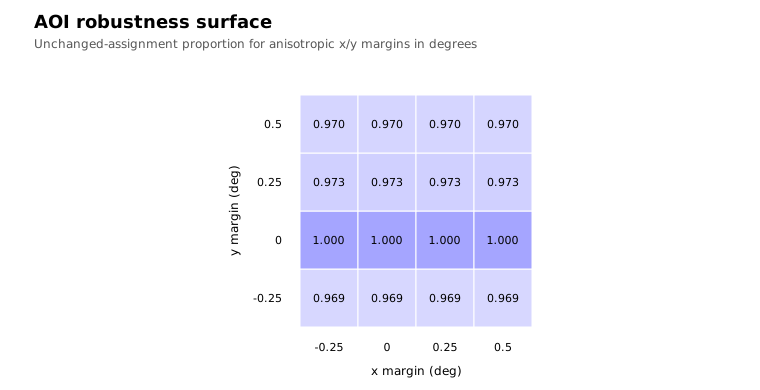
Robustness surface
The example produces four plot families:
- nominal versus perturbed AOIs with reassigned observations;
- unchanged-assignment trajectories;
- coefficient trajectories with uncertainty intervals;
- a two-dimensional anisotropic robustness surface.
Failure behavior
The test suite also deliberately includes geometry collapse, callback failure, and non-converged model branches. These remain in the audit trail rather than disappearing from the denominator.
Synthetic evidence only
Numerical values produced by this example validate the software workflow. They are not empirical advertising findings and should not be generalized to real disclosure effects.
Interpretation
Assignment stability and coefficient stability answer different questions. A result can show many reassigned observations without reversing a coefficient, or show high assignment stability while the model estimate remains sensitive. Report both layers.
Continue with the methodological guide and API reference.