Worked example: detector failure clinic
This synthetic example is intentionally not a successful-analysis showcase. It demonstrates how the workflow behaves when scientifically important failures occur and verifies that they remain visible instead of being repaired silently.
The runnable source is examples/detector_multiverse_failure_clinic.py.
1. Deliberate detector failure
The multiverse contains an I-VT branch and an external callback that deliberately raises an error. With continue_on_error=True, the I-VT branch runs and the external branch is retained as status = "failed" with its error message.
detected = ep.run_detector_multiverse(
    data,
    [ivt30, external_fail],
    continue_on_error=True,
)

print(detected.status)
print(detected.failures)
The failed detector is not replaced by I-VT, REMoDNaV, or another surrogate.
2. Deliberate model-input attrition
The clinic then creates exactly one low-quality target-AOI row and one non-finite dwell outcome before model propagation.
inference = ep.run_detector_inference_multiverse(
    features,
    {
        "engine": "callback",
        "outcome": "dwell_time_ms",
        "aoi_id": "disclosure",
    },
    model_callback=tidy_callback,
    minimum_valid_fraction=0.5,
)

print(inference.input_audit)
print(inference.warnings)
For the I-VT branch the audit records one quality_excluded_rows, one outcome_missing_rows, and the exact model_rows_used. The failed external branch has zero available propagated rows and remains no_model_data at the modelling stage.
This distinction matters: AOI selection, quality exclusion, outcome missingness, and backend failure are different scientific states.
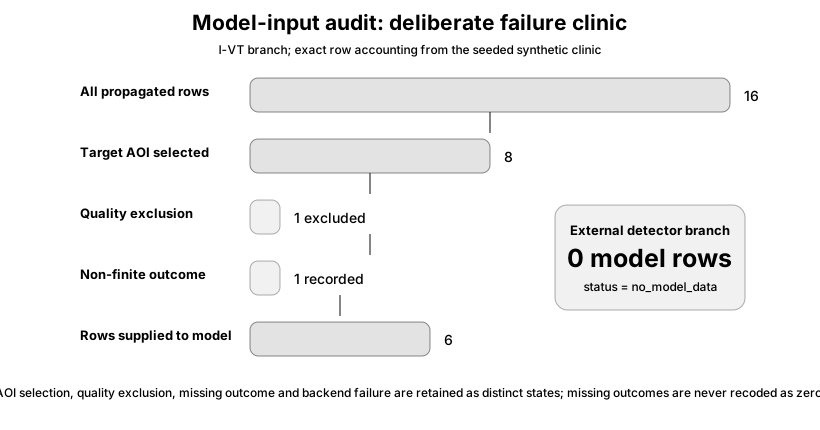
In the seeded clinic, the successful I-VT branch has 16 propagated rows, 8 target-AOI rows, 1 declared quality exclusion, 1 non-finite outcome, and 6 rows supplied to the callback estimator. The deliberately failing external detector has no model rows and remains no_model_data. The figure therefore visualizes exact recorded audit counts rather than reconstructing them from the final coefficient table.
3. Invalid callback output
Finally, a deliberately invalid callback returns the same coefficient term twice. The branch fails with an EyeProcessValidationError rather than allowing one detector to contribute multiple rows to the stability summary.
invalid = ep.run_detector_inference_multiverse(
    features,
    model_spec,
    model_callback=duplicate_callback,
)

print(invalid.failures)
Interpretation
A robust workflow is not one in which every branch is forced to succeed. It is one in which branch success, failure, exclusion, convergence, and term availability are explicitly attributable and reproducible.
Use this clinic when validating a new external detector adapter, specialist model callback, quality rule, or reporting pipeline.
Reporting example
Two detector specifications were planned. The internal I-VT branch completed, whereas the deliberately failing external branch was retained as a detector-stage failure and was not replaced. During model propagation, the input audit separately recorded target-AOI selection, one prespecified quality exclusion, one non-finite outcome, and the resulting model N. An invalid duplicate-term callback was rejected and recorded as a model-stage failure.
Next steps
Decision guide · Troubleshooting · Reporting template · API reference