Data Quality
Eye-tracking data quality is multidimensional. This guide keeps accuracy, precision, sampling stability, and data availability separate so a convenient dashboard cannot obscure the measurement process.
Important
No default threshold excludes a participant, trial, or sample. User-supplied thresholds create review flags only. Units are never mixed or converted implicitly.
Workflow
graph LR
  A[Raw gaze + timestamps] --> B[Validate units and timebase]
  B --> C[Stable-target validation segments]
  C --> D[Accuracy]
  C --> E[RMS-S2S / SD / BCEA]
  B --> F[Effective Hz + jitter]
  B --> G[Validity + missing runs]
  D --> H[Canonical quality report]
  E --> H
  F --> H
  G --> H
  H --> I[Review flags]
  I --> J[Sensitivity analysis]
  J --> K[Manuscript reporting]
Accuracy versus precision
Accuracy is the distance between recorded and known target position. Precision describes reproducibility while the intended gaze position is stable. A constant offset therefore has poor accuracy but can have excellent precision; centered noise can show the opposite pattern.
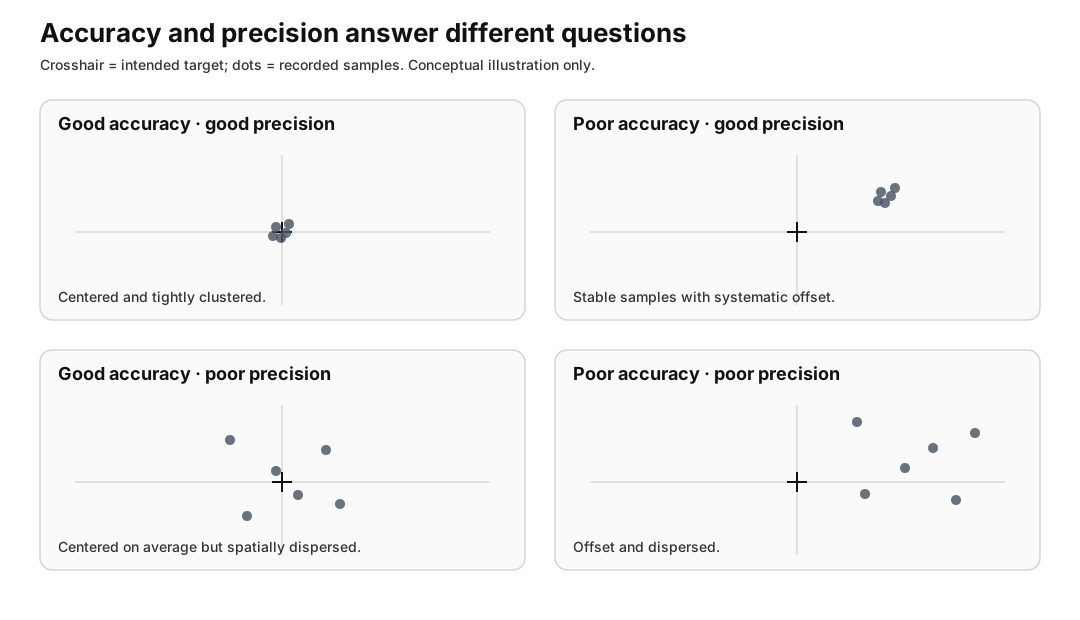
Conceptual illustration, not empirical data. The target is fixed at the crosshair while sample location and spread vary independently.
import eyeprocesspy as ep

data = ep.simulate_gaze_quality_calibration(samples_per_target=8)
report = ep.create_gaze_quality_report(
    data,
    by=["profile", "target_id"],
    valid="valid",
    missing_reason="missing_reason",
    nominal_sampling_hz=60,
)
RMS-S2S precision
For adjacent valid samples,
[ \mathrm{RMS\text{-}S2S}=\sqrt{\frac{1}{K}\sum_i [(x_{i+1}-x_i)^2+(y_{i+1}-y_i)^2]}. ]
compute_rms_s2s() never bridges across a missing sample. Use max_gap_ms only when your protocol defines a maximum defensible pairwise interval; the value is preserved in provenance.
Use it for: short-term sample-to-sample fluctuation during stable gaze.
Do not use it for: sequences spanning target changes, saccades, or other intentional gaze movement.
Standard-deviation precision
compute_gaze_sd_precision() describes the spatial spread of gaze around a stable location using the population SD convention used in the data-quality guidance (denominator n). It is complementary to RMS-S2S, not a substitute for it.
BCEA
[ \mathrm{BCEA}=2\pi k\sigma_x\sigma_y\sqrt{1-\rho^2},\qquad k=-\log(1-p). ]
The probability is explicit (probability=0.68 by default) and the area unit is reported (deg^2, px^2, or normalized^2).
Effective versus nominal sampling rate
A hardware label is not an empirical timebase audit. estimate_effective_sampling_rate() reports observed timestamp count, the sample count used for effective-Hz estimation, timestamp span, an estimated recording duration (span plus one median positive interval), effective Hz, and median interval. When nominal Hz is supplied it reports both long_interval_count (how many positive intervals exceeded the declared multiple of the nominal interval) and dropped_interval_count (the estimated number of missing nominal samples represented by those long gaps). When gaze coordinates/validity are supplied, effective Hz uses valid gaze samples with finite timestamps; otherwise it describes the timestamp stream. estimate_sampling_interval() also exposes duplicate and non-monotonic timestamps, while estimate_sampling_jitter() summarizes interval variability.
Data loss and missingness
compute_gaze_data_loss() reports valid, invalid, and missing fractions; number and duration of loss runs; and, when supplied, reason-specific fractions such as blink or tracker invalidity. Missing gaze is never converted to zero.
Units
Supported coordinate units are degrees, pixels, and normalized. Conversion requires an explicit output_unit plus screen geometry:
geometry = {
    "screen_width_px": 1920,
    "screen_height_px": 1080,
    "screen_width_cm": 53.0,
    "screen_height_cm": 29.8,
    "viewing_distance_cm": 60.0,
}
accuracy_deg = ep.compute_gaze_accuracy(
    pixel_validation,
    unit="pixels",
    output_unit="degrees",
    geometry=geometry,
)
No conversion occurs merely because geometry is present.
Interpretation boundaries
Do not interpret a quality metric as attention, cognition, motivation, competence, or clinical status. Quality metrics characterize the measurement process. Likewise, a review flag is not an automatic exclusion decision.
Next steps
- Worked 9-point validation example
- Data-quality reporting guideline
- Focused Data Quality API
- Complete API reference