Runnable examples
eyeprocesspy ships deterministic examples that require no private participant data. The focused workflows below have been executed against the CI-built 0.1.0 wheel; the gallery generators produce the figures shown throughout this site.
-
:material-vector-link: Trial-level mediation preparation
Preserve every repeated-measures trial while separating within- and between-participant exposure/gaze components and auditing zero, missingness, and quality states.
-
:material-crosshairs-gps: Measurement validity and dynamic gaze
Audit calibration error, pupil-size artefact, moving AOIs, pursuit/microsaccade classification, naturalistic coordinates, scanpath metric dependence, and synthetic measurement stress.
-
:material-eye: Core gaze, AOI and provenance
Validate a canonical
EyeDataset, recover scanpaths and transitions, compute gaze entropy, render auditable plots and inspect provenance. -
:material-target: Calibration uncertainty → probabilistic AOIs
Fit an empirical calibration-error model, propagate coordinate uncertainty and diagnose boundary-sensitive AOI assignments.
-
:material-chart-scatter-plot: Standardized data quality
Use a synthetic 9-point validation to separate accuracy from precision, inspect realized sampling and data loss, apply review-only thresholds, and carry quality decisions into sensitivity analysis.
Open validation workflow · Open plot gallery · Open sensitivity workflow
-
:material-chart-timeline-variant: Process-measure reliability
Estimate repeated-measure ICC, Bland–Altman agreement and temporal stability without confusing reliability with construct validity.
-
:material-timer-sand: Censored gaze latency
Build event/censor rows from trial windows and fixation/AOI events, retain never-inspected valid trials, fit clustered Cox/AFT models, inspect diagnostics, and produce manuscript-ready reporting.
-
:material-source-branch: Evidence-verification survival
Model time to first source/evidence AOI entry under repeated conditions, retain valid never-inspected trials as censored observations, and compare clustered Cox with explicit AFT sensitivity models.
-
:material-clipboard-text-outline: AOI analysis plan
Fix the perturbation envelope, denominator rules, model specification, failure handling, and interpretation language before branch-specific results are inspected.
-
:material-package-variant-closed-check: AOI reporting bundle
Package the declared plan, branch audit, assignment/model evidence, failures, provenance, report, figures, and deterministic hashes for manuscript or reviewer handoff.
-
:material-vector-polygon: AOI perturbation sensitivity
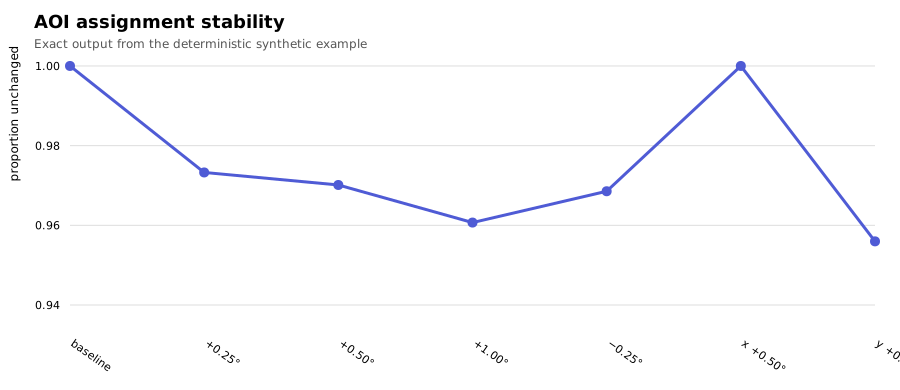
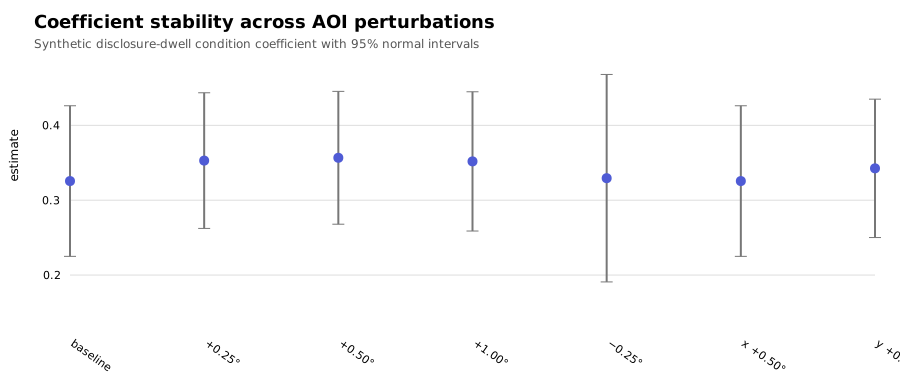
Perturb AOI geometry in pixels or degrees, remap fixations, recompute features, propagate the same model, and inspect robustness visually.
-
:material-alert-circle-check: AOI failure clinic
Trigger geometry failure, overlap ambiguity, non-convergence, callback failure, and missing coordinates deliberately, then inspect the retained audit trail.
-
:material-chart-bell-curve-cumulative: IRT diagnostics
Inspect conditional information, item fit and DIF with publication-ready Matplotlib diagnostics.
-
:material-tune-variant: Detector choice → inference
Compare defensible event detectors, propagate differences into AOI features, fit the same model across branches, and report coefficient stability rather than significance counts.
-
:material-alert-circle-outline: Detector failure clinic
Exercise explicit detector failure, quality exclusion, outcome missingness, and callback-contract failure while retaining every state in audit tables.
For short task-oriented snippets, use the Cookbook. For visual output, browse the visual gallery.
Verify the installation
import eyeprocesspy as ep

print(ep.__version__)
print(ep.__r_reference_version__)

study = ep.eyeprocess_benchmark_study()
audit = ep.validate_benchmark_study(study)
print(audit["valid"])
Import and validate an export
import eyeprocesspy as ep

eye = ep.read_eye_export("participant_001.csv", vendor="auto")
issues = ep.validate_eye_dataset(eye)

if not issues.empty:
    print(issues)
The canonical EyeDataset keeps recordings, streams, gaze, eye samples, episodes, events, intervals, responses, coordinate spaces, AOIs, features, quality and provenance in explicit tables.
Scanpath and transition analysis
sequence = ep.scanpath_sequence(
    eye,
    trial_id="trial-01",
    source="visits",
    collapse_consecutive=True,
)

matrix = ep.transition_matrix(
    eye,
    source="visits",
    normalize="row",
)

entropy = ep.gaze_entropy(
    eye,
    level="trial",
    source="samples",
)
Plot gaze, fixations and pupil data
import matplotlib.pyplot as plt
import eyeprocesspy as ep

ax = ep.plot_eye_trace(eye, trial_id="trial-01")
plt.show()

ax = ep.plot_scanpath(eye, trial_id="trial-01")
plt.show()

ax = ep.plot_pupil_timeseries(eye, trial_id="trial-01")
plt.show()
The plotting surface preserves its numerical payload on the returned axes where relevant:
Matrix plots additionally expose ax.eyeprocess_plot_matrix.
Process-measure reliability
profile = ep.process_reliability_profile(
    repeated,
    person="person",
    session="session",
    measure="dwell_score",
)

print(profile["icc"])
print(profile["bland_altman"]["summary"])
Reliability is population- and design-dependent; it does not establish construct validity.
Calibration uncertainty and probabilistic AOIs
model = ep.calibration_error_model(calibration_validation_data)
uncertainty = ep.gaze_uncertainty_ellipse(model, level=0.95)

assignment = ep.probabilistic_aoi_assignment(
    gaze_points,
    aois,
    model,
    draws=500,
    seed=1,
    min_probability=0.50,
)
This workflow quantifies coordinate uncertainty under the fitted calibration-error model; it does not estimate a posterior probability of psychological attention.
IRT diagnostic plotting
ax = ep.plot_eye_irt_information_profile(information_profile)
ax = ep.plot_eye_irt_item_fit(item_fit, statistic="infit")
ax = ep.plot_eye_irt_dif_curve(dif_curve)
The wider IRT surface also includes person fit, Q3/local dependence, score uncertainty, adaptive traces, link stability, DTF, recovery/SBC evidence, bank coverage, prior sensitivity and process-alignment diagnostics.
Provenance and reproducibility
manifest = ep.provenance_manifest(eye)
print(manifest["schema_version"])
print(manifest["sources"])
print(manifest["validation"])
For release-level verification, use the deterministic benchmark, validation evidence, reproducibility manifest and software-paper evidence workflows documented in the article library.
Executable programs
| Script | Purpose | Output |
|---|---|---|
examples/data_quality_validation.py |
Standardized 9-point quality report with review-only thresholds | console report |
examples/detector_multiverse_worked.py |
Detector specs → events → AOIs/features → identical model → robustness report | detector-multiverse-output/*.svg + Markdown |
examples/detector_multiverse_failure_clinic.py |
Deliberate detector/model failures → retained status, warnings, input audit, callback validation | console audit tables |
examples/calibration_probabilistic_aoi.py |
Calibration error → uncertainty ellipse → probabilistic AOI | workflow-output/*.svg |
examples/process_reliability.py |
ICC, Bland–Altman and temporal stability | workflow-output/process-reliability.svg |
examples/irt_diagnostics.py |
Information, item fit and DIF diagnostics | workflow-output/*.svg |
examples/core_gallery.py |
Eight core gaze/AOI/pupil plots | gallery-output/*.svg |
examples/advanced_gallery.py |
Reliability, uncertainty, quality and IRT plot families | gallery-output/*.svg |
examples/worked_gaze_survival_analysis.py |
Raw trial/event inputs → censoring → Kaplan–Meier → clustered Cox/AFT → diagnostics/reporting | console summaries + survival plots |
examples/worked_gaze_verification_survival.py |
Source/evidence AOI entry → censoring → clustered Cox/AFT → diagnostics/reporting | CSV/JSON summaries + Kaplan–Meier SVG |
examples/aoi_perturbation_sensitivity.py |
AOI geometry → reassignment → feature/model sensitivity → robustness plots | workflow-output/aoi-*.svg |
examples/aoi_reporting_bundle.py |
AOI result → manuscript/reviewer evidence bundle → deterministic SHA-256 manifest | workflow-output/aoi-reporting-bundle/* |
examples/aoi_perturbation_failure_clinic.py |
Deliberate AOI geometry/model failures → retained audits → troubleshooting report | workflow-output/aoi-failure-clinic/* |
| examples/multilevel_mediation_preparation.py | Trial-level gaze-mediator preparation, within/between decomposition, zero/missing/quality audit | console audit tables |
All listed examples are deterministic and use no private participant data.
AOI uncertainty
- AOI analysis plan: filled preregistration-style plan with API mapping and planned interpretation rules.
- AOI reporting bundle: deterministic evidence package for manuscript, reviewer, and replication handoff.
- AOI perturbation sensitivity: fixation-level end-to-end geometry, assignment, feature, model, and plotting workflow.
- AOI perturbation failure clinic: deliberate geometry/model failure, ambiguity, non-convergence, and retained audit trails.
- Sample-level AOI sensitivity: explicit sample semantics, zero-versus-missing cells, and when to separate geometry from detector uncertainty.
AOI robustness learning path
| Step | Question | Start here |
|---|---|---|
| 1. Plan | What boundary changes are scientifically defensible? | Filled analysis plan |
| 2. Run | How do assignments, features, and the same model change? | Perturbation sensitivity workflow |
| 3. Diagnose | What if geometry, assignment, or model branches fail? | Failure clinic |
| 4. Report | What evidence should accompany the manuscript/reviewer response? | Reporting bundle |
Standardized data quality
- Worked 9-point validation: six synthetic quality profiles separating target error, short-term precision, timing instability, and missingness.
- Data Quality plot gallery: focused accuracy, RMS-S2S, BCEA, sampling-interval, and dashboard visuals with interpretation boundaries.
- Quality-rule sensitivity: compare defensible review/exclusion specifications while keeping the canonical quality report intact.
- Methodological guide: equations, units, interpretation boundaries, and when not to use each metric.
- Reporting guideline: manuscript items, suggested wording, limitations, and long-gap versus estimated dropped-sample reporting.
Bayesian-network examples
- Multimodal Bayesian-network example: Condition, gaze, pupil, EDA, trust, and choice with fixed-DAG fitting, constrained structure learning, and posterior evidence propagation.
- Bayesian-network sensitivity: compare graph robustness across detector and AOI specifications while keeping preprocessing outside the BN layer.