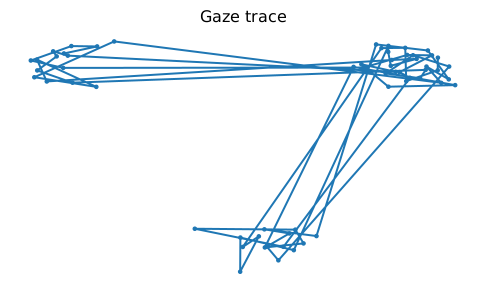
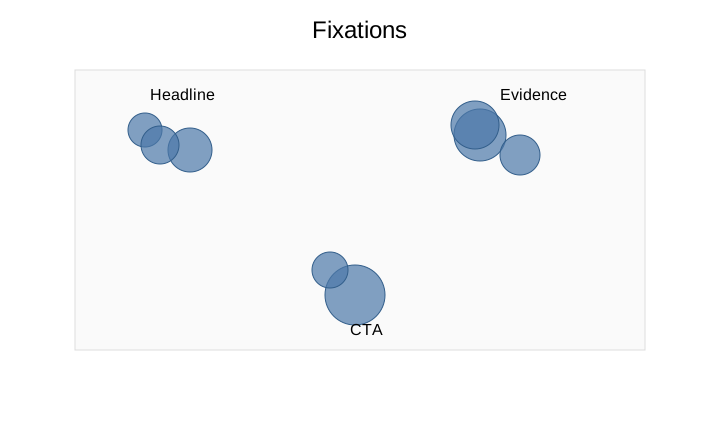
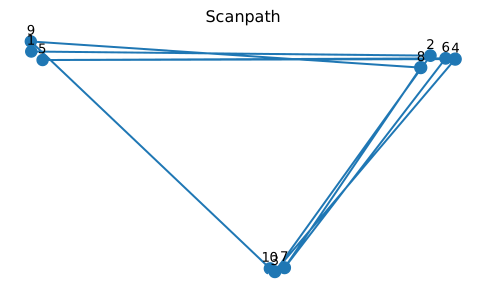
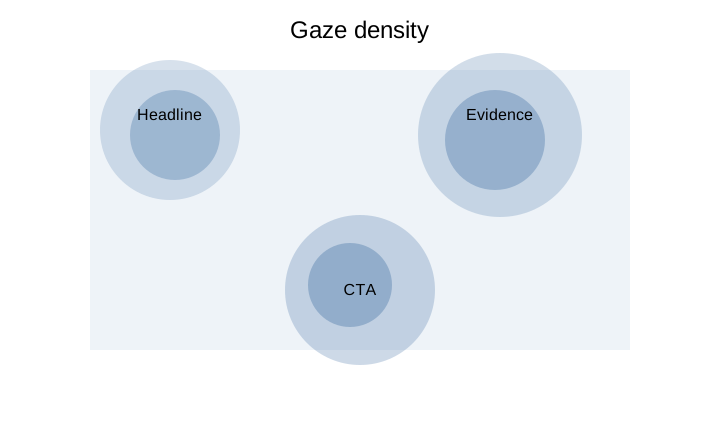
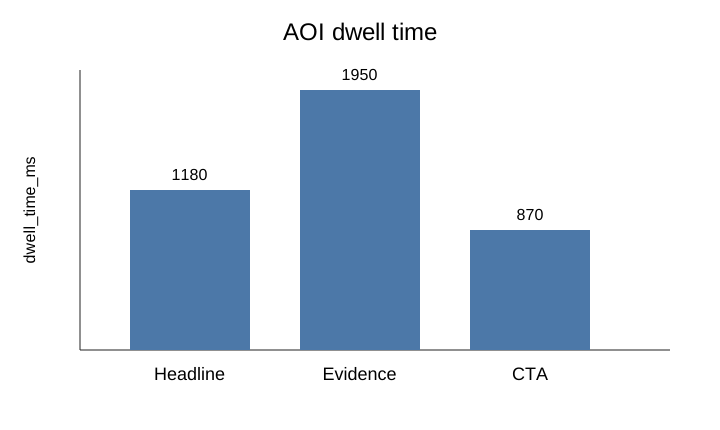
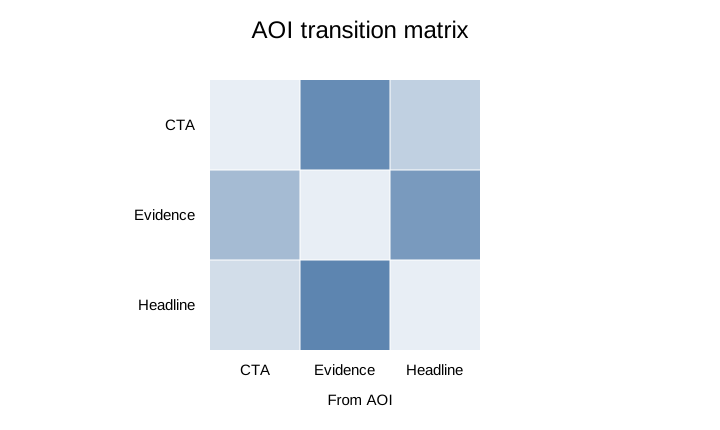
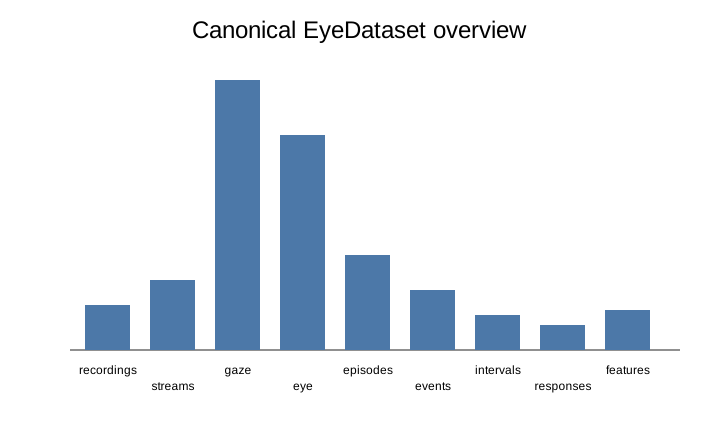
The previews on this page summarize deterministic eyeprocesspy 0.1.0 example outputs. Core plots come from the gallery scripts; method-specific panels come from the synthetic survival, detector-multiverse, AOI-uncertainty, and standardized-quality examples. No private participant data are used.
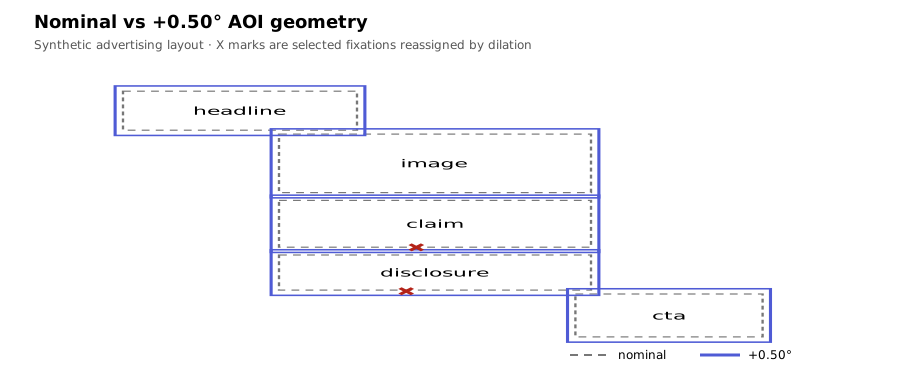
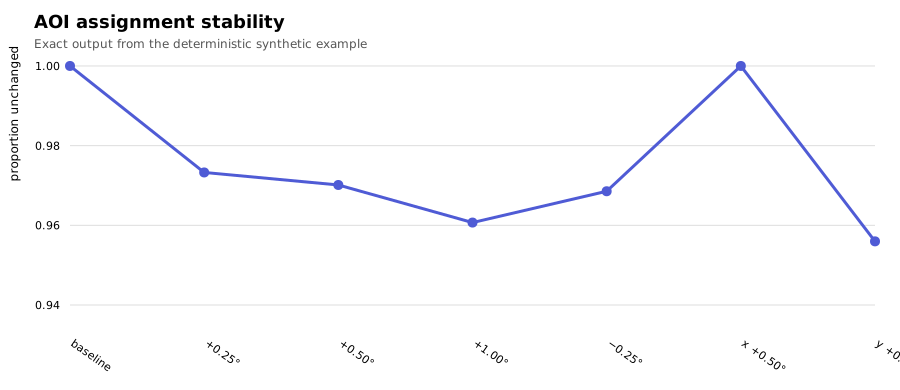
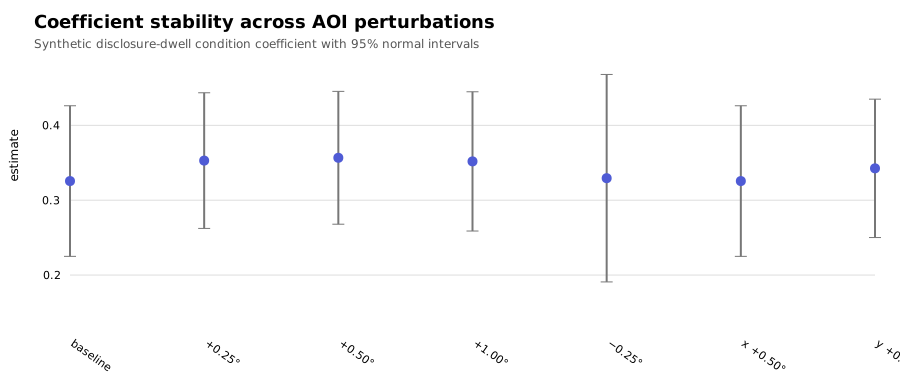
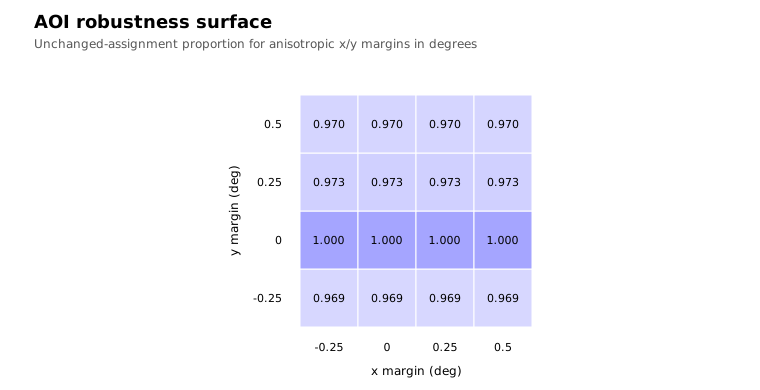
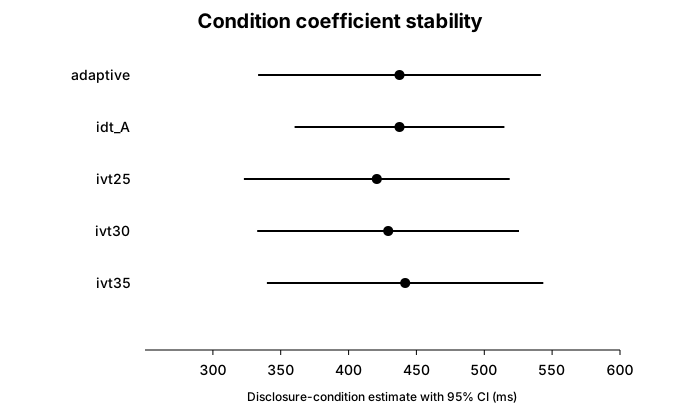
These diagnostics come from the synthetic AOI perturbation workflow. Read them together: geometry explains what changed, assignment stability quantifies how much changed, coefficient stability shows whether inference moved, and the robustness surface shows where sensitivity concentrates across two-dimensional boundary changes.
Geometry perturbation. Compare nominal and perturbed boundaries and inspect observations that cross an AOI decision boundary.Assignment stability. Summarize unchanged, newly assigned, lost, and reassigned observations across declared branches.Coefficient stability. Inspect effect magnitude and intervals across evaluable branches instead of reducing robustness to significance counts.Robustness surface. Locate regions of higher or lower stability when horizontal and vertical geometry changes are varied jointly.
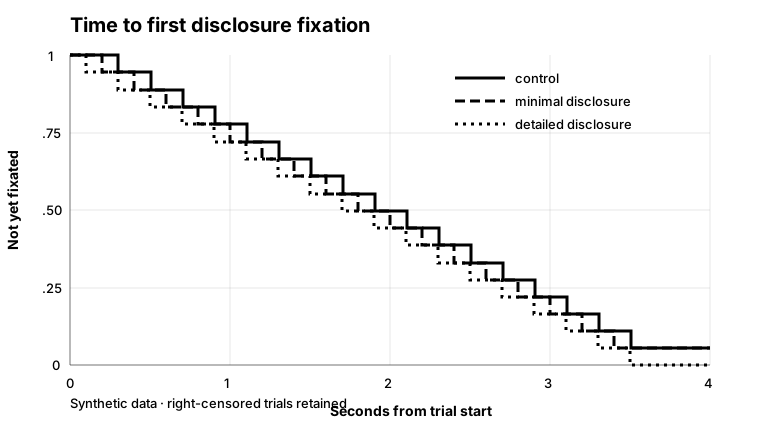
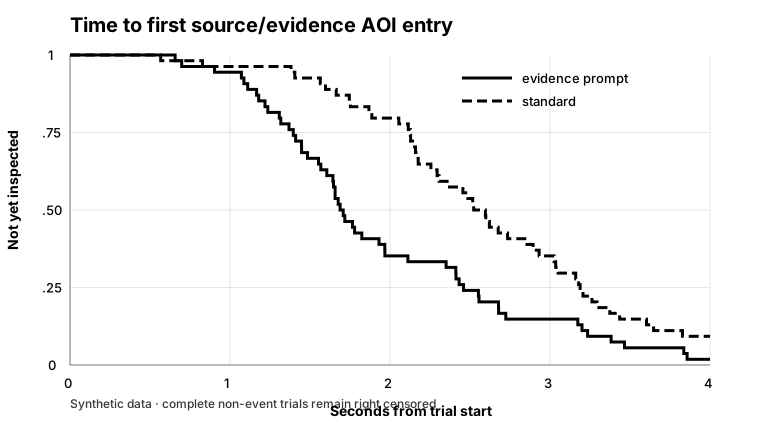
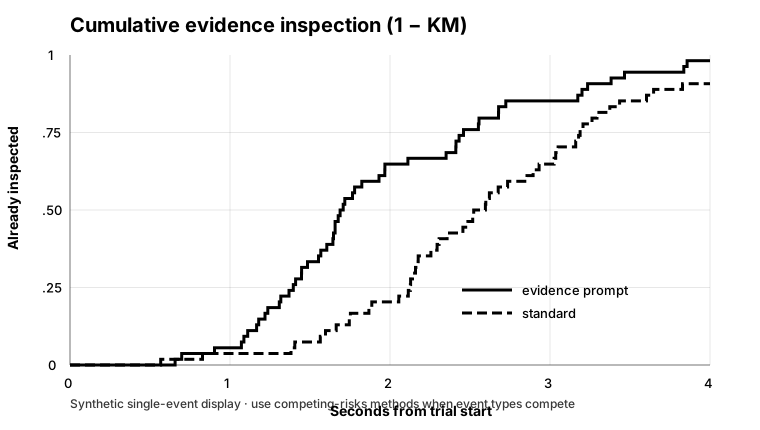
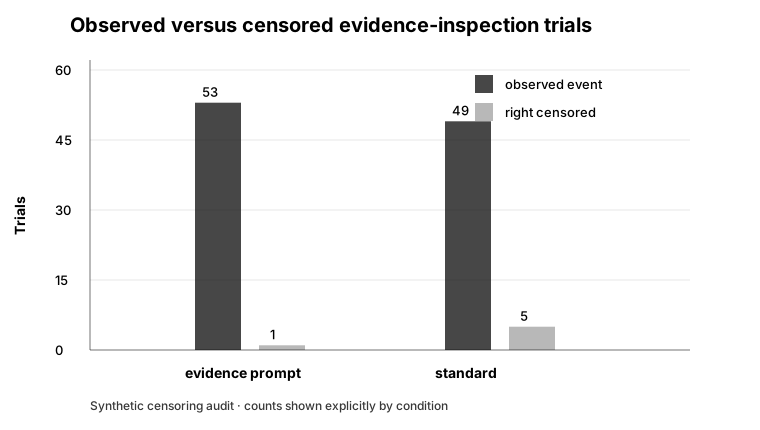
Disclosure inspection. Kaplan–Meier curves retain valid trials that end before first disclosure fixation.Evidence verification. Time to first source/evidence AOI entry under repeated conditions.Single-event incidence. 1−KM shows the share already inspected; it is not a competing-risks estimator.Censoring audit. Event and right-censor counts are reported explicitly by condition before modelling.
Detector sensitivity and inference accountability
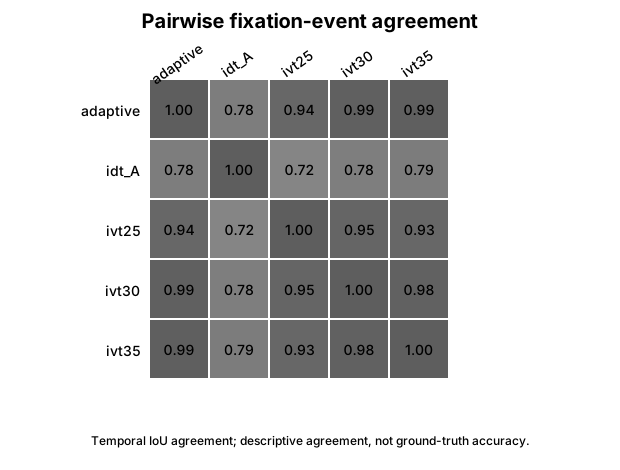
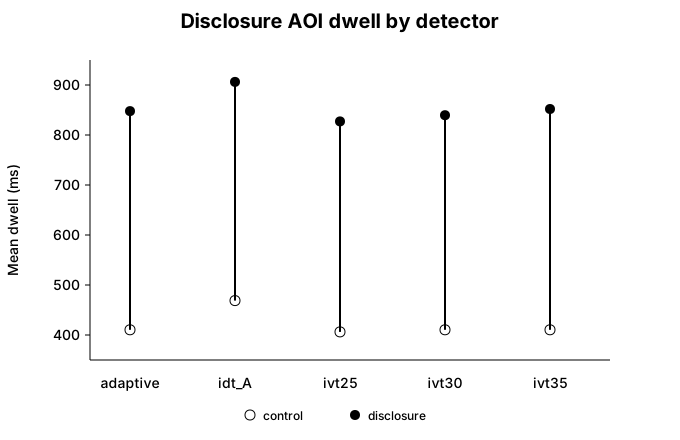
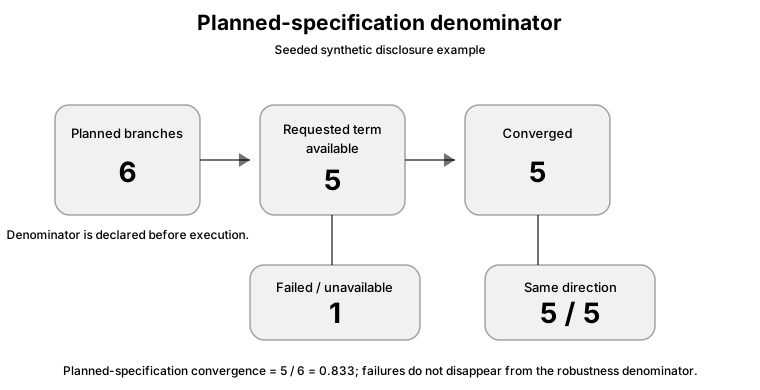
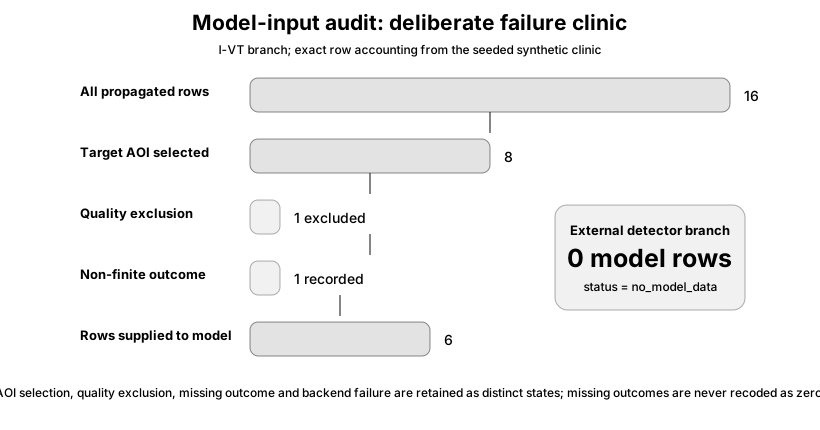
Event agreement. Pairwise temporal overlap among successful fixation catalogues; descriptive agreement, not ground-truth accuracy.Feature sensitivity. The same synthetic condition contrast propagated through alternative defensible detector specifications.Inference stability. Coefficient estimates and intervals under the identical downstream model.Denominator accountability. Failed or unavailable branches remain in the planned robustness denominator.Model-input audit. AOI selection, quality exclusion, missing outcome, and model rows remain separately visible.
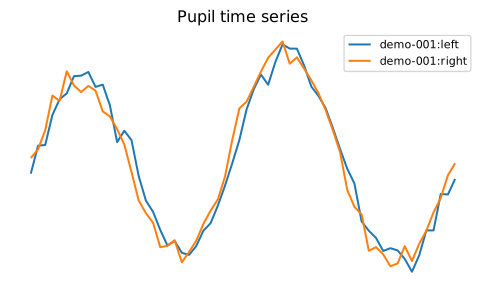
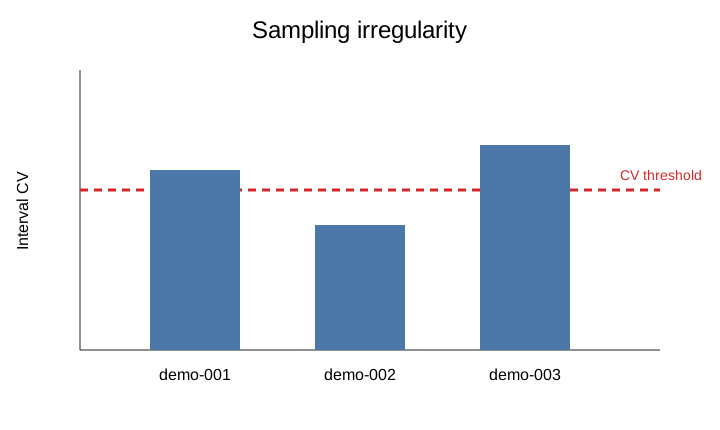
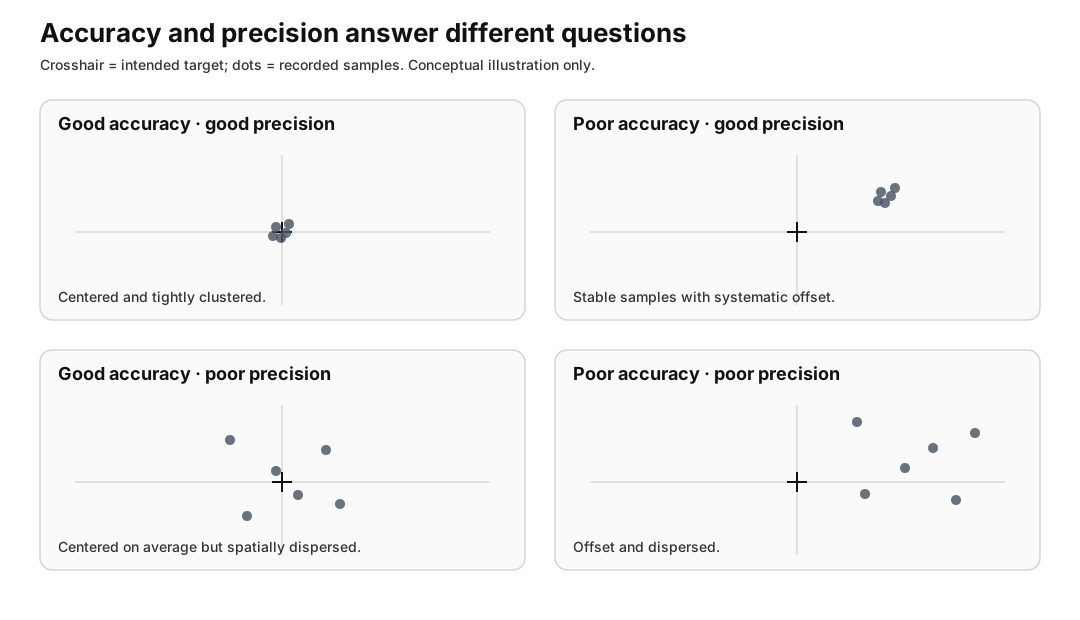
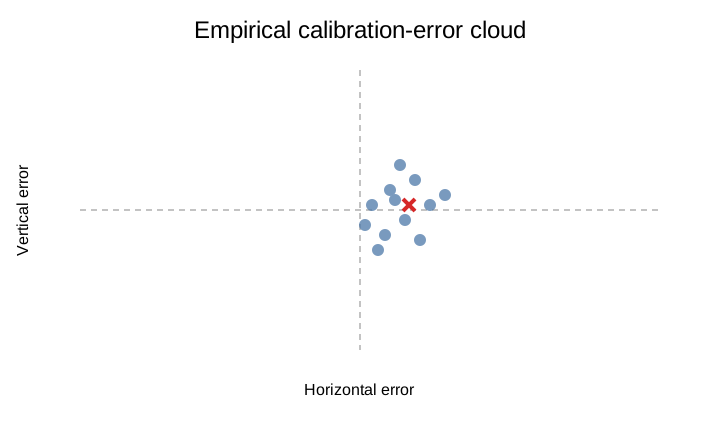
Pupil time series. Eye-specific pupil streams on a shared timebase.Sampling irregularity. Effective sampling diagnostics with an explicit review threshold.Standardized data quality. Separate target-referenced accuracy from spatial and short-term precision before review decisions.Calibration error. Empirical horizontal/vertical error cloud used to propagate gaze uncertainty.Probabilistic AOIs. Membership probabilities after calibration uncertainty is propagated.
These deterministic synthetic panels expose measurement assumptions rather than hiding them behind a single corrected dataset.
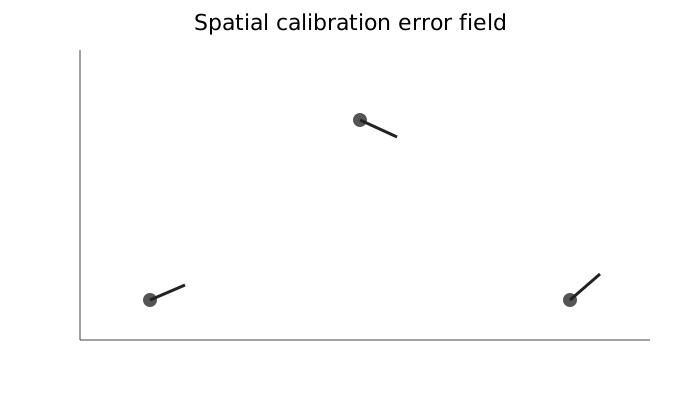
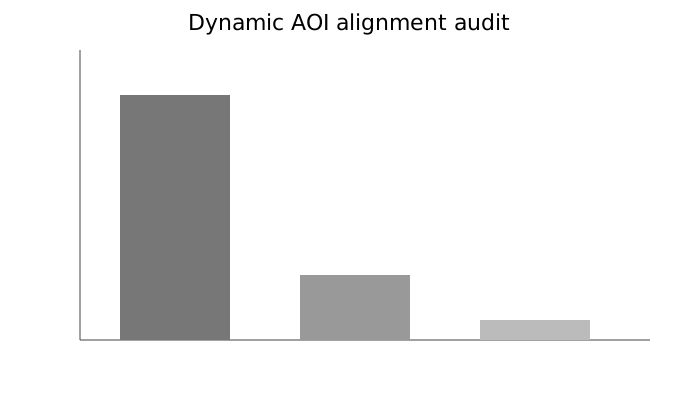
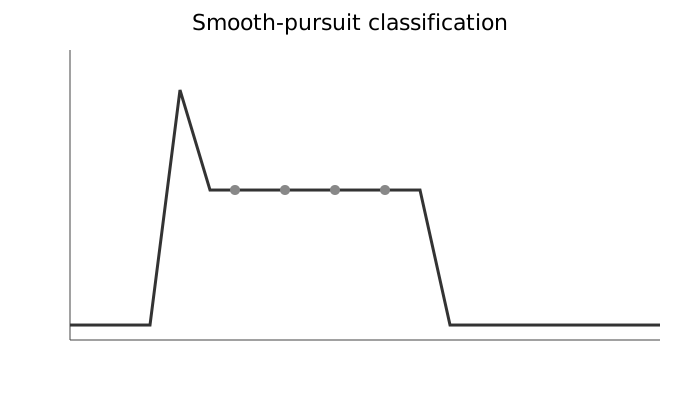
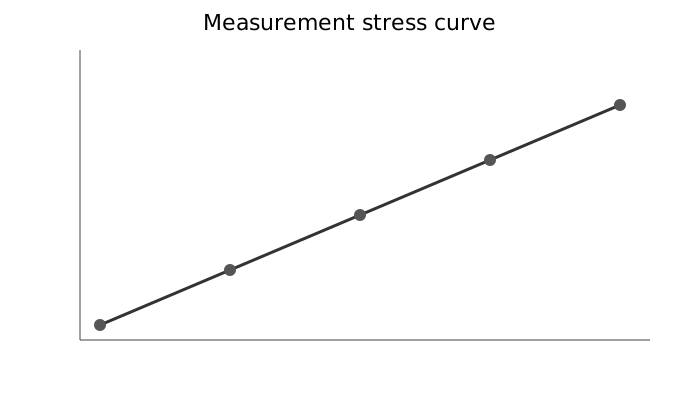
Spatial error field. Target-local systematic gaze error used for explicit spatial correction or uncertainty analysis.Dynamic AOI coverage. Assigned, outside, ambiguous, missing, and uncovered-geometry states remain distinguishable.Pursuit classification. Transparent velocity/direction rules support review and sensitivity analysis.Measurement stress. Downstream degradation is traced across declared corruption severity rather than inferred from one dataset.
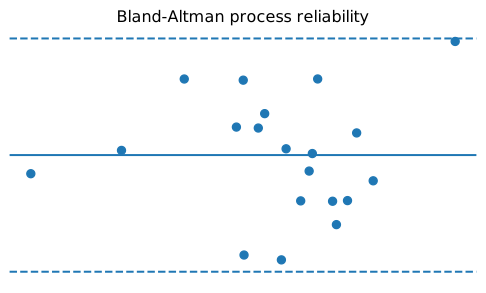
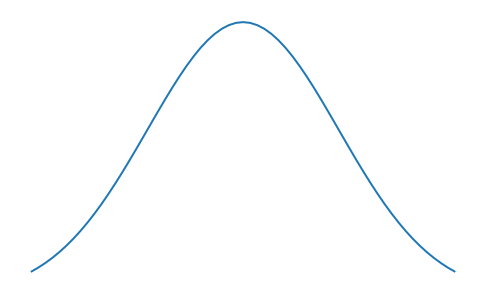
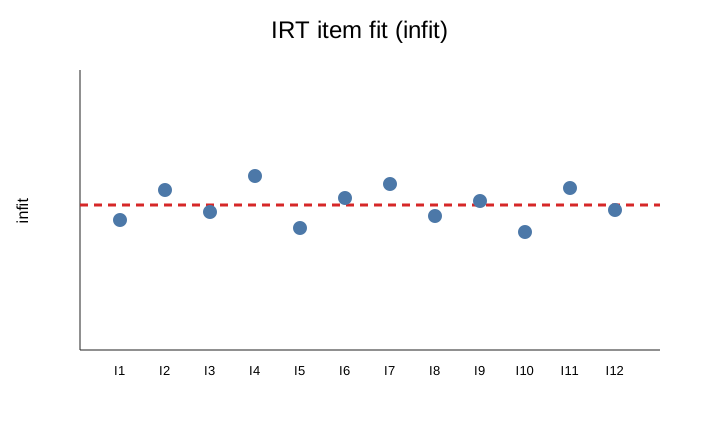
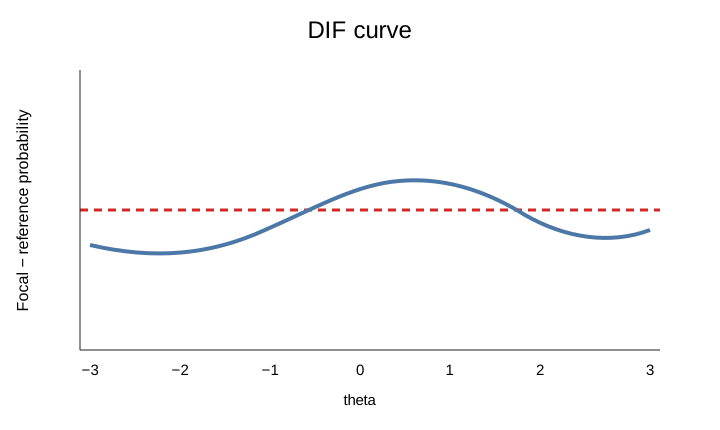
Process reliability. Bland–Altman diagnostics for repeated process measures.IRT information. Test information across the latent continuum.IRT item fit. Item-level fit diagnostics against the reference line.DIF curve. Signed focal-reference probability difference across theta.
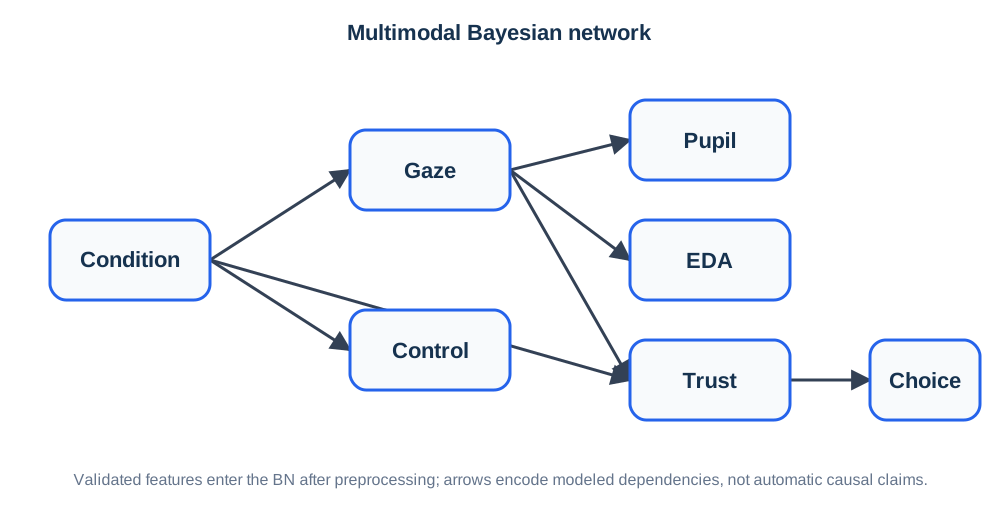
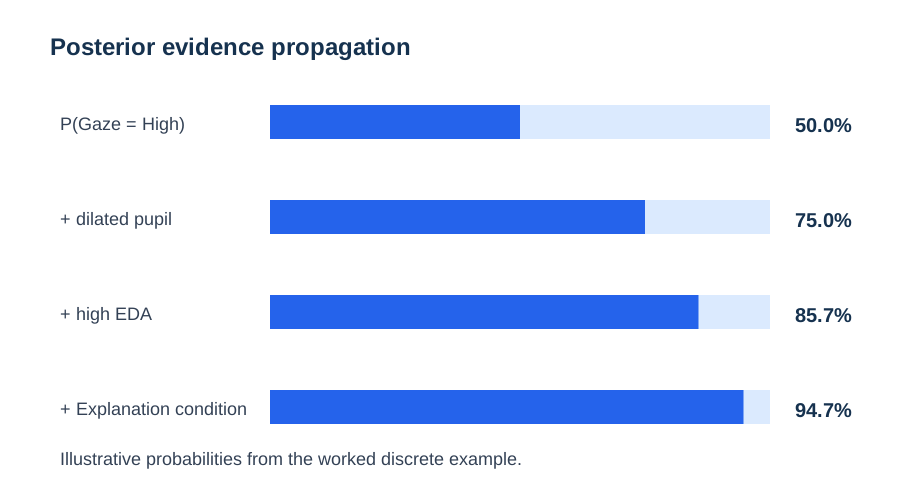
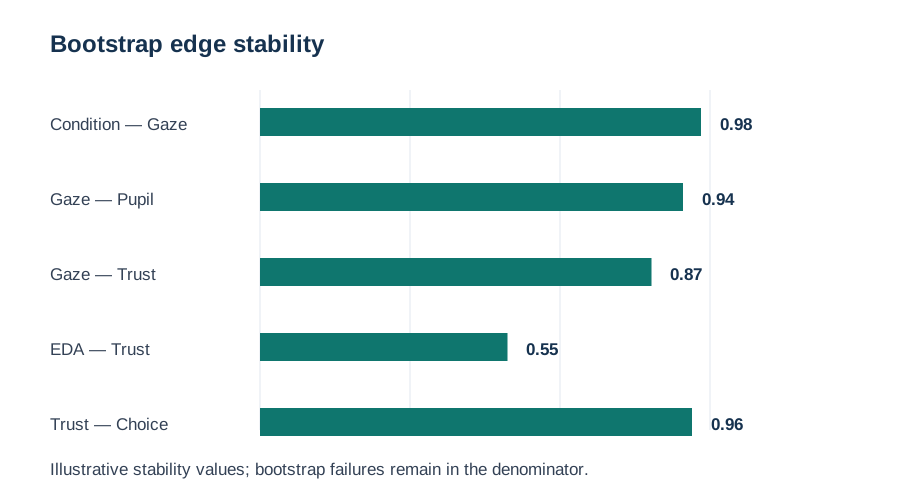
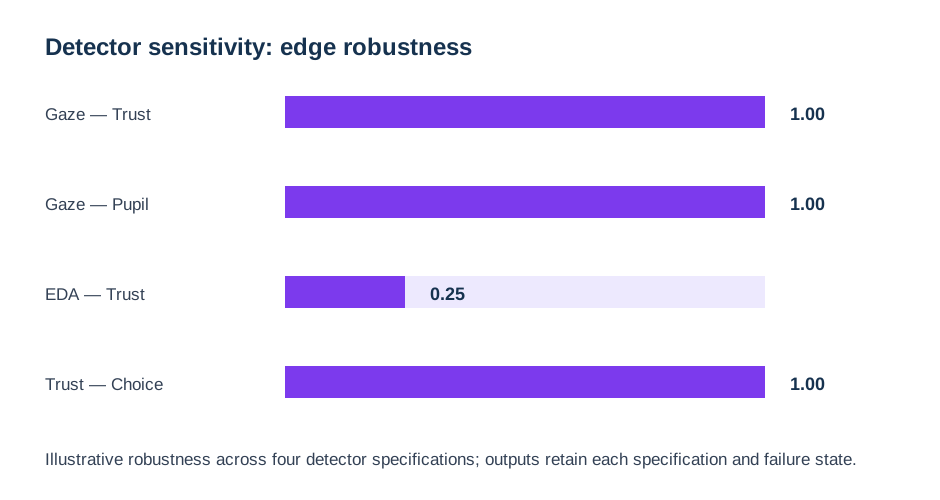
These deterministic illustrations accompany the static Bayesian-network guide. They show the graph contract, evidence propagation, bootstrap stability, and detector-specification robustness; they are illustrative outputs, not empirical findings.
Multimodal DAG. Validated features enter a downstream probabilistic network after preprocessing and provenance capture.Evidence propagation. Illustrative updates to the posterior probability of high gaze inspection as multimodal evidence is added.Bootstrap stability. Edge presence across planned bootstrap replications, with failures retained in the denominator.Detector sensitivity. Edge robustness across alternative defensible detector-derived feature tables.
The plotting functions retain the underlying plot data on the Matplotlib axes where relevant (ax.eyeprocess_plot_data, and for matrix plots ax.eyeprocess_plot_matrix). This makes the visual output auditable and allows publication styling without losing the numerical payload.
Scientific interpretation
The gallery demonstrates computational capabilities. A gaze, pupil, reliability, or psychometric statistic is not automatically a validated psychological construct. Use the package's evidence, provenance, and guardrail layers alongside an appropriate study design.