Trial-level multilevel gaze mediation
Method overview
Use this workflow when the scientific question is expressed at the trial level, for example:
AI correctness → source inspection → override decision
or:
disclosure → disclosure dwell → trust → reliance
The preparation layer belongs in eyeprocesspy. It preserves the repeated-measures structure, decomposes trial-varying variables into within- and between-participant components, audits missingness and trial support, and carries provenance into the downstream model. It does not fit a Bayesian mediation model.
Why not aggregate first?
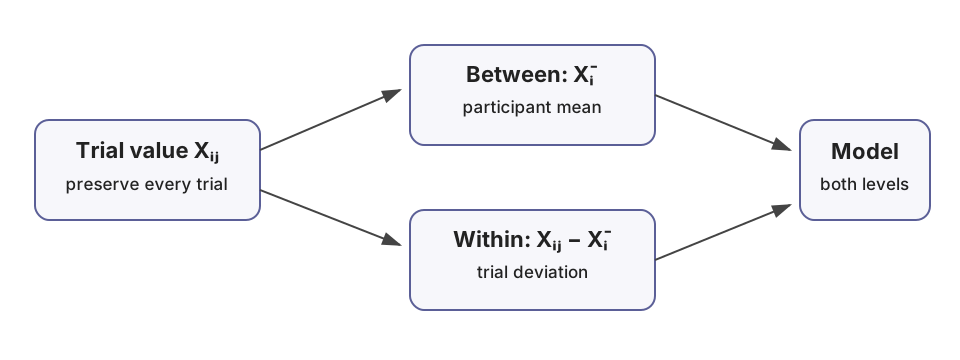
A participant mean combines two distinct sources of information: trial-to-trial deviations within a person and stable differences between people. The resulting single-level path can therefore answer a different question from the trial-level process that generated the data. prepare_multilevel_mediation_data() keeps both components explicit:
By default the between component is the participant mean itself. Grand-mean centering is available but must be requested explicitly.
When to use
Use trial-level mediation when the exposure/manipulation or mediator varies across repeated trials, the temporal ordering is defensible, and the substantive estimand concerns within-person trial-to-trial processes. It is especially useful when gaze is one link in a behavioral mechanism rather than merely a participant-level trait proxy.
When not to use
Do not use this workflow merely because multiple trials are available. Avoid a mediation interpretation when the mediator is recorded after the outcome, the exposure is not plausibly prior to the mediator, the design cannot distinguish within- and between-person variation, or missing gaze is so structurally informative that complete-case modeling is not defensible. A significant product of coefficients does not repair a weak causal design.
Core preparation API
from eyeprocesspy import prepare_multilevel_mediation_data

prepared = prepare_multilevel_mediation_data(
    trials,
    x_col="ai_correct",
    mediator_col="source_dwell",
    outcome_col="correct_override",
    participant_col="participant_id",
    trial_col="trial_id",
    quality_col="valid_fraction",
    minimum_quality=0.80,
    quality_action="flag",
    source_id="ai-advice-study",
    preprocessing_spec={"blink_policy": "flag"},
    event_detector={"algorithm": "I-VT", "velocity_threshold": 30},
    aoi_specification={"source": "registered-study-aoi-v2"},
)
No row is silently removed. mediation_analysis_eligible identifies rows that satisfy the declared observation and quality rules; choosing whether to exclude them is a later, explicit modeling decision.
Observation-state semantics
The output distinguishes four mediator states:
| State | Meaning |
|---|---|
observed_nonzero |
mediator was observed and non-zero |
observed_zero |
a genuine observed zero |
not_observed |
mediator was not observed |
poor_quality |
trial failed the declared quality rule |
A missing gaze mediator is never converted to zero. If quality_action="mask_mediator" is used, masking is explicit, preserved in provenance, and rows remain in the prepared object.
Serial mediators and moderators
Keep decomposition in eyeprocesspy:
from eyeprocesspy import add_multilevel_mediation_component

prepared = add_multilevel_mediation_component(
    prepared,
    value_col="trust",
    semantic="mediator2",
    within_col="M2_within",
    between_col="M2_between",
)
The same helper can prepare a moderator using semantic="moderator", within_col="Z_within", and between_col="Z_between". Bayesian backends consume these columns but do not recreate them.
Quality and failure cases
The preparation function fails rather than guessing when participant/trial keys are duplicated, required variables are non-numeric, or a required within-person exposure has no within-participant variation. Singleton participants are retained and flagged. Unbalanced trials are retained and summarized.
Provenance
Prepared objects carry source identity/fingerprint, preprocessing specification, detector details, AOI specification, quality rules, decomposition settings, missingness policy, and package version where supplied. This metadata is intended to travel with the downstream Bayesian model.
Visual example
The figure uses synthetic data and illustrates the preparation estimand: both axes are participant-centered trial deviations, not participant means. The regression line is descriptive and is not a fitted mediation model.
Guide map
- Design and preparation decision guide
- Why participant aggregation can mislead
- Preparing trial-level gaze mediators
- Missingness, quality, and trial retention
- Pre-fit analysis readiness checklist
Next step
Pass the prepared object to gp3bayespy.specify_multilevel_gaze_mediation() or gp3bayespy.fit_multilevel_gaze_mediation(). Do not manually reconstruct X_within, X_between, M_within, or M_between in the modeling package.
Runnable examples
The repository example examples/multilevel_mediation_preparation.py is intentionally small enough for CI. It demonstrates genuine zero gaze, missing gaze, a poor-quality trial, within/between decomposition, and the resulting audits without fitting a model.