Worked example: disclosure dwell under detector uncertainty
This example is synthetic, reproducible, CI-sized, and deliberately includes one optional-backend failure case.
Research question
A simulated disclosure condition produces longer gaze dwell on a disclosure AOI. The analysis asks whether the positive condition effect survives defensible variation in event detection.
1. Simulate 60 Hz gaze data
import eyeprocesspy as ep

data = ep.simulate_detector_multiverse_data(
    n_participants=8,
    sampling_rate=60,
    seed=20260918,
)
The generator creates explicit trial intervals, a disclosure AOI, a main-content AOI, valid/missing samples, and a known positive disclosure-dwell effect.
2. Declare the detector set
The runnable script compares I-VT at 25, 30 and 35 deg/s, an I-DT specification, the robust-MAD adaptive reference detector, and a REMoDNaV branch.
No branch receives an undeclared threshold. If REMoDNaV is not installed, that branch is recorded as failed and the remaining branches continue; it is never replaced silently.
3. Run and propagate
result = ep.run_detector_multiverse(data, multiverse)
result = ep.propagate_detector_to_aoi(result, overlap="error")
result = ep.propagate_detector_to_features(result)
Event agreement
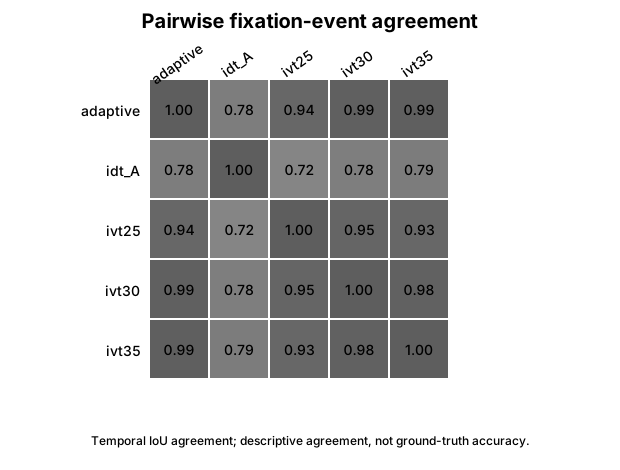
Interpret this figure as pairwise temporal agreement, not ground-truth accuracy.
Disclosure dwell
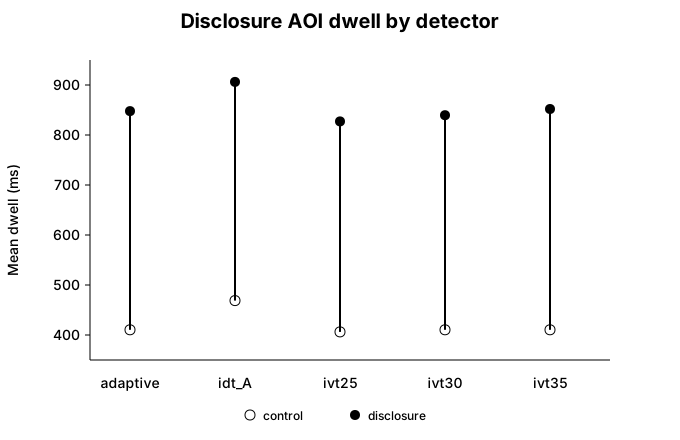
The known simulated disclosure effect remains visible, while the absolute dwell estimates vary because event boundaries and fragmentation differ by detector.
4. Propagate to inference
model_spec = {
    "engine": "statsmodels_ols",
    "formula": "dwell_time_ms ~ C(condition_id) + C(participant_id)",
    "outcome": "dwell_time_ms",
    "aoi_id": "disclosure",
}

inference = ep.run_detector_inference_multiverse(
    result,
    model_spec,
    minimum_valid_fraction=0.5,
)
Participant fixed effects keep the example lightweight for CI. In an empirical repeated-measures study, a mixed model may be preferable; use statsmodels_mixedlm or an explicit callback to the specialist modelling stack chosen for the study.
Model-input audit
Before interpreting coefficients, inspect the row-accounting table:
inference.input_audit[
    [
        "detector_id",
        "input_rows",
        "aoi_selected_rows",
        "quality_excluded_rows",
        "outcome_missing_rows",
        "model_rows_used",
        "status",
    ]
]
This table distinguishes AOI selection, prespecified quality filtering, outcome missingness, and model failure. Those states should not be collapsed into a single post-hoc N.
Coefficient stability
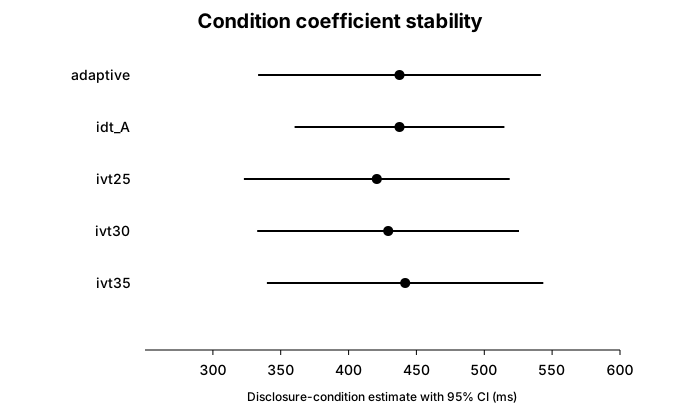
The synthetic run used to generate this page produced same-direction condition coefficients across all successfully modelled internal detector branches. The exact values are not scientific results and will change if the simulation parameters change.
The stability summary uses the planned-specification denominator. In this seeded example, six detector branches were declared, five returned the disclosure coefficient, and the unavailable REMoDNaV branch remains visible as a model-stage failure. Thus specifications = 6, term_available_specifications = 5, model_failure_specifications = 1, and the convergence rate is 5 / 6, not 5 / 5.
Planned-denominator audit
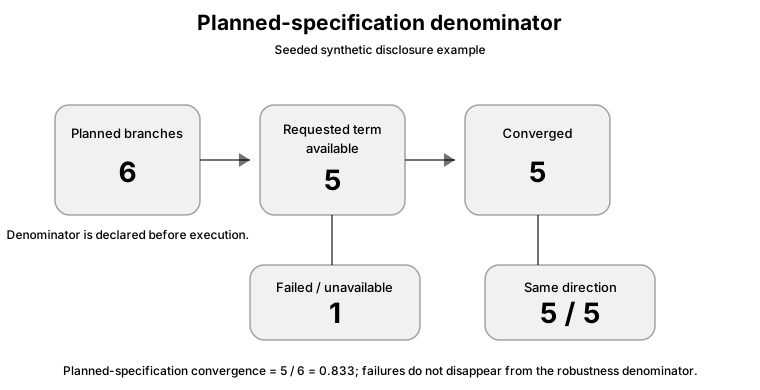
This figure is a reporting aid, not a new statistic: it visualizes the same planned-specification accounting returned by the stability summary. See the visual diagnostic atlas for a publication-oriented reading sequence.
5. Inspect what changed
summary = ep.summarise_detector_robustness(
    result,
    inference=inference,
    term="C(condition_id)[T.disclosure]",
    substantive_threshold=100,
)

summary["event_summary"]
summary["feature_sensitivity"]
summary["inference_stability"]
summary["failures"]
The output separates event sensitivity, measurement sensitivity, model stability and branch failures. A failure is evidence about the evaluated workflow; it is not silently removed from the audit trail.
6. Generate a reproducible report
ep.report_detector_multiverse(
    result,
    inference=inference,
    term="C(condition_id)[T.disclosure]",
    substantive_threshold=100,
    path="detector-multiverse-report.md",
)
The complete runnable source is examples/detector_multiverse_worked.py.