Gazepoint import and quality-control workflow
eyeprocesspy includes dedicated Gazepoint readers and file-workflow helpers while converting outputs into the same vendor-neutral canonical dataset used by the rest of the package.
Identify an export before importing it
import eyeprocesspy as ep

kind = ep.gp_identify_export_type("recording.csv")
profile = ep.gp_profile_export("recording.csv")
fields = ep.gp_list_export_fields("recording.csv")
This is useful when a study directory mixes gaze, fixation, event, biometric, or other export families.
Validate the source export
Validation at the vendor-file stage can detect problems that become harder to diagnose after files are combined.
Read individual Gazepoint export families
gaze = ep.read_gazepoint_gaze("gaze.csv")
fixations = ep.read_gazepoint_fixations("fixations.csv")
events = ep.read_gazepoint_events("events.csv")
biometrics = ep.read_gazepoint_biometrics("biometrics.csv")
Use the most specific reader when you know the export family. Use read_gazepoint() or read_eye_export(..., vendor="gazepoint") when automatic routing is more appropriate.
Work with a folder, not file order
pairs = ep.gp_pair_exports("export-folder")
audit = ep.gp_audit_file_pairs(pairs)
eye = ep.read_gazepoint_folder("export-folder")
When gaze and biometric exports must be reconciled, use the matching/pairing helpers rather than relying on alphabetical file order or manually constructed participant IDs.
Related helpers include:
gp_match_recordings();gp_match_biometrics();read_gazepoint_combined();gp_audit_file_pairs().
Parse task and media events
Event parsing must be checked against the experiment's real task protocol. A parser can identify encoded events; it cannot reconstruct an undocumented study design.
Validate after canonicalization
Then audit the measurement conditions relevant to the study:
rates = ep.audit_sampling_rate(eye)
quality = ep.audit_signal_quality(eye)
missing = ep.audit_missingness(eye)
spaces = ep.audit_coordinate_spaces(eye)
Visual QC
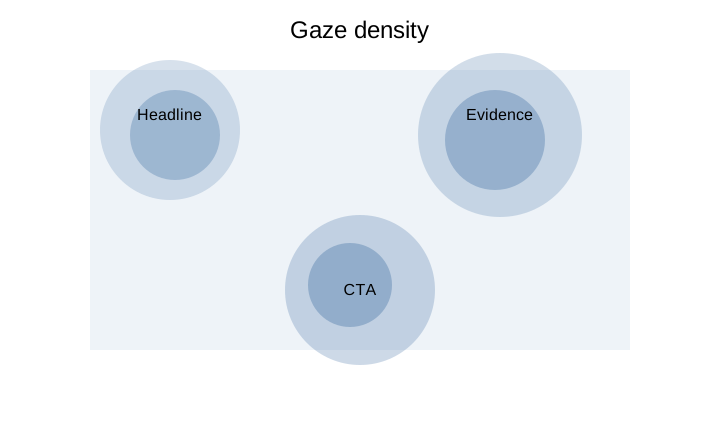
Also inspect traces, fixations, scanpaths, pupil streams, and trial/event timing when those data are present.
Preserve device and export provenance
For Gazepoint-specific research, retain:
- Gazepoint software/export version where available;
- the exact files associated with each recording;
- whether vendor fixations or eyeprocess-derived fixations were analyzed;
- coordinate space and stimulus geometry;
- expected vs empirical sampling context;
- event parsing rules;
- biometric synchronization/matching decisions;
- exclusions and QC thresholds.
Recommended route
- profile/identify source files;
- validate vendor files;
- pair related exports;
- import into the canonical model;
- validate the canonical model;
- audit sampling, missingness, coordinates, and events;
- inspect plots;
- derive features only after the observation pipeline is understood;
- preserve provenance with the analysis outputs.