End-to-end eye-tracking workflow
A defensible eye-tracking workflow is not just read → calculate → model. eyeprocesspy is structured around an explicit sequence: import → canonicalize → validate → audit measurement conditions → derive process features → visualize → model → preserve evidence.
1. Import into the canonical model
When a folder contains multiple files, prefer read_eye_folder() or a vendor-specific workflow over manual concatenation so file-level provenance and pairing decisions are not lost.
2. Validate the dataset contract
An empty error table means the canonical structure is coherent. It does not prove that calibration, sampling, preprocessing, tasks, AOIs, or measurement choices are scientifically valid.
3. Audit measurement conditions
readiness = ep.analysis_readiness(eye)
rates = ep.audit_sampling_rate(eye)
missing = ep.audit_missingness(eye)
spaces = ep.audit_coordinate_spaces(eye)
Before inferential modeling, make the following explicit:
- coordinate system and screen/media geometry;
- normalized vs pixel coordinates;
- timebase and event alignment;
- empirical/effective sampling rate;
- gaze validity and missingness rules;
- calibration or validation quality where available;
- trial definitions and exclusions;
- whether features are sample-, episode-, AOI-, trial-, item-, person-, session-, or recording-level.
4. Inspect the raw spatial process
ax = ep.plot_eye_trace(eye, trial_id="T1")
ax.figure.tight_layout()

ax = ep.plot_gaze_heatmap(eye, trial_id="T1", bins=(40, 30))
ax.figure.tight_layout()
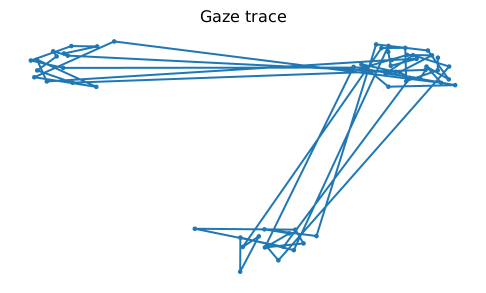
A visual diagnostic is not a substitute for QC, but it is often the fastest way to detect coordinate reversal, unexpected clipping, missing trials, or event-selection mistakes.
5. Inspect fixation and scanpath structure
ax = ep.plot_fixations(eye, trial_id="T1")
ax.figure.tight_layout()

ax = ep.plot_scanpath(eye, trial_id="T1")
ax.figure.tight_layout()
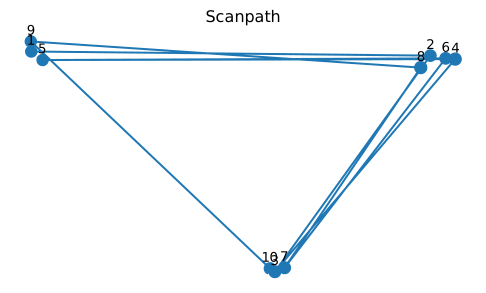
Sequence structure can contain information that disappears after aggregation to total dwell or fixation count.
6. Derive AOI sequences and transitions
sequence = ep.scanpath_sequence(
    eye,
    source="visits",
    collapse_consecutive=True,
)

matrix = ep.transition_matrix(
    eye,
    source="visits",
    normalize="row",
)

print(sequence)
print(matrix)
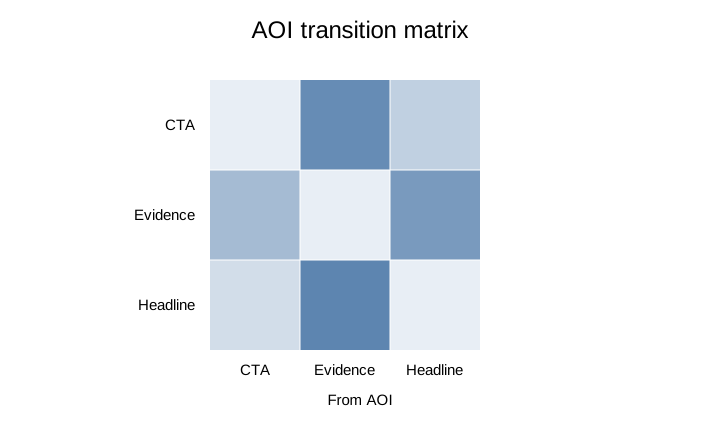
When interpreting transitions, document whether the source is AOI visits, fixation episodes, or sample-level assignments and whether consecutive self-states were collapsed.
7. Inspect pupil streams separately from gaze
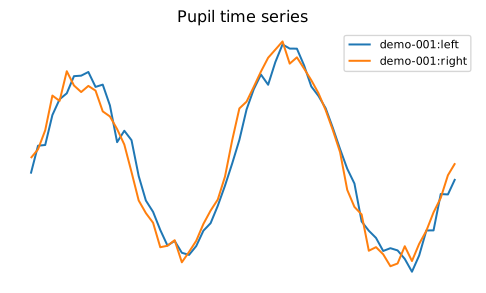
Pupil measurements have their own validity, blink, missingness, interpolation, baseline, and time-alignment assumptions. They should not inherit gaze preprocessing decisions automatically.
8. Quantify quality before modeling
Use quality functions appropriate to the design rather than a single composite QC score. Depending on the data, this can include sampling audits, missingness, calibration error, gaze precision, process reliability, and sensitivity to exclusions or preprocessing.
9. Preserve provenance
A reproducible analysis should preserve at least:
- exact package version/commit;
- source files and hashes where available;
- import/vendor decisions;
- coordinate definitions;
- time/event alignment;
- preprocessing and exclusions;
- feature definitions and levels;
- quality/validation evidence;
- statistical model specification.
10. Model after the measurement pipeline is defensible
Mixed models, SEM, Bayesian models, ML, IRT, and sequence models cannot repair an undocumented observation pipeline. Treat aggregation and feature engineering as measurement decisions, not neutral formatting.