Psychometrics and IRT with process data
eyeprocesspy treats eye-tracking and other process measures as measurement evidence that can be connected to psychometric models when the design justifies that connection. The package includes IRT foundations, fit and diagnostic tools, process-informed and dynamic models, DIF/DTF, score uncertainty, adaptive-testing helpers, multidimensional extensions, validation workflows, and scientific plots.
Start from an explicit measurement question
Before selecting a model, define:
- the latent variable or trait being modeled;
- the item/response structure;
- the response scale and scoring rule;
- whether process variables are predictors, auxiliary measurements, outcomes, or part of a joint model;
- the level of each process feature (sample, fixation, AOI, trial, item, person, session);
- how missingness and exclusions are handled;
- what evidence would count as model adequacy or construct validity.
A large process-feature set is not itself a measurement model.
Information and conditional precision
When an information profile is available:
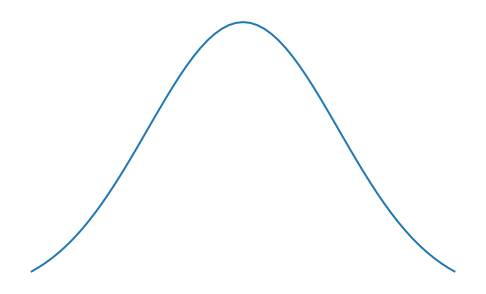
Conditional information and conditional SEM are useful because score precision varies across the latent continuum. A single global reliability coefficient cannot describe that heterogeneity.
Item and person fit
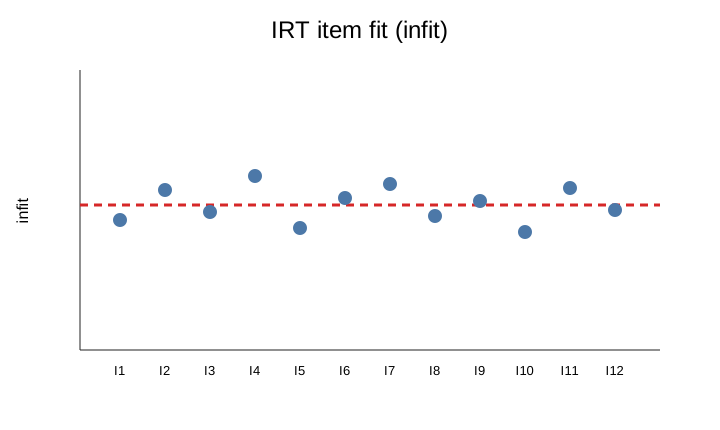
Fit statistics are diagnostics rather than automatic deletion rules. Investigate design, scoring, multidimensionality, local dependence, sparse exposure, and process evidence before removing items or participants.
Local dependence and Q3-style diagnostics
The IRT diagnostic surface includes residual/local-dependence tools and Q3 matrices. If process features suggest shared stimulus structure, navigation dependencies, repeated content, or temporal carryover, residual dependence may be scientifically meaningful rather than merely a nuisance.
DIF and differential test functioning
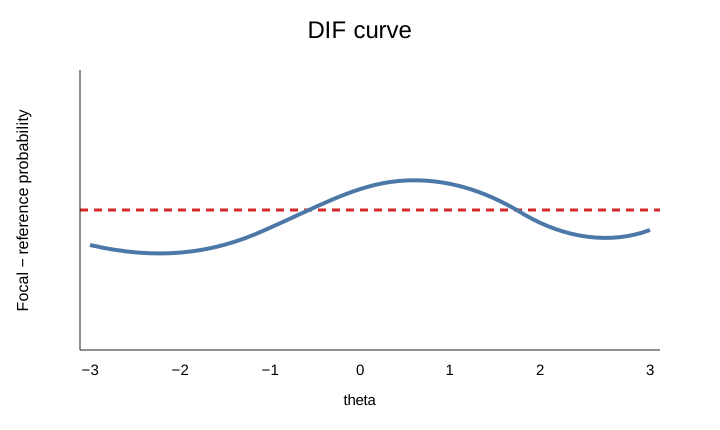
DIF analysis should separate statistical evidence from substantive interpretation. Group differences in item behavior can arise from construct-irrelevant barriers, true multidimensionality, differential familiarity, translation/presentation effects, sampling, or model misspecification.
Process-informed IRT
Process features can be incorporated when the model and design make their role explicit. Examples include:
- item-level gaze or timing features as explanatory item covariates;
- person-level process summaries as auxiliary person predictors;
- trial-level process variables connected to response accuracy;
- joint response-time/process models;
- functional pupil representations linked to item/person parameters;
- dynamic process states or sequences used as structured auxiliary information.
Avoid assigning a psychological label to a feature merely because it predicts an IRT parameter.
Dynamic and advanced process models
The package exposes dynamic/process families for workflows where behavior evolves across trials or measurement occasions. Use them only when the study can support the additional temporal/state assumptions. Report initialization, identification constraints, transition structure, priors/regularization, convergence diagnostics, and sensitivity analyses.
Score uncertainty
Point estimates of theta should be accompanied by conditional uncertainty where possible. The plotting surface includes score-uncertainty displays, and the model utilities expose information/SEM and related diagnostics.
Adaptive testing
Adaptive-testing functions can support item selection, information targeting, bank-coverage diagnostics, and traces of interim ability estimates. Operational CAT requires more than a working selection algorithm:
- calibrated and monitored item banks;
- exposure/content constraints;
- stopping-rule validation;
- fairness and DIF monitoring;
- security and item-drift controls;
- prospective simulation and operational validation.
The package's adaptive-testing governance article should be read before consequential use.
Validation before substantive claims
For new or extended models, use the package's validation program:
- simulation/recovery;
- SBC-style evidence where appropriate;
- stress tests;
- negative controls;
- grouped/leakage-aware validation;
- robustness and sensitivity analyses;
- validation atlases/evidence objects.
A model that converges is not necessarily identified, calibrated, transportable, or substantively valid.
Process features and leakage
When process variables are used for prediction or validation, split data at the scientifically independent unit. Trial-level rows from the same participant, item, stimulus, or session can create severe leakage if random row-wise splits are used.
Use grouped validation when the deployment/interpretation target requires generalization across participants, items, sessions, devices, or stimuli.
Reporting checklist
For process-informed psychometrics, report:
- response/scoring model;
- item/person/sample structure;
- process feature definitions and units;
- feature extraction and aggregation level;
- missingness and exclusions;
- identification constraints;
- estimation engine and version;
- fit/local-dependence diagnostics;
- score uncertainty;
- DIF/fairness checks where relevant;
- grouped validation strategy;
- simulation/recovery or other validation evidence;
- sensitivity analyses;
- interpretation boundaries for process measures.