Calibration uncertainty and probabilistic AOIs
Hard AOI assignment treats a gaze point as if its coordinate were exact. This workflow instead estimates an empirical calibration-error model, propagates that uncertainty, and summarizes AOI membership probability under the fitted measurement-error model.
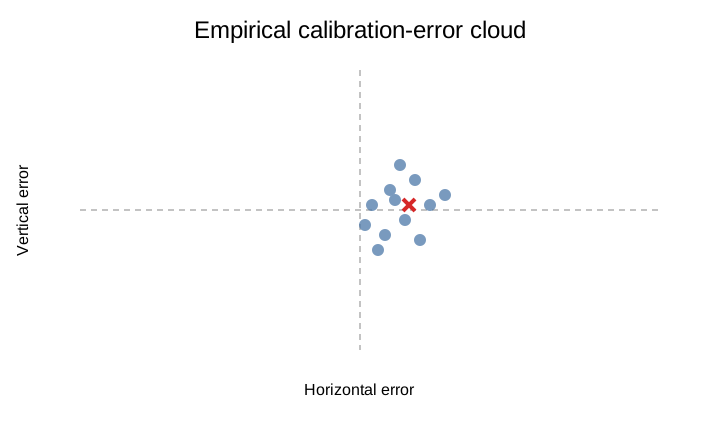
The executable example is examples/calibration_probabilistic_aoi.py.
1. Estimate the calibration-error distribution
The input contains target coordinates and observed gaze coordinates. The model stores the empirical mean error, covariance, raw error cloud and descriptive error metrics.
2. Summarize the uncertainty ellipse
The ellipse is a geometric summary of the fitted two-dimensional calibration error; it is not a participant diagnosis or universal accuracy threshold.
3. Propagate uncertainty into AOI membership
assignment = ep.probabilistic_aoi_assignment(
    gaze_points,
    aois,
    model,
    draws=400,
    seed=9,
    min_probability=0.50,
)

print(assignment["assignments"])

Each point is repeatedly perturbed under the empirical calibration-error model, producing a membership distribution across AOIs. Ambiguous boundary points can therefore remain uncertain instead of being forced into a single deterministic rectangle.
4. Compare hard and probabilistic assignment
Use disagreement as a measurement-sensitivity diagnostic. It can reveal AOIs or trials whose substantive conclusions depend strongly on calibration error or boundary placement.
Do not over-interpret probability
These probabilities quantify propagated coordinate uncertainty under the fitted calibration model. They are not posterior probabilities that a participant psychologically attended to an AOI.