Pupillometry workflow
Pupil analysis is especially sensitive to time alignment, missingness, blink handling, baseline choices, filtering, and aggregation. eyeprocesspy keeps pupil observations in the canonical eye_samples table and supports both scalar and trajectory-level/process representations.
Inspect the canonical pupil stream first
import eyeprocesspy as ep

ax = ep.plot_pupil_timeseries(eye, trial_id="T1")
ax.figure.tight_layout()
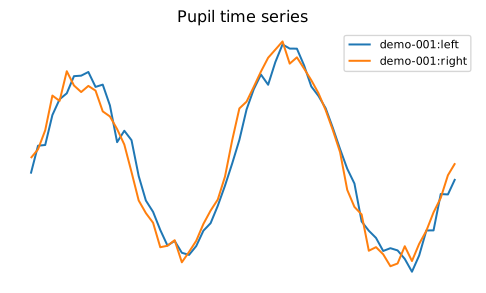
Before preprocessing, confirm that eye labels, timestamps, trial IDs, validity information, and pupil units are what the study expects.
Treat preprocessing as part of the measurement model
A manuscript-quality pipeline should make the following decisions explicit:
- left/right/binocular handling;
- validity and blink rules;
- whether missing segments are interpolated;
- maximum interpolated gap;
- filtering/smoothing choices;
- event alignment and latency window;
- baseline interval;
- baseline correction form;
- trial exclusion rules;
- whether inference uses samples, windows, scalar summaries, or functional representations.
Interpolation is a transformation of missing observations, not recovery of ground truth.
Baseline choices
The functional-pupil workflow supports explicit baseline strategies such as subtraction, percentage change, and z-scoring. Baseline choice changes the estimand and should therefore be reported alongside the time window and event definition.
Functional pupil representations
For time-resolved analysis, eyeprocesspy provides the functional-pupil family for:
- aligned pupil trajectories;
- basis representations;
- nuisance adjustment;
- trial-level coefficient extraction;
- functional/process connections to IRT workflows;
- explicit backend checks for advanced models.
Optional statistical backends are not silently substituted. If an exact backend is unavailable, the package raises a backend error rather than changing the estimator under the same function label.
Missingness is scientific information
Pupil missingness can be informative about tracking conditions, blink behavior, head position, glasses, task phases, or other measurement conditions. Use the pupil-missingness and quality functions to quantify patterns and sensitivity rather than reporting only the interpolated result.
At minimum, consider reporting:
- fraction of available pupil observations;
- distribution and duration of missing segments;
- exclusions due to missingness;
- interpolation rule;
- sensitivity to alternative missingness thresholds;
- whether missingness differs systematically across experimental conditions.
Align pupil with events carefully
Pupil responses are temporally smooth and delayed relative to many experimental events. Event alignment should distinguish:
- stimulus/event timestamp uncertainty;
- device clock alignment;
- pre-event baseline period;
- analysis window;
- overlapping events;
- trial boundaries.
Clock/timebase audit functions and explicit event tables should be used before interpreting fine-grained timing differences.
Combine pupil with other process channels
The package's multimodal/process families allow pupil features or trajectories to coexist with gaze, AOI, response, and other synchronized process information. This does not mean every channel should be fused into a single latent construct. Preserve channel-specific units and validity evidence.
Reporting checklist
For a reproducible paper, report:
- device/export context and nominal sampling rate;
- empirical sampling/timing checks;
- pupil units and eye handling;
- validity/blink definition;
- missingness/interpolation rule;
- filtering/smoothing;
- baseline definition and correction;
- event alignment and analysis window;
- feature/trajectory representation;
- aggregation level;
- exclusions;
- robustness/sensitivity checks.
Interpretation boundary
A pupil change is not automatically a measure of cognitive load, effort, arousal, surprise, or emotion. Construct interpretation requires an experimental design and external validity evidence that distinguish competing explanations.
See the visual gallery Explore process quality and uncertainty