Workflow · Analytical robustness
996102e0
Robustness audit workflow
Use this workflow when more than one analytical path is scientifically defensible and you want to know whether the conclusion depends on those choices.
Workflow overview
State the scalar quantity whose stability will be evaluated before constructing the decision space.
List each defensible choice and its levels with a methodological rationale.
Encode scientific constraints before execution rather than discarding rows after seeing their estimates.
Run every declared valid specification against the same endpoint.
Inspect ordered estimates, sign/magnitude stability, marginal factor sensitivity, and pairwise interaction sensitivity.
Explain where instability arises instead of selecting the most favourable pipeline.
1. Define the common endpoint
Examples of a suitable endpoint include:
- condition-minus-control dwell difference;
- paired AOI occupancy contrast;
- gaze-path-rate contrast;
- mean fixation-duration contrast;
- a prespecified model coefficient;
- a known-truth recovery error in simulation.
The endpoint should have the same scientific meaning under every specification.
2. Declare the decision space
from gazeaudit import PipelineSpace

space = (
    PipelineSpace()
    .add_choice("detector", ["ivt", "idt"])
    .add_choice("qc", ["moderate", "strict"])
    .add_choice("aoi_mode", ["hard", "probabilistic"])
)
The point is not to maximise the number of combinations. A smaller justified space is scientifically stronger than a large arbitrary one.
3. Encode invalid combinations
def valid_if(spec):
    # Replace this illustration with study-specific scientific constraints.
    return not (
        spec["detector"] == "idt"
        and spec["qc"] == "strict"
    )
Invalidity should be based on design or methodological incompatibility—not on an unattractive estimate.
4. Execute all valid specifications
from gazeaudit import run_specs

results = run_specs(
    study,
    space,
    endpoint=endpoint_function,
    processor=processor_function,
    valid_if=valid_if,
)
Preserve the full output table. The scientific record is the complete valid specification space, not only a preferred row.
5. Order the estimates
from gazeaudit import specification_curve

curve = specification_curve(results)
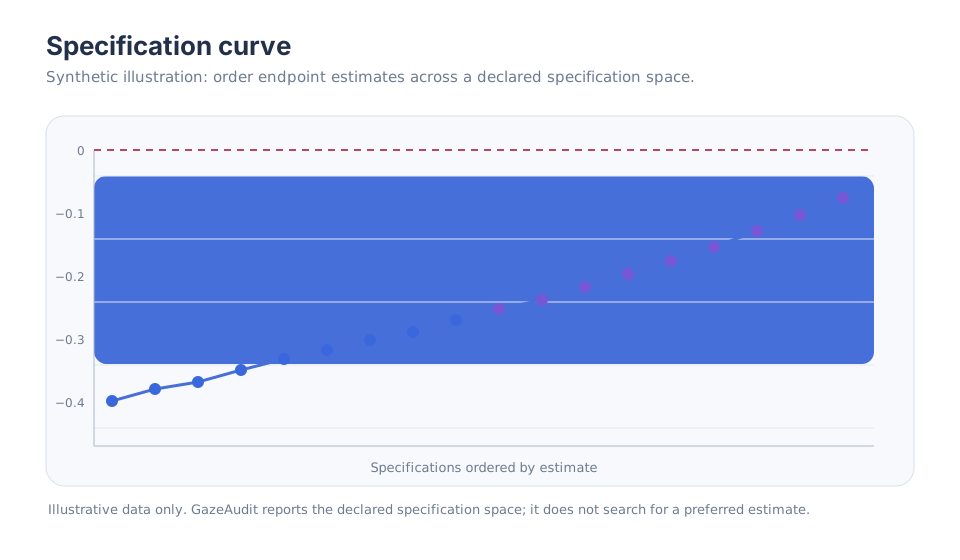
Questions to ask:
- Is the sign invariant?
- Is the range substantively narrow or wide?
- Are there clusters corresponding to particular methods?
- Are extreme estimates linked to one factor level or interaction?
6. Summarise overall stability
from gazeaudit import effect_stability

stability = effect_stability(results, null=0.0)
Report sign fractions and the actual range/quantiles rather than reducing the analysis to a single adjective.
7. Screen factor sensitivity
from gazeaudit import marginal_sensitivity, pairwise_interaction_sensitivity

factors = ["detector", "qc", "aoi_mode"]

marginal = marginal_sensitivity(results, factors)
pairwise = pairwise_interaction_sensitivity(results, factors)
These are descriptive diagnostics. They help locate instability but are not a causal attribution of variance.
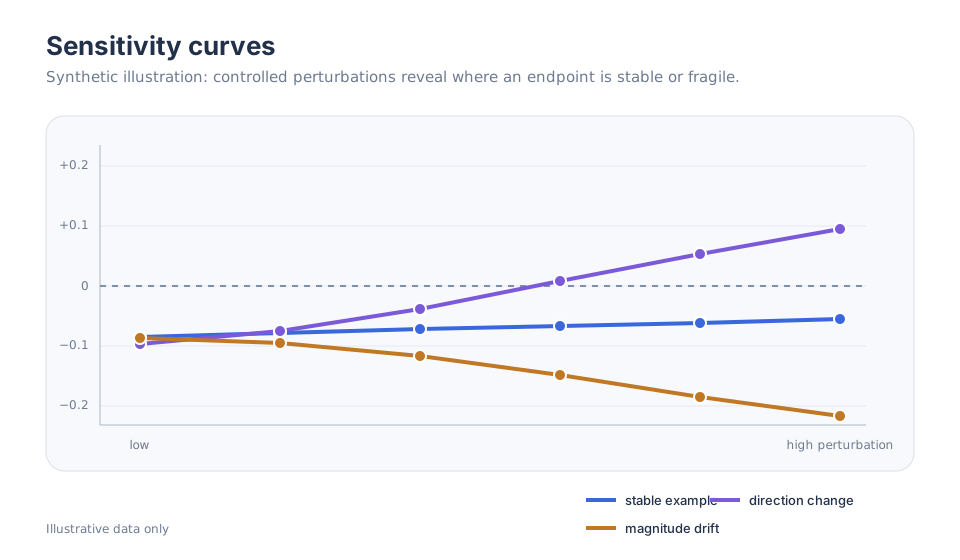
8. Add perturbation families when scientifically relevant
Not every sensitivity axis belongs inside an ordinary categorical multiverse. Controlled perturbations such as:
- spatial-error scale;
- target sampling rate;
- added missingness;
can be more interpretable as explicit sensitivity curves.
9. Interpret instability scientifically
A materially unstable result is not a software failure. It can be an important methodological finding.
Possible interpretations include:
- the endpoint is highly sensitive to one methodological choice;
- a detector family changes the substantive direction;
- only boundary-sensitive AOI definitions create instability;
- downsampling removes information required by the endpoint;
- missingness interacts with a particular analysis branch;
- multiple defensible choices produce genuinely different scientific conclusions.
The appropriate response may be narrower claims, additional validation, redesigned measurement, or explicit reporting of uncertainty—not choosing whichever specification is most convenient.
10. Preserve the robustness record
Archive:
- full declared factor/level definitions;
- validity rule;
- exact executed specification table;
- one endpoint estimate per specification;
- ordered specification curve;
- effect-stability summary;
- marginal and pairwise sensitivity tables;
- any perturbation curves;
- software and source provenance.
Optional conclusion-recovery rule
If a known-truth or independently justified reference effect exists, add a ConclusionRule and use the publication-audit layer. Do not manufacture a reference from the same results that will be evaluated against it.
Next
Bind the complete robustness record with the reproducible publication workflow or review the specification-space guide for function-level detail.