Frozen case study · completeness gate
996102e0
GazeBase: when the right answer is incomplete
This case demonstrates a core GazeAudit rule: a declared specification space is not allowed to shrink after execution merely because some specifications are inconvenient or non-computable.
Frozen question
The GazeBase protocol declared a seven-detector space and a 95% finite-participant completeness gate. The fixed cohort contained 322 participants. A robustness classification was permitted only if the declared detector space satisfied the frozen completeness requirement.
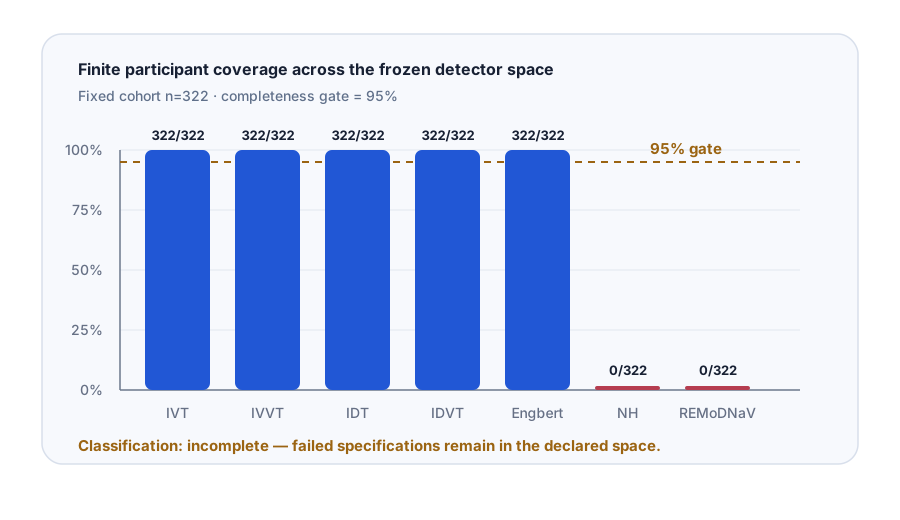
What happened
| Detector | Finite participant estimates | Coverage |
|---|---|---|
| IVT | 322/322 | 100% |
| IVVT | 322/322 | 100% |
| IDT | 322/322 | 100% |
| IDVT | 322/322 | 100% |
| Engbert | 322/322 | 100% |
| NH | 0/322 | 0% |
| REMoDNaV | 0/322 | 0% |
The five computable detector estimates remain archived descriptive outputs, but they are not promoted into a robustness claim. Removing NH and REMoDNaV after seeing their failure would change the declared specification space after outcome inspection.
Why incomplete is scientifically informative
The result shows that workflow completeness is itself part of the scientific claim. GazeAudit fails closed when a frozen prerequisite is violated. It does not silently delete failed specifications and then summarise the remainder as if the smaller space had been declared from the beginning.
This distinction matters whenever robustness analysis includes external detectors, preprocessing packages, model families, or other alternatives that may fail under a particular data contract.
Provenance snapshot
- Frozen protocol fingerprint:
3f64122f62cbc9762b0bd0e0b95c7fef6ff40c4700215ee4b90f005af77003b1 - Scientific commit:
609203dfc37f2ef4984de82b888660e7cc30675c - Final artifact:
gazebase-partitioned-final-609203df - Artifact ID:
10284017265 - ZIP SHA-256:
2fae4e99243e6738047a34b8dc24a183e8fb98606e4873723d43b8baa4ae937b - Execution fingerprint:
35975d89dea728bd3aa146739dc58ea2bcb9322e357a44856b424fffb4183632
What to learn from this case
Use a completeness gate when the scientific meaning of the robustness audit depends on evaluating all predeclared alternatives. Decide in advance what counts as an admissible failure, whether failed specifications can be repaired, and whether a reduced space is scientifically equivalent to the original one. If it is not equivalent, stop rather than silently redefine the multiverse.
Authoritative sources
This page is an explanatory view. The frozen authority remains the validation matrix, GazeBase protocol, and controlled execution procedure.