Guide · Analytical robustness
996102e0
Specification-space guide
Robustness analysis is useful only when the alternative specifications are scientifically defensible. GazeAudit therefore separates declaring the decision space from summarising the resulting estimates.
1. Identify decisions that could reasonably vary
Examples include:
- detector family or detector threshold;
- QC threshold;
- missing-data rule;
- AOI geometry or uncertainty model;
- sampling-rate perturbation;
- preprocessing branch;
- inclusion rule;
- endpoint implementation when multiple operationalisations are defensible.
Do not add arbitrary choices merely to enlarge the multiverse. Each level should have a methodological rationale.
2. Declare the space
Before constructing PipelineSpace, record the robustness question, endpoint reference, factors, typed levels, rationale, decision timing, validity-rule mode, failure policy, and untested uncertainty dimensions. The Specification Space Declaration Center generates a no-default declaration and preserves the declared Cartesian count separately from the valid execution denominator.
from gazeaudit import PipelineSpace

space = (
    PipelineSpace()
    .add_choice("detector", ["ivt", "idt"])
    .add_choice("qc", ["strict", "moderate"])
    .add_choice("aoi_mode", ["hard", "probabilistic"])
)

print(space.size)
# 8
PipelineSpace enumerates combinations in deterministic order.
3. Reject invalid combinations before execution
Some combinations may be technically possible but scientifically nonsensical. Use valid_if to remove them explicitly:
def valid_spec(spec):
    if spec["detector"] == "idt" and spec["qc"] == "strict":
        return False
    return True

specs = space.enumerate_specs(valid_if=valid_spec)
This is preferable to running every combination and discarding inconvenient rows after inspecting estimates.
4. Use one common scientific endpoint
Before implementation, record the endpoint’s scientific quantity, unit, contrast direction, analysis unit/aggregation, eligible denominator, missing-input behavior, non-finite behavior, transformations, required inputs, and interpretation boundary. The Endpoint Definition & Handoff Center provides a no-default declaration builder, and Endpoint definition and invariance explains how to distinguish upstream specification variation from endpoint drift.
run_specs() evaluates every valid specification and collects one scalar estimate.
from gazeaudit import run_specs

results = run_specs(
    study,
    space,
    endpoint=endpoint_function,
    processor=processor_function,
    valid_if=valid_spec,
)
The processor receives (study, specification). The endpoint receives (processed_object, specification) and must return one finite scalar.
A common endpoint is essential: the purpose is to compare what happens to the same scientific quantity under different defensible analytical paths.
5. Inspect the specification curve
from gazeaudit import specification_curve

curve = specification_curve(results)
print(curve[["spec_id", "estimate"]])
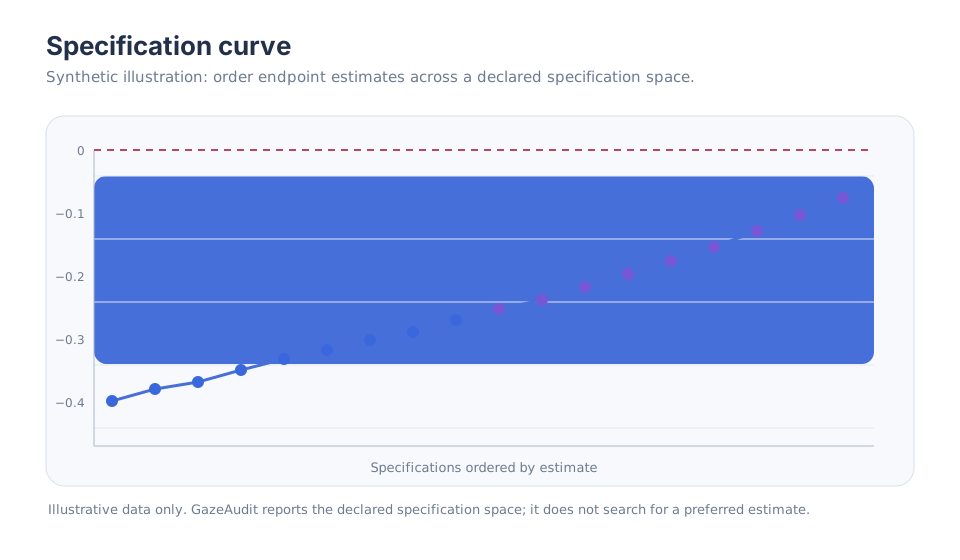
6. Summarise sign and magnitude stability
from gazeaudit import effect_stability

stability = effect_stability(results, null=0.0)
print(stability)
The summary includes the number of specifications, mean/median/range, central quantiles, positive/negative/exact-null fractions, and a descriptive sign-stability measure.
These are descriptive robustness summaries. They are not posterior probabilities and they do not replace a formal inferential model.
7. Locate sensitive decisions
Use marginal sensitivity to screen which declared factors account for the largest differences in cell means:
from gazeaudit import marginal_sensitivity

marginal = marginal_sensitivity(
    results,
    factors=["detector", "qc", "aoi_mode"],
)
For pairwise descriptive interactions:
from gazeaudit import pairwise_interaction_sensitivity

interactions = pairwise_interaction_sensitivity(
    results,
    factors=["detector", "qc", "aoi_mode"],
)
The ratios are screening diagnostics, not causal variance decompositions. In dependent, incomplete, or unbalanced specification spaces, sensitivity ratios can overlap and need not sum to one.
8. Distinguish robustness from optimisation
A robustness analysis asks:
How much does the scientific conclusion change across reasonable choices?
It should not ask:
Which reasonable-looking choice gives the strongest effect or smallest p-value?
GazeAudit’s scientific principle is deliberately anti-optimisation: declare the defensible space first, then characterise its consequences.
Practical design checklist
Before running the multiverse, write down:
- the scientific endpoint;
- each factor and its levels;
- why each level is defensible;
- invalid combinations and the reason for excluding them;
- the reference specification, if one exists;
- the conclusion rule or robustness criterion, if one will be used;
- any perturbation analyses that are separate from ordinary analytical choices;
- the software/data provenance that must be captured.
From descriptive robustness to conclusion recovery
When a known-truth or otherwise prejustified reference effect exists, a ConclusionRule can define acceptable recovery using effect-error tolerance, direction recovery, and a minimum across-specification recovery fraction.
The reference effect is not inferred by GazeAudit for real-data analyses. It must be defined and justified independently before robustness outputs are inspected.
Continue with publication audits or run the specification-curve example.