Workflows
996102e0
Research workflows
Use these pages when you already understand the basic functions and need to structure a complete analysis or revision record.
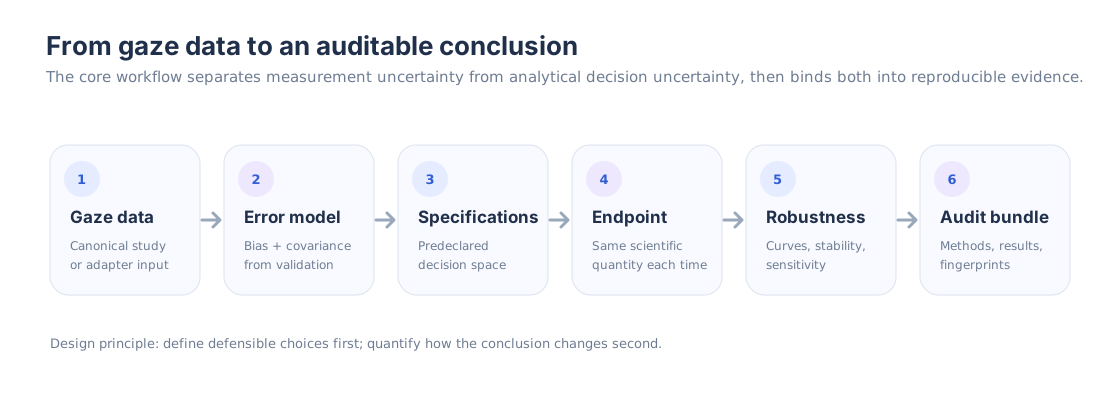
First-study audit
Question: how do I take one real project from canonical data through preflight, declared robustness, evidence review, and publication provenance?
Typical sequence:
- define the scientific endpoint and study-specific assumptions;
- map one canonical
GazeStudy; - run structural preflight and record decisions;
- add readiness or measurement layers only when scientifically relevant;
- declare and execute the defensible specification space;
- inspect robustness and targeted sensitivity diagnostics;
- preserve the complete evidence and software identity.
Measurement audit
Question: could plausible gaze-position error change AOI membership or the scientific endpoint?
Typical sequence:
- preserve validation information;
- fit global or grouped error models;
- propagate uncertainty into AOI membership;
- compare hard and probabilistic assignment;
- calculate uncertainty-weighted endpoints;
- stress-test the error model.
Robustness audit
Question: does the scientific endpoint remain stable across defensible analytical decisions?
Typical sequence:
- define the common endpoint;
- declare a
PipelineSpace; - remove scientifically invalid combinations before execution;
- execute all remaining specifications;
- inspect specification curve and sign/magnitude stability;
- screen marginal and pairwise sensitivity;
- interpret instability without post-hoc optimisation.
Sensitivity audit
Question: how does one fixed endpoint behave when a specific ordered uncertainty dimension is deliberately perturbed?
Typical sequence:
- freeze the endpoint and baseline representation;
- name one perturbation dimension such as sampling rate, controlled missingness, or spatial-error scale;
- justify the evaluated range independently of the observed endpoint;
- declare units, model/mechanism, randomness, and software identity;
- execute and preserve the complete curve;
- interpret direction and magnitude separately;
- integrate the result with the main robustness record without collapsing different uncertainty types into one score.
Peer-review revision toolkit
Question: how do I add reviewer-requested work without rewriting what existed at submission?
Typical sequence:
- classify the reviewer request before changing the record;
- preserve the submitted evidence and its original denominator;
- record outcome-inspection timing for post-review analytical decisions;
- execute reviewer-requested amendments under their own denominators;
- bind each response item to manuscript and archive locations;
- record material v1 → v2 changes in a version-change manifest;
- scaffold and validate the structural revision package;
- run the final resubmission consistency gate.
The toolkit routes to the amendment guide, response-letter guide, executable gazeaudit-revision-package workflow, worked failure/repair example, and final editor-handoff checks.
Reproducible publication
Question: can another researcher reconstruct what was declared, executed, revised, and reported?
Typical sequence:
- freeze software and source identity;
- freeze the scientific decision rule where appropriate;
- execute the analysis;
- build a deterministic audit bundle;
- preserve scientific and execution fingerprints;
- preserve review-stage amendments and their temporal provenance;
- archive report, methods, manifests, complete results, and final evidence maps;
- cite the exact release or commit.
Combine workflows deliberately
The first-study workflow is the project-level spine. Measurement, robustness, sensitivity, revision, and publication workflows are governed layers that can be nested where the study requires them.
For example, a PipelineSpace may contain hard versus probabilistic AOI branches, while each probabilistic branch is generated under a declared error model. If peer review later requests a stricter threshold, that analysis belongs in a separately timed revision layer rather than being silently inserted into the submitted specification space. The publication workflow can then bind the submitted and post-review records without collapsing them.
The important constraint is semantic and temporal clarity: measurement assumptions, analytical choices, perturbation analyses, reviewer-requested extensions, corrections, and publication rules should remain distinguishable in the provenance record.