Frozen case study · measurement uncertainty
996102e0
Korthals target-tracking: a robust negative result
This case shows what GazeAudit means by propagating measurement uncertainty into a scientific endpoint without turning a measurement-model interval into a population confidence interval.
Frozen estimand
The AOI is a target-centred circle with radius 1 dva. The endpoint is jumping-circle occupancy minus moving-circle occupancy. Complete matched-cell contrasts are averaged without weighting within participants and participant estimates are then averaged without weighting at study level.
The frozen grouped isotropic Gaussian gaze-error model uses validation error_avg, zero bias, 2,000 Monte Carlo draws, batch size 8, seed 20260316, and zero as the directional reference.
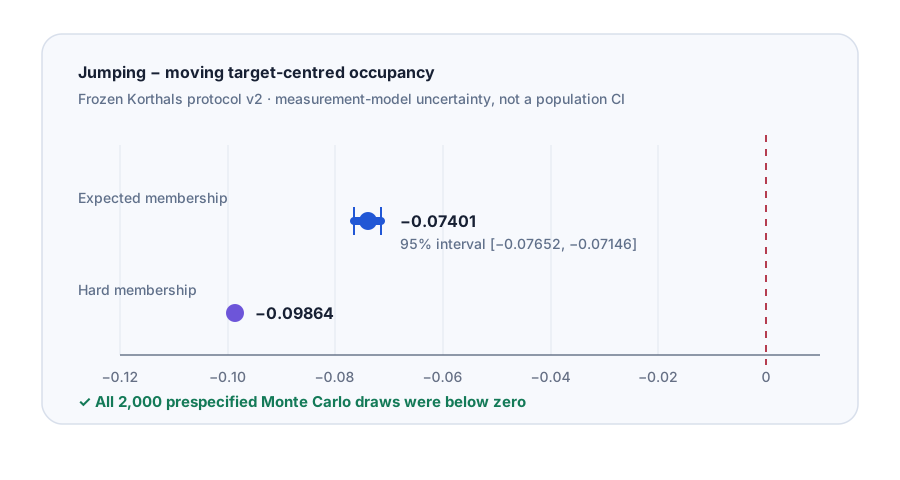
Authoritative numbers
| Quantity | Frozen result |
|---|---|
| Observations | 448,336 |
| Retained trials | 999 |
| Monte Carlo draws | 2,000 |
| Hard effect | −0.0986408756 |
| Expected membership effect | −0.0740075674 |
| Monte Carlo SD | 0.0013013517 |
| 95% measurement-model interval | [−0.0765249127, −0.0714615962] |
| Probability below zero | 1.0 |
| Probability above zero | 0.0 |
| Classification | robust_negative |
The predeclared rule assigns robust_negative when the hard effect is negative and at least 95% of measurement-error draws are below zero. All 2,000 draws were below zero.
What changed after propagating measurement uncertainty?
The estimated magnitude moved toward zero: from approximately −0.09864 under hard binary membership to −0.07401 under expected probabilistic membership. That shift is substantively useful. A stable direction does not imply that deterministic AOI assignment and uncertainty-aware assignment are numerically interchangeable.
The scientific statement is intentionally narrow:
Under the frozen paired AOI estimand, target-centred 1-dva occupancy was lower for jumping circles than for moving circles, and the negative direction remained stable under the prespecified measurement-error propagation model.
Why this matters for practice
Hard AOI membership can hide boundary uncertainty even when the final sign is stable. For a new study, the useful question is therefore not merely whether a probabilistic analysis changes significance. Ask how the endpoint moves, which observations drive uncertainty, and whether the declared scientific conclusion survives the measurement model you justified before inspecting the result.
Provenance snapshot
- Scientific workflow:
korthals-scientific-execution #1 - Execution commit:
3312423cb43b1d9da3877914455dd471aba81174 - Protocol-v2 fingerprint:
1cd4150c9341db145b8f6aee544f9634c67c46116e61e7e675ae3c50282d2d55 - Artifact ID:
10306308440 - ZIP SHA-256:
2eaab8171d9d5f70e138eb929554648cb6bed10b21646ab0acd7cfae4d607d11 - Audit scientific fingerprint:
aa4c04af9c011fe997ef107c8250b20d6a20824b180abdeb16871b5b5a2fc768
Authoritative source
This page is an explanatory view. The frozen authority is the Korthals protocol-v2 result and the validation matrix.