Example · Data QC
996102e0
Study preflight example
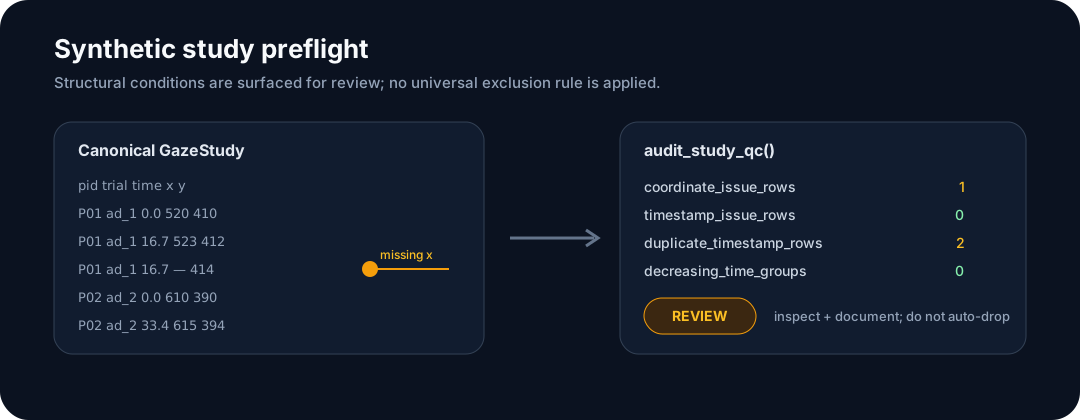
This example uses the repository script examples/study_preflight.py. It is intentionally small and deterministic so the structural-QC contract can be inspected without downloading data or making network requests.
The synthetic table contains two conditions that deserve review:
- one row has a missing horizontal coordinate;
- two rows in the same participant × trial unit share the same finite timestamp.
Neither condition is converted automatically into a participant/trial exclusion.
Run the repository example
python examples/study_preflight.py
The script constructs the canonical study with explicit semantic column mapping and then builds a provenance-aware StudyQCAudit.
import pandas as pd

from gazeaudit import GazeStudy

frame = pd.DataFrame(
    {
        "participant_id": ["P01", "P01", "P01", "P02", "P02"],
        "trial_id": ["ad_1", "ad_1", "ad_1", "ad_2", "ad_2"],
        "time_ms": [0.0, 16.7, 16.7, 0.0, 33.4],
        "gaze_x_px": [520.0, 523.0, None, 610.0, 615.0],
        "gaze_y_px": [410.0, 412.0, 414.0, 390.0, 394.0],
    }
)

study = GazeStudy(
    frame,
    x="gaze_x_px",
    y="gaze_y_px",
    timestamp="time_ms",
    participant="participant_id",
    trial="trial_id",
)
Expected structural result
The important summary fields remain:
status: review
issue_codes: ('coordinate_nonfinite', 'timestamp_duplicate')
coordinate_issue_rows: 1
duplicate_timestamp_rows: 2
The duplicate count is two rows, not one duplicate event: both rows participating in the repeated participant × trial × timestamp key are reported.
Inspect the diagnostics before deciding
from gazeaudit import study_qc_diagnostics

diagnostics = study_qc_diagnostics(study)
print(diagnostics[["diagnostic_id", "issue_code", "detail_code", "row_position"]])
For this fixture the deterministic diagnostics are:
| Diagnostic | Issue | Detail | Scope |
|---|---|---|---|
D000001 |
timestamp_duplicate |
timestamp_duplicate |
row |
D000002 |
coordinate_nonfinite |
x_missing |
row |
D000003 |
timestamp_duplicate |
timestamp_duplicate |
row |
The ID is a stable reference within the deterministic study representation being audited. If mapped data or row order changes, rerun the audit rather than carrying old IDs forward.
Record what you decided
The repository example records two explicit decisions:
from gazeaudit import StudyQCDecision, build_study_qc_audit

decisions = (
    StudyQCDecision(
        issue_code="coordinate_nonfinite",
        action="retain for explicit downstream missingness handling",
        rationale=(
            "The missing coordinate is retained so its handling remains visible "
            "to the downstream sensitivity analysis."
        ),
        diagnostic_ids=("D000002",),
    ),
    StudyQCDecision(
        issue_code="timestamp_duplicate",
        action="retain after representation review",
        rationale=(
            "The repeated timestamp is documented rather than silently deduplicated."
        ),
        diagnostic_ids=("D000001", "D000003"),
    ),
)

audit = build_study_qc_audit(study, decisions=decisions)
These actions are illustrative, not recommended defaults. A real dataset may justify repair, exclusion, channel combination, reordering, retention, or another documented treatment.
Read the provenance fingerprints
print(audit.study_fingerprint)
print(audit.audit_fingerprint)
print(audit.manifest_fingerprint)
The three levels answer different questions:
study_fingerprint— are the five mapped structural-QC columns and their row order the same?audit_fingerprint— are the study identity, structural findings, and researcher decisions the same?manifest_fingerprint— is that audit record also bound to the same recorded software environment?
The study fingerprint deliberately excludes unrelated columns that structural QC did not inspect.
Export evidence
from gazeaudit import write_study_qc_artifacts, verify_study_qc_artifacts

write_study_qc_artifacts(audit, "qc-evidence")
assert verify_study_qc_artifacts("qc-evidence")
This writes deterministic report/diagnostic/decision data plus an audit manifest and a byte-level artifact manifest. Editing one exported payload causes verification to fail.
Bind the QC record into a publication audit
from gazeaudit import study_qc_publication_metadata

qc_metadata = study_qc_publication_metadata(audit)

bundle = build_conclusion_audit_bundle(
    results,
    reference_effect=reference_effect,
    rule=rule,
    title="Primary robustness audit",
    endpoint="primary endpoint",
    source_description="Analysis dataset",
    metadata={"study_qc": qc_metadata},
)
The compact QC descriptor becomes part of the publication bundle’s existing scientific fingerprint. The publication schema itself does not change.
What a clean report means
When no implemented structural condition is present:
assert audit.report.status == "pass"
assert audit.report.issue_codes == ()
A pass means only that this structural preflight found no implemented issue. It does not establish calibration quality, detector validity, absence of informative missingness, correct AOI design, or robustness of the substantive conclusion.
Continue the workflow
- Data onboarding and structural preflight — full interpretation and provenance contract.
- Publication audit guide — bind QC identity into robustness evidence.
- AOI uncertainty — model spatial measurement uncertainty.
- Interoperability — ingest supported BIDS/pymovements structures.
- End-to-end robustness audit — move from one canonical study to a declared specification space.