Guide · Measurement uncertainty
996102e0
AOI uncertainty guide
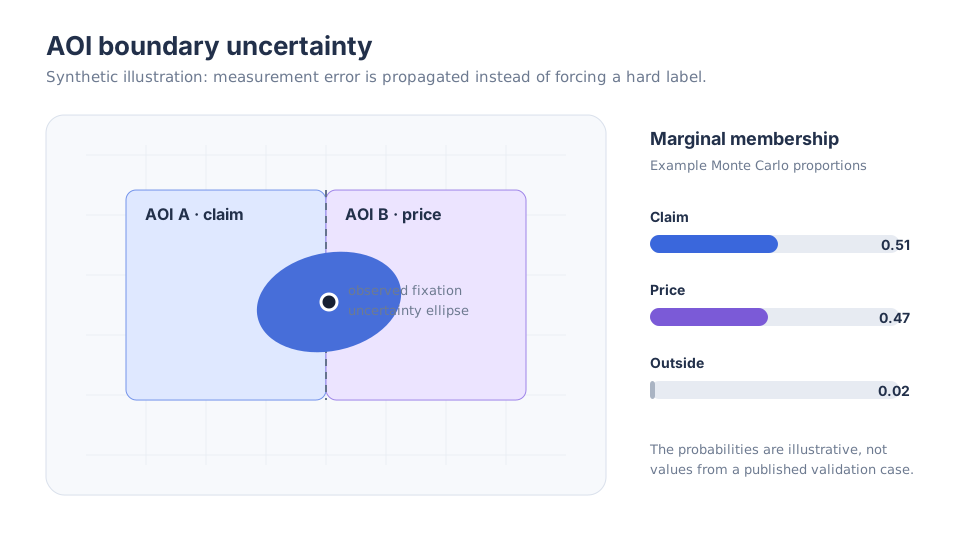
A gaze coordinate is an observation, not a known true point. Calibration/validation error, tracker noise, head movement, geometry, and local measurement conditions can make deterministic AOI assignment especially brittle near boundaries. GazeAudit makes that uncertainty explicit.
The core model
For the global Gaussian model, GazeAudit defines measurement error as
error = observed - true.
GaussianGazeErrorModel.fit() estimates the mean x/y error and residual covariance from validation observations. For a new observed point, latent true locations are sampled by subtracting error draws from the observation.
from gazeaudit import GaussianGazeErrorModel

model = GaussianGazeErrorModel.fit(validation_frame)
This is intentionally a simple, auditable model. It should be treated as a scientific assumption that can itself be stress-tested.
When only mean radial error is available
Some validation summaries report only mean Euclidean position error. from_mean_radial_error() converts that summary into an isotropic Gaussian model under an explicit Rayleigh-to-Gaussian assumption:
model = GaussianGazeErrorModel.from_mean_radial_error(
    mean_radial_error=28.0,
    n_validation=9,
)
This constructor does not recover anisotropy, spatial variation, or uncertainty in the reported validation summary. Use it only when that approximation is defensible and state the assumption in the methods.
Grouped error models
When uncertainty is expected to differ across participants, sessions, calibration blocks, devices, or other predeclared strata, use GroupedGaussianGazeErrorModel.
from gazeaudit import GroupedGaussianGazeErrorModel

grouped = GroupedGaussianGazeErrorModel.from_mean_radial_errors(
    {
        "p01": 24.0,
        "p02": 31.0,
        "p03": 19.0,
    },
    n_validation={"p01": 9, "p02": 9, "p03": 9},
)
Grouped models fail closed: every observation supplied to a grouped uncertainty audit must map to a declared model key. GazeAudit does not silently fall back to a pooled model when a group is missing.
Probabilistic AOI membership
aoi_probabilities() draws latent true positions and calculates the fraction of draws inside each AOI.
probabilities = aoi_probabilities(
    points,
    aois,
    model,
    draws=5000,
    rng=42,
)
With grouped models:
probabilities = aoi_probabilities(
    points,
    aois,
    grouped,
    groups=participant_ids,
    draws=5000,
    rng=42,
)
Important probability semantics
- AOI probabilities are marginal membership probabilities.
- Overlapping AOIs are allowed.
- Therefore AOI probabilities need not sum to one.
outsideis the probability of belonging to none of the supplied AOIs.- Monte Carlo uncertainty can be reduced by increasing
draws, but more draws do not make the underlying measurement model more correct.
Hard versus probabilistic assignment
A useful audit is not merely to replace one metric with another but to quantify where the interpretation changes.
from gazeaudit import compare_hard_probabilistic, summarize_aoi_risk

comparison = compare_hard_probabilistic(
    points,
    aois,
    model,
    draws=5000,
    rng=42,
)
risk = summarize_aoi_risk(comparison)
Use this comparison to ask questions such as:
- Which observations are near an AOI decision boundary?
- How often does the hard assignment disagree with the model-conditional membership probability?
- Are the scientifically important trials disproportionately boundary-sensitive?
- Does a substantive endpoint change when probability weights replace binary labels?
Expected endpoints
GazeAudit includes uncertainty-weighted dwell and fixation-count helpers:
from gazeaudit import expected_dwell, expected_fixation_count

claim_dwell = expected_dwell(
    probabilities,
    durations=durations_ms,
    aoi="claim",
)

claim_fixations = expected_fixation_count(
    probabilities,
    aoi="claim",
)
The result should be interpreted as an endpoint under the declared measurement-error model, not as a direct observation of latent truth.
Sensitivity to the error model
The error model belongs inside the robustness analysis. scale_error_model() can generate controlled alternatives around a fitted model, and spatial_sensitivity_curve() evaluates a common endpoint across scales.
A practical analysis can therefore distinguish:
- within-model Monte Carlo uncertainty — finite draws under a fixed error model;
- measurement-model sensitivity — how the endpoint changes when the assumed error magnitude changes;
- analytical sensitivity — how the endpoint changes under other defensible pipeline choices.
Conflating those layers makes it difficult to tell where instability actually comes from.
Recommended reporting
At minimum, report:
- the source of validation information;
- the error definition and model family;
- whether the model is global or grouped;
- the number of validation observations used for each fitted model;
- the Monte Carlo draw count and random seed strategy;
- AOI geometry and overlap semantics;
- whether
outsidewas retained; - the endpoint derived from membership probabilities;
- any error-scale sensitivity analysis;
- hard-versus-probabilistic discrepancies when they affect interpretation.
Next
Run the AOI boundary example or combine AOI uncertainty with a declared analytical multiverse in the specification-space guide.