Workflow · Measurement uncertainty
996102e0
Measurement audit workflow
Use this workflow when the scientific endpoint depends on gaze position, AOI membership, or a spatial decision boundary that could plausibly be affected by tracker error.
Workflow overview
Retain pointwise target/observed coordinates when available; otherwise preserve the exact summary from which an approximation is constructed.
Choose global versus grouped structure and document the assumptions before inspecting downstream endpoint sensitivity.
Use Monte Carlo latent positions to estimate marginal membership probabilities for every declared AOI.
Compare deterministic and probabilistic membership and identify observations with high flip probability or ambiguity.
Calculate uncertainty-weighted dwell, fixation count, or a study-specific effect from the probabilistic memberships.
Scale or stratify the error model and inspect whether the scientific conclusion depends materially on the measurement assumption.
1. Preserve validation evidence
Preferred input is pointwise validation data containing observed and target x/y coordinates. This allows GaussianGazeErrorModel.fit() to estimate systematic bias and residual covariance directly.
If only mean radial error is available, the package can construct an isotropic approximation, but the conversion is assumption-driven and should be reported as such.
For participant-, session-, device-, or block-specific validation evidence, use a grouped model rather than pooling automatically.
2. Fit the declared model
from gazeaudit import GaussianGazeErrorModel

error_model = GaussianGazeErrorModel.fit(validation)
Record at least:
- error definition (
observed - true); - validation source;
- number of complete validation observations;
- fitted mean error;
- fitted covariance;
- grouping structure if used;
- any approximation from radial summaries.
3. Propagate to AOI membership
from gazeaudit import aoi_probabilities

probabilities = aoi_probabilities(
    points,
    aois,
    error_model,
    draws=5000,
    rng=42,
)
The draw count governs Monte Carlo precision under the model. It does not express confidence that the model itself is correct.
4. Audit boundary risk
from gazeaudit import compare_hard_probabilistic, summarize_aoi_risk

comparison = compare_hard_probabilistic(
    points,
    aois,
    error_model,
    draws=5000,
    rng=42,
)

risk_summary = summarize_aoi_risk(comparison)
Inspect where hard membership is most likely to flip under the declared measurement model. High-risk observations are not automatically invalid; they are observations whose interpretation is especially dependent on the measurement assumption.
5. Propagate uncertainty into the endpoint
from gazeaudit import expected_dwell

weighted_dwell = expected_dwell(
    probabilities,
    durations=durations_ms,
    aoi="target",
)
For study-level inference, the endpoint may be a contrast constructed after aggregating probabilistic dwell or fixation contributions. Keep the endpoint definition fixed while measurement assumptions vary.
6. Stress-test spatial error
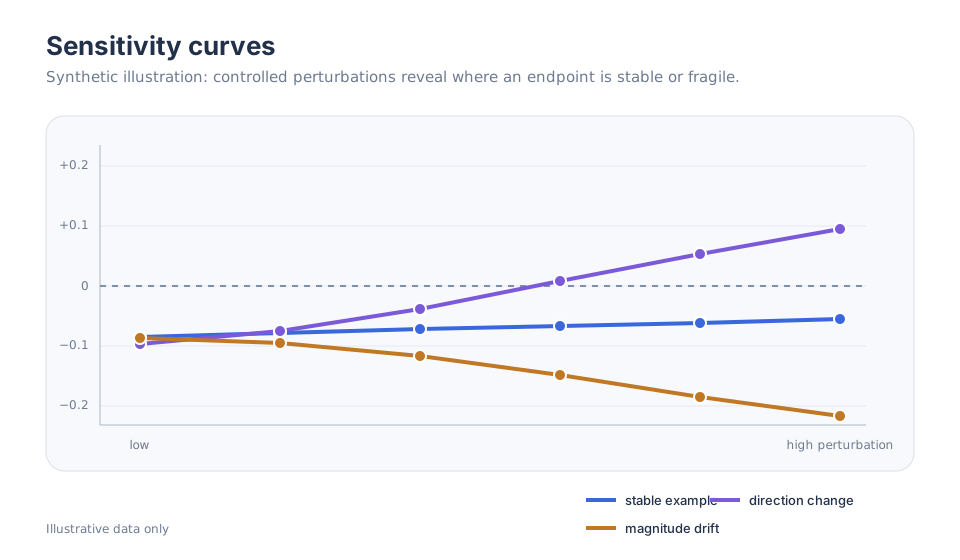
Use scale_error_model() or spatial_sensitivity_curve() when the magnitude of spatial error itself is uncertain or when you want to show how conclusions change under controlled scaling.
A useful design is to include the fitted model as the reference scale and evaluate smaller/larger plausible scales around it. The scale grid should be justified before inspecting which value produces the preferred result.
7. Decide whether measurement uncertainty is substantively important
Useful questions include:
- Does the sign of the endpoint change?
- Does the magnitude change enough to alter the substantive interpretation?
- Are only a small number of boundary observations driving the difference?
- Is sensitivity concentrated in one participant/session/device group?
- Does hard-versus-probabilistic disagreement align with the scientific contrast?
- Does the conclusion remain stable when the error magnitude is scaled within a plausible range?
8. Preserve the evidence
For formal work, archive:
- validation data or immutable source identity;
- fitted error-model parameters;
- AOI geometry;
- point/observation identifiers;
- Monte Carlo seed strategy and draw count;
- hard/probabilistic comparison table;
- risk summary;
- endpoint table;
- spatial sensitivity curve;
- exact GazeAudit version/commit.
Failure modes to avoid
Treating validation error as a universal constant
A single tracker-wide accuracy number may not represent participant/session-specific uncertainty. Use grouped models when the design and evidence justify them.
Increasing draws instead of questioning the model
More Monte Carlo draws reduce simulation noise. They do not solve model misspecification.
Excluding high-risk observations automatically
Boundary risk is diagnostic. It is not a universal QC rule.
Comparing different endpoints across models
If the scientific endpoint changes definition when the error model changes, measurement sensitivity and endpoint redefinition become confounded.
Next
If multiple analytical choices exist beyond the measurement model, continue to the robustness audit workflow. For publication-grade provenance, finish with the reproducible publication workflow.