Reference · Data contract
996102e0
Data Contract & Schema Mapping Center
Use this page when you have a gaze or fixation table and need to answer:
What does GazeAudit require before I can create a canonical
GazeStudy?
The runtime authority is the public GazeStudy contract. This page turns that contract into a practical schema-mapping workflow without imposing a vendor-specific export format.
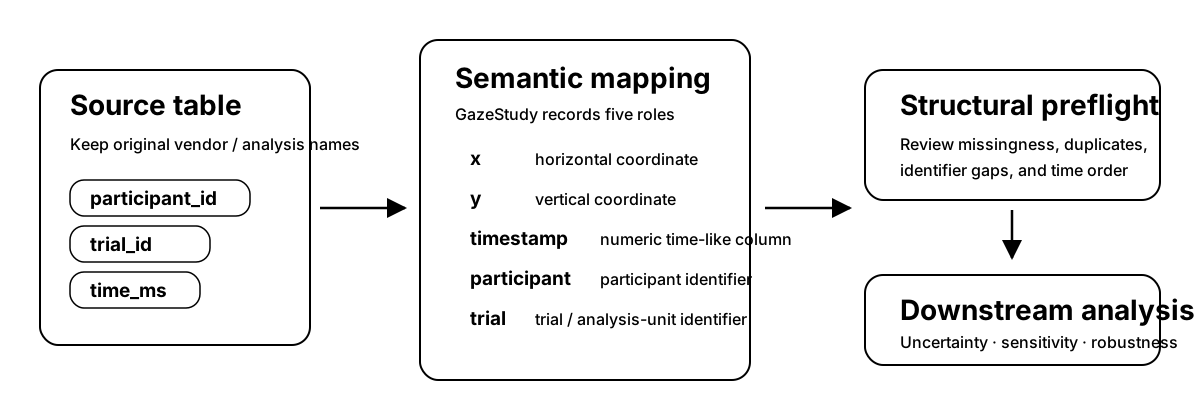
Constructor contract
The current public signature is:
GazeStudy(
    data,
    x="x",
    y="y",
    timestamp="timestamp",
    participant="participant",
    trial="trial",
)
Those default names are software defaults, not a requirement to rename your data.
| Contract | Constructor behavior |
|---|---|
| input object | data must be a pandas DataFrame |
| table length | at least one observation is required |
| mapped columns | x, y, timestamp, participant, and trial source columns must exist |
| x / y | mapped columns must have a numeric pandas dtype |
| timestamp | mapped column must have a numeric pandas dtype |
| participant / trial values | column existence is required; missing identifier values are handled by structural preflight rather than rejected by the constructor |
| additional columns | preserved unchanged in study.data |
| time ordering | not enforced at construction; use structural preflight or validate_time_order() |
| units | not inferred or converted |
Map your existing column names
This builder generates the semantic GazeStudy(...) mapping plus an optional documentation-side provenance record. It does not upload or inspect your data, infer units, fabricate source identity, or choose any QC rule.
Canonical constructor snippet
Complete all five semantic column mappings to generate code.No mapping generated yet.
Documentation-side mapping record
Complete all five semantic column mappings to generate the mapping record.This JSON is a documentation record, not a GazeAudit runtime object. Optional provenance fields remain empty when you do not provide them; the mapper never guesses.
Mapping record contract
The generated JSON uses a small documentation schema:
{
  "schema": "gazeaudit-data-mapping-record-v1",
  "source_id": "exports/session_level_long.csv",
  "columns": {
    "participant": "participant_code",
    "trial": "stimulus_trial",
    "timestamp": "recording_time_ms",
    "x": "screen_x_px",
    "y": "screen_y_px"
  },
  "units": {
    "coordinates": "pixels",
    "timestamp": "milliseconds from trial onset"
  },
  "coordinate_convention": "origin top-left; x right; y down",
  "pre_mapping_transformations": "binocular channels combined before canonical table"
}
The record is descriptive. It does not certify that the mapping is scientifically correct, and it does not hash or inspect your data. Its machine-readable structure is governed by the data-mapping record JSON Schema. If source identity must be immutable, record a project-controlled checksum or persistent dataset identifier in source_id.
Continue to Record data-mapping provenance for the governance rules and Mapping change audit for a worked comparison of harmless renames versus substantive transformations.
Construction failure versus structural review
Not every data problem belongs at the same layer.
| Condition | GazeStudy(...) |
Structural preflight |
|---|---|---|
| mapped column absent | fails | not reached |
| x, y, or timestamp column nonnumeric | fails | not reached |
| zero rows | fails | not reached |
| missing x/y values in a numeric column | constructs | review |
| infinite x/y values | constructs | review |
| missing/infinite timestamps in a numeric column | constructs | review |
| missing participant/trial values | constructs | review |
| duplicate finite timestamps within participant × trial | constructs | review |
| decreasing finite timestamps within participant × trial | constructs | review; validate_time_order() can also fail fast |
This separation is intentional. The constructor validates the canonical representation; structural preflight reports conditions that require contextual inspection rather than silently converting them into exclusions.
Minimal valid synthetic table
A table can be small and still satisfy the constructor contract:
import pandas as pd

from gazeaudit import GazeStudy

frame = pd.DataFrame(
    {
        "participant_id": ["P01", "P01"],
        "trial_id": ["T01", "T01"],
        "time_ms": [0.0, 16.7],
        "gaze_x_px": [520.0, 523.0],
        "gaze_y_px": [410.0, 412.0],
    }
)

study = GazeStudy(
    frame,
    x="gaze_x_px",
    y="gaze_y_px",
    timestamp="time_ms",
    participant="participant_id",
    trial="trial_id",
)
This proves only that the canonical constructor contract is satisfied. It does not establish calibration quality, AOI validity, detector validity, adequate sampling, or inferential robustness.
Unit record
Record the units and coordinate convention alongside the mapping. A compact project note can be enough:
x: gaze_x_px — pixels, stimulus coordinate system
y: gaze_y_px — pixels, stimulus coordinate system
timestamp: time_ms — milliseconds from trial onset
participant: participant_id — anonymized participant key
trial: trial_id — within-participant stimulus presentation
If you transform units before construction, record that transformation as preprocessing provenance rather than relying on the canonical object to remember an unrecorded conversion.
What happens next
Bind the five semantic roles to the actual source columns.
Document coordinate and timestamp units plus any preprocessing transformation.
Create `GazeStudy` and handle hard schema errors explicitly.
Run structural QC; inspect review conditions rather than treating them as automatic exclusions.
Record researcher-owned repairs, retention, exclusion, or representation decisions.
Continue with Map your table into GazeStudy for the task-oriented procedure, or Valid, invalid, and reviewable tables for a synthetic failure-case walkthrough.