Frozen case study · sampling and missingness
996102e0
Pedrotti/de Chambrier: a materially fragile endpoint
This case separates directional stability from magnitude recovery. The frozen long-minus-short gaze-path-rate contrast remained negative throughout the sampling analysis, yet several perturbations exceeded the predeclared 20% relative-deviation tolerance.
Frozen estimand
The endpoint is the participant-balanced long-minus-short numeric gaze-path-rate difference, in pixels per second. Trial path displacement is divided by original trial duration, short and long numeric means are formed within participant, their difference is computed, and participant contrasts are averaged without weighting at study level.
Native missingness is preserved. Displacement is accumulated only across consecutive scheduled rows whose two gaze endpoints are finite; gaps are not bridged.
The frozen reference estimate is −75.3781404722 px/s.
Sampling-rate sensitivity
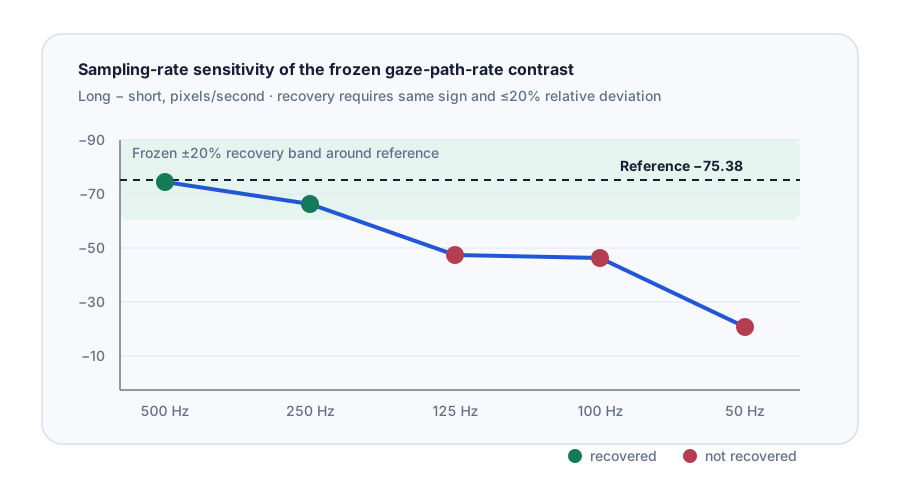
| Target rate | Estimate (px/s) | Relative deviation | Same sign | Recovered |
|---|---|---|---|---|
| 500 Hz | −74.5618 | 1.08% | yes | yes |
| 250 Hz | −66.3495 | 11.98% | yes | yes |
| 125 Hz | −47.4680 | 37.03% | yes | no |
| 100 Hz | −46.2298 | 38.67% | yes | no |
| 50 Hz | −20.5618 | 72.72% | yes | no |
Sampling-family recovery is therefore 0.4.
Added-missingness sensitivity
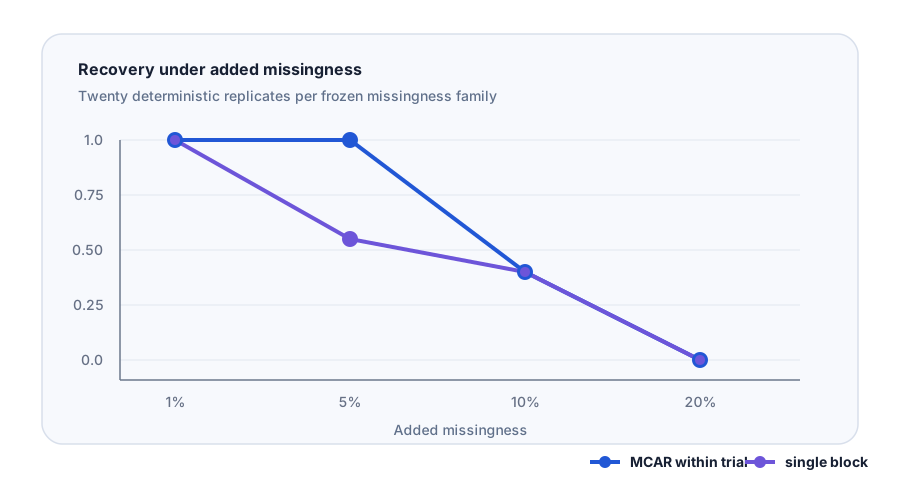
| Mechanism | 1% | 5% | 10% | 20% |
|---|---|---|---|---|
| MCAR within trial | 1.00 | 1.00 | 0.40 | 0.00 |
| Single block within trial | 1.00 | 0.55 | 0.40 | 0.00 |
Each family contains 20 prespecified deterministic replicates generated from root seed 20260913.
Why the classification is materially_fragile
The frozen individual-recovery rule requires both:
- strict sign agreement with the reference estimate; and
- no more than 20% relative deviation in magnitude.
The full audit is classified materially_fragile when any frozen perturbation family reaches the predeclared material-fragility ceiling. Several families recovered at 0.4 or 0.0, so the rule necessarily returns materially_fragile.
What to learn from this case
A stable sign can coexist with scientifically important dependence on measurement resolution and missing-data structure. For rate-like eye-tracking endpoints, downsampling can change the amount of path displacement observed per unit time even when the broad ordering of conditions is unchanged.
That is why sensitivity analysis should report how far the endpoint moves, not merely whether a coefficient keeps its sign or a test remains significant.
Provenance snapshot
- Scientific workflow:
pedrotti-scientific-execution #1 - Execution commit:
270d444c599363ebd25f25e8a95f5f3c78e55b02 - Protocol fingerprint:
efb194ad2c492768962320198d281c98574eb2dc22291279bfd176a15606a0d5 - Artifact ID:
10328414078 - ZIP SHA-256:
b411fe6a5f4ad7035ac606d60a952306c0b818d956f7b4930827b8cbe10ae8d5 - Results fingerprint:
5bafe0d1d1d0d054a681cb7136fc4e259c0f75e07d51653acde472c7c6e4dce9
Authoritative source
This page is an explanatory view. The frozen authority is the Pedrotti/de Chambrier authoritative result and the validation matrix.