Article · Interpretation
996102e0
How to read a fragile result
A robustness analysis is allowed to conclude that the result is fragile. That outcome is not a failed analysis. It is evidence that the scientific conclusion depends materially on one or more defensible measurement or analytical choices.
The useful next question is not “how do I make the result robust?” It is:
Which assumptions carry the conclusion, and what claim remains justified after that dependence is made explicit?
Fragility has different forms
Directional fragility
Some defensible specifications produce positive effects and others negative effects. This is usually the strongest warning that a simple directional claim is not stable under the declared decision space.
Magnitude fragility
The sign is stable but the size varies enough to change the substantive interpretation. A conclusion can therefore be directionally stable yet materially fragile.
Threshold fragility
The estimate crosses a scientifically meaningful decision threshold. The threshold should be substantively justified; a p-value boundary should not automatically become the definition of scientific robustness.
Localised fragility
Most specifications agree, but one factor level or factor interaction creates a distinct cluster of results. This is where marginal and pairwise sensitivity diagnostics are especially useful.
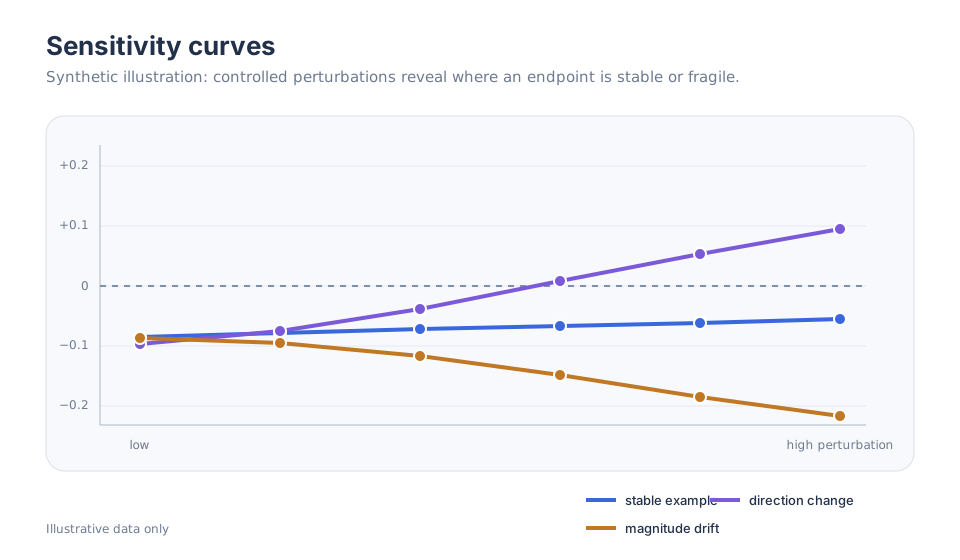
Perturbation fragility
A controlled change in measurement assumptions, sampling rate, or missingness produces a systematic endpoint drift or direction change.
First locate the source
Before interpreting the fragility globally, ask where it comes from.
Useful diagnostics include:
- the complete specification curve;
- sign fractions and estimate range;
- marginal sensitivity by factor;
- pairwise interaction sensitivity;
- hard-versus-probabilistic AOI disagreement;
- spatial-error sensitivity;
- sampling-rate sensitivity;
- missingness sensitivity;
- participant/session/device grouping where scientifically justified.
The goal is to distinguish a broad instability from a narrow method-specific dependence.
Do not delete the uncomfortable branch
If a specification was declared scientifically defensible before results were inspected, an inconvenient estimate is not a reason to remove it.
A branch can be excluded only if a genuine scientific or technical invalidity is established and documented. The reason should be independent of whether that branch strengthens or weakens the preferred conclusion.
Otherwise the robustness audit becomes a selection exercise.
Narrow the claim to the evidence
Fragility often means the original claim was too broad.
For example:
- If direction is stable but magnitude is not, report directional robustness and magnitude sensitivity.
- If only one detector family reverses the effect, report detector dependence and investigate why the event definitions differ.
- If AOI uncertainty changes the endpoint, report sensitivity to boundary/measurement assumptions.
- If downsampling materially alters the conclusion, avoid claiming portability across lower sampling representations without further validation.
- If added missingness creates instability, make the dropout mechanism part of the interpretation rather than treating it as generic data loss.
A canonical fragile result in GazeAudit
The frozen Pedrotti/de Chambrier sampling-and-missingness audit has the canonical outcome materially_fragile under its declared protocol.
That label should be read at the protocol level: the frozen gaze-path-rate contrast did not remain sufficiently stable across the specified downsampling and added-missingness perturbations. It is not a generic claim that the source dataset, study, or every possible endpoint is “fragile”.
The authoritative provenance and wording remain in the validation matrix and case-specific frozen records.
Fragility can identify the next experiment
A good sensitivity analysis often tells you what to validate next.
Examples:
- collect better participant-level validation if spatial error drives AOI instability;
- preregister detector thresholds if detector choice dominates the estimate;
- acquire at a higher rate if sampling sensitivity threatens the endpoint;
- redesign AOIs with more spatial separation if boundary ambiguity dominates;
- model dropout explicitly if missingness patterns drive the result;
- replicate across devices when portability is the uncertainty of interest.
In this sense, fragility is not the end of the analysis. It is a map of where the scientific design is most vulnerable.
What a transparent paper should report
When a result is materially sensitive, report:
- the declared alternatives or perturbations;
- the complete estimate range and sign pattern;
- the factor(s) most associated with instability;
- any interaction or boundary-risk evidence;
- which conclusions remain stable;
- which conclusions must be narrowed;
- what uncertainty dimensions remain untested;
- the exact software/protocol version used.
Avoid replacing the full robustness evidence with one selected “main analysis” plus a vague statement that sensitivity checks were similar when they were not.
Robustness analysis is useful because failure is possible
A method that always declares success cannot audit robustness. The scientific value of GazeAudit’s framework depends on allowing robust, fragile, and incomplete evidence states to remain distinct when the data and frozen rules support them.
Continue with the robustness audit workflow or inspect the frozen validation matrix.