
Gazepoint worked example: evidence verification latency
Source:vignettes/articles/gaze-survival-verification-example.Rmd
gaze-survival-verification-example.RmdPurpose
This article shows the thin gp3tools route for
time to first source/evidence inspection. It does not
implement a second survival engine: all event/censor construction, model
fitting, diagnostics, and reporting are delegated to
eyeprocess.
Build the synthetic verification dataset
raw <- eyeprocess::simulate_gaze_survival_inputs(
  "verification",
  seed = 20260918,
  n_participants = 36,
  trials_per_participant = 3
)
Run the explicit adapter workflow
verification <- gp3tools::run_gazepoint_latency_analysis(
  raw$trials,
  raw$events,
  target_aoi = "source_evidence",
  formula = "condition",
  participant_col = "participant_id",
  cox_structure = "cluster_robust",
  aft_distribution = "weibull",
  km_group = "condition",
  event_type = "first_aoi_entry",
  condition_col = "condition_id",
  event_detector = "synthetic_truth",
  aoi_specification = "fixed synthetic source/evidence AOI",
  quality_rules = list(valid_fraction_min = .90)
)
## Warning: Information criteria are not directly comparable across Cox partial
## likelihood, coxme penalized frailty likelihood, and AFT full likelihood, or
## across different analysis-row counts. Use diagnostics and estimand-specific
## interpretation instead of ranking by AIC/BIC.
verification$censoring## n_trials n_analyzable n_observed_events n_censored n_review_required
## 1 108 108 102 6 0
## censoring_fraction
## 1 0.05555556
verification$report$effects## term estimate_log_scale std_error hazard_ratio conf_low
## 1 conditionstandard -1.087844 0.2157481 0.3369423 0.2207549
## conf_high statistic p_value effect_measure
## 1 0.5142812 -5.042194 4.602255e-07 hazard_ratio
verification$ph_diagnostics## term rho chisq p_value alpha ph_flag
## 1 condition NA 6.369666 0.01160874 0.05 TRUE
## 2 GLOBAL NA 6.369666 0.01160874 0.05 TRUEcox_structure and aft_distribution are
required deliberately. gp3tools never chooses a
repeated-participant estimator or AFT family for the analyst.
Visualize time to evidence inspection
eyeprocess::plot_gaze_survival_curve(
  verification$data,
  group = "condition"
)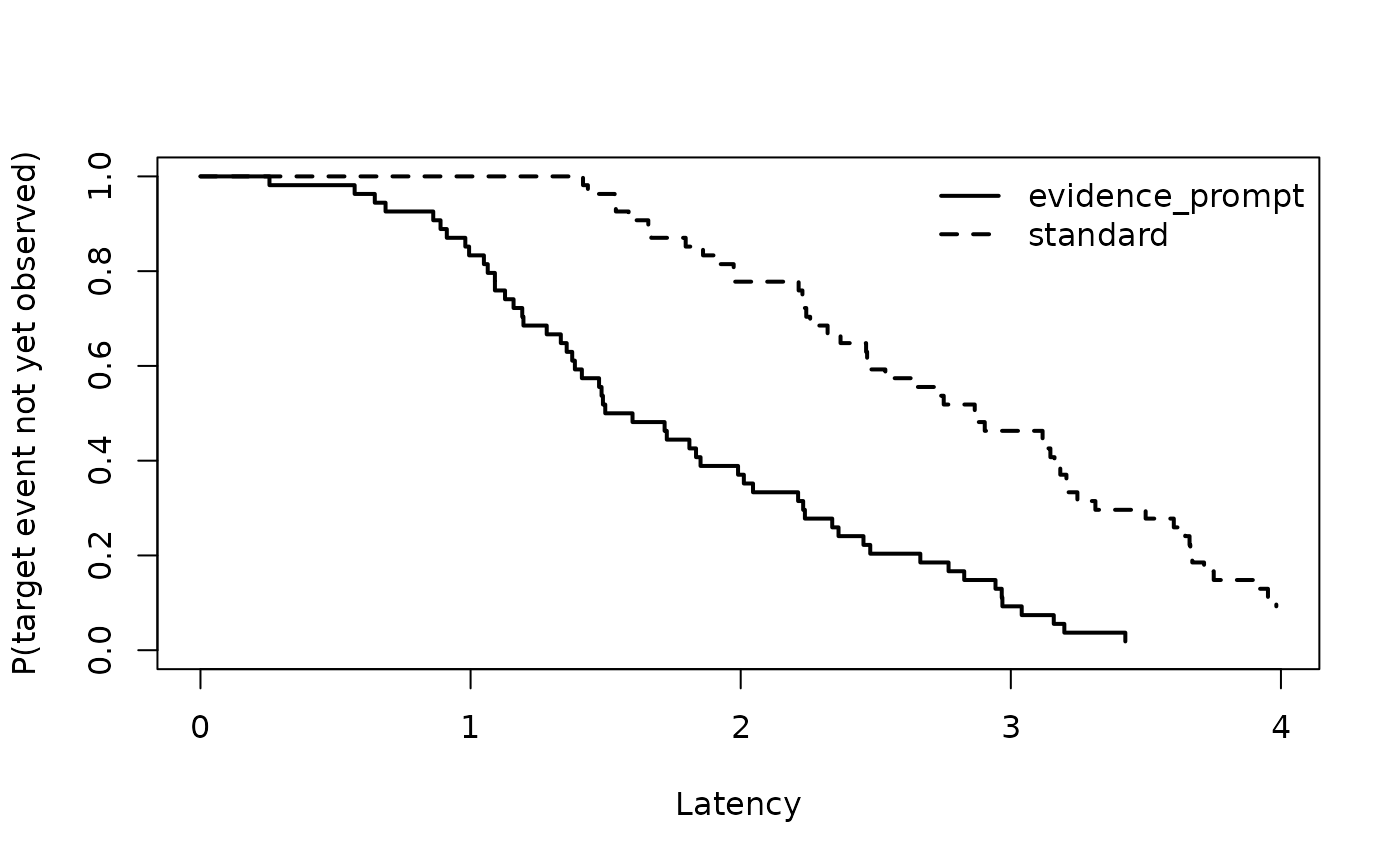
Kaplan-Meier curves for time to first source/evidence AOI entry.
A lower survival curve indicates that a larger share of trials has already entered the source/evidence AOI by that time.
Complementary verification plots
eyeprocess::plot_gaze_cumulative_incidence(
  verification$data,
  group = "condition"
)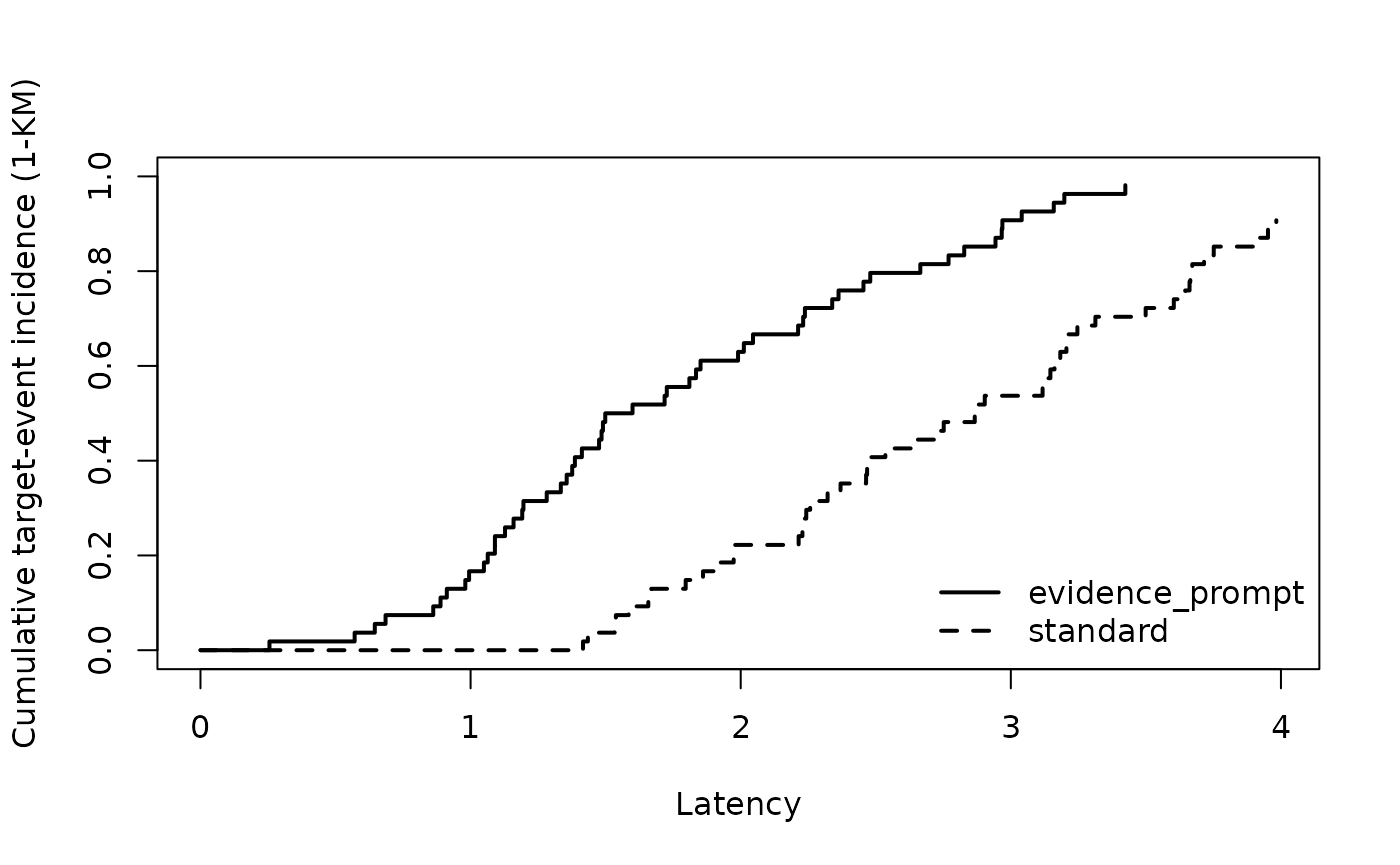
Single-event 1-KM view for evidence inspection.
eyeprocess::plot_gaze_hazard(
  verification$data,
  group = "condition"
)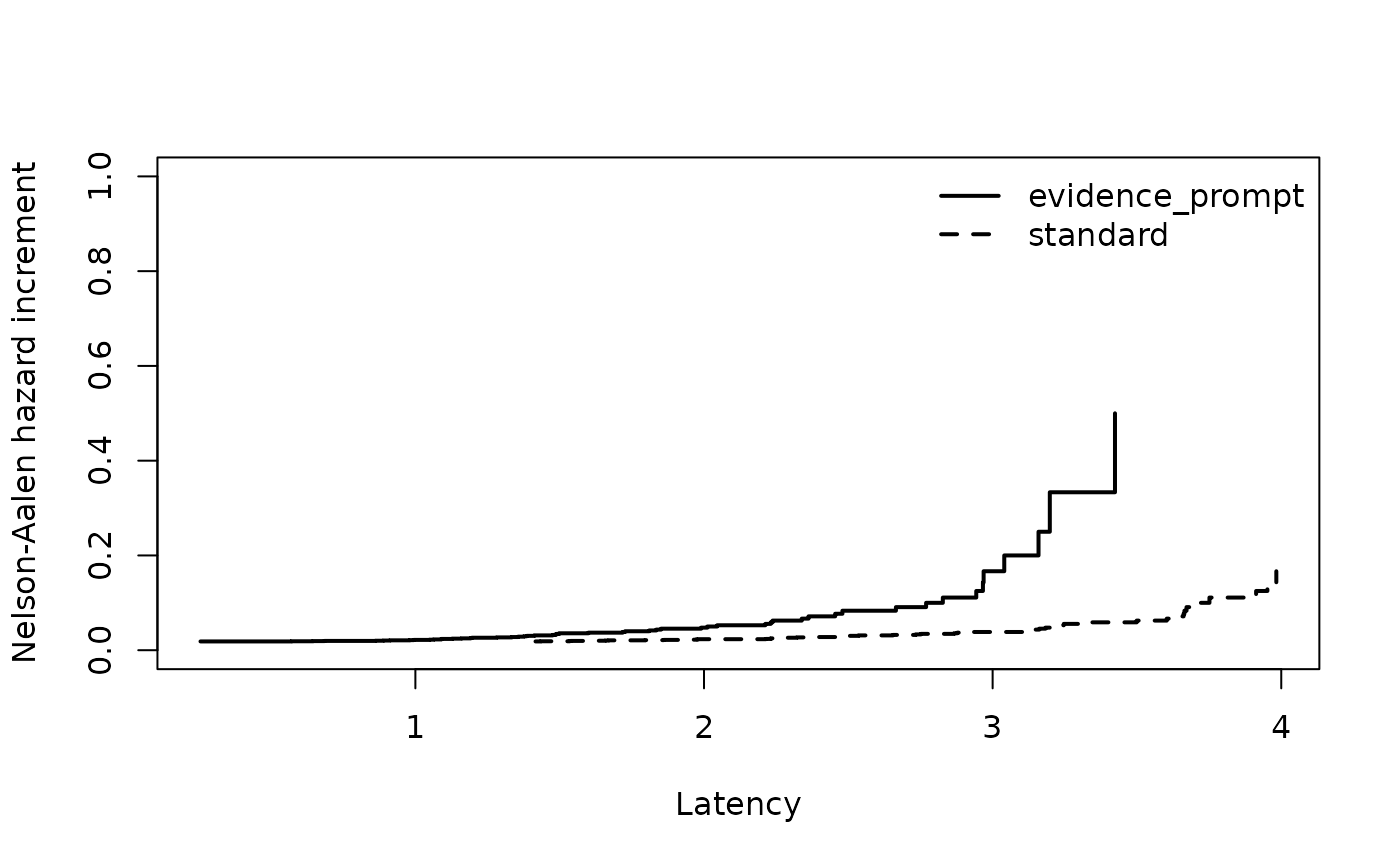
Empirical event/risk increments for evidence inspection.
Use the 1-KM plot only for the single target event represented here. It is not a competing-risks cumulative-incidence estimator when mutually exclusive event types compete. The hazard panel is an empirical event/risk diagnostic, not a smooth latent hazard estimate.
Interpretation
The clustered Cox hazard ratio describes the relative instantaneous evidence-inspection rate among trials still at risk. It is not a mean-latency ratio. The delegated Weibull AFT output instead expresses a multiplicative event-time contrast under the named distribution.
Troubleshooting clinic
Do not silently convert any of the following into ordinary right censoring:
- an incomplete trial observation window;
- missing or ambiguous trial/event identity;
- gaze quality below the declared rule;
- event time after the censoring limit.
If event counts are sparse or censoring is extreme, report that
limitation even if the backend converges. If the scientific model
requires latent participant frailty, request
cox_structure = "frailty" explicitly and report the
corresponding marginal Cox PH diagnostic separately.
Reporting example
Gazepoint evidence-inspection latency was analysed through the vendor-neutral
eyeprocesssurvival engine usinggp3tools. Complete usable trials without a source/evidence entry were retained as right-censored observations; unresolved or poor-quality trials were not converted to censoring. We fitted a participant-clustered Cox model and a pre-specified Weibull AFT sensitivity model, reporting effect estimates with 95% confidence intervals together with censoring summaries and proportional-hazards diagnostics.
Report both package versions, the target event/AOI, time origin, observation-window rule, quality criterion, Cox structure, AFT family, event/censor counts, diagnostics, and sensitivity branches.
API links
-
gp3tools::prepare_gazepoint_survival_data()— thin preparation adapter. -
gp3tools::run_gazepoint_latency_analysis()— thin end-to-end adapter. -
eyeprocess::plot_gaze_survival_curve()— vendor-neutral survival visualization. -
eyeprocess::report_gaze_survival_model()— vendor-neutral reporting bundle.