
Cluster-permutation time-course workflow
Source:vignettes/articles/cluster-permutation-workflow.Rmd
cluster-permutation-workflow.RmdThis article gives a compact example of the conservative
cluster-permutation workflow in gp3tools. The workflow is
intended for two-condition, within-subject, one-dimensional time-course
data. It is suitable for cautious screening of time-contiguous effects,
not for exact onset or offset claims.
Simulated example data
set.seed(123)

raw <- simulate_gazepoint_cluster_timecourse_data(
  n_subjects = 12,
  n_time_bins = 30,
  conditions = c("control", "treatment"),
  effect_start = 12,
  effect_end = 20,
  effect_size = 0.7,
  seed = 123
)

head(raw)
#>   subject condition time_bin      outcome
#> 1    S001   control        1  0.023352640
#> 2    S002   control        1  0.006406593
#> 3    S003   control        1  0.276462794
#> 4    S004   control        1  0.767104526
#> 5    S005   control        1  0.269113265
#> 6    S006   control        1 -0.240940613
Prepare the time-course grid
prepare_gazepoint_timecourse_test_data() converts a
long-format data set into the internal column contract expected by
run_gazepoint_cluster_permutation().
prepared <- prepare_gazepoint_timecourse_test_data(
  raw,
  subject_col = "subject",
  condition_col = "condition",
  time_col = "time_bin",
  outcome_col = "outcome",
  condition_order = c("control", "treatment")
)

head(prepared)
#>   .gp3_cluster_subject .gp3_cluster_condition .gp3_cluster_time_bin
#> 1                 S001                control                     1
#> 2                 S001              treatment                     1
#> 3                 S001                control                     2
#> 4                 S001              treatment                     2
#> 5                 S001                control                     3
#> 6                 S001              treatment                     3
#>   .gp3_cluster_outcome .gp3_cluster_status
#> 1           0.02335264                  ok
#> 2          -0.38697165                  ok
#> 3           0.11443486                  ok
#> 4           0.20485385                  ok
#> 5           0.07188089                  ok
#> 6           0.32232050                  ok
Audit the grid
Before running a cluster-permutation workflow, check whether the data grid is complete, paired, and compatible with the validated two-condition workflow.
grid_audit <- audit_gazepoint_timecourse_grid(prepared)

grid_audit$grid_summary
#>   n_input_rows n_valid_rows n_subjects n_conditions n_time_bins
#> 1          720          720         12            2          30
#>   n_expected_cells n_observed_cells n_missing_cells n_duplicate_cells
#> 1              720              720               0                 0
#>   n_unpaired_subject_time_cells
#> 1                             0
grid_audit$readiness
#>                            check passed
#> 1         exactly_two_conditions   TRUE
#> 2          no_missing_grid_cells   TRUE
#> 3             no_duplicate_cells   TRUE
#> 4 no_unpaired_subject_time_cells   TRUE
#> 5                numeric_outcome   TRUE
design_diagnostic <- diagnose_gazepoint_cluster_design(prepared)

design_diagnostic
#>         diagnostic                                                    value
#> 1       conditions                                                        2
#> 2 paired_time_grid                                                        0
#> 3       duplicates                                                        0
#> 4      sample_size                                                       12
#> 5        time_bins                                                       30
#> 6  validated_scope two-condition within-subject one-dimensional time course
#>   passed
#> 1   TRUE
#> 2   TRUE
#> 3   TRUE
#> 4   TRUE
#> 5   TRUE
#> 6   TRUE
#>                                                                                                                         interpretation
#> 1                                                                    The implemented inferential engine is for exactly two conditions.
#> 2                                                                      Each subject-time cell should have both conditions represented.
#> 3                                                                     Duplicate cells should be aggregated before permutation testing.
#> 4                                                                         Permutation stability depends on the number of paired units.
#> 5                                                                     Cluster formation requires an ordered one-dimensional time grid.
#> 6 ANOVA, mixed-model, TFCE, multidimensional, covariate-adjusted, and parallel engines are intentionally outside this validated scope.
Run the cluster-permutation workflow
For a fast documentation example, this article uses a small number of permutations. Real analyses should use a larger number and report the settings.
cluster_result <- run_gazepoint_cluster_permutation(
  prepared,
  condition_order = c("control", "treatment"),
  n_permutations = 99,
  cluster_threshold = 1.5,
  min_time_bins = 2,
  seed = 123
)

names(cluster_result)
#> [1] "timecourse"               "clusters"
#> [3] "permutation_distribution" "data"
#> [5] "settings"                 "model_status"
#> [7] "n_subjects"               "n_time_bins"
#> [9] "warning"
Summarise clusters
cluster_summary <- summarize_gazepoint_time_clusters(cluster_result)

cluster_summary
#>   cluster_id cluster_direction start_time_bin end_time_bin n_time_bins
#> 1          1          positive             12           20           9
#>   cluster_statistic p_value cluster_significant cluster_summary_status
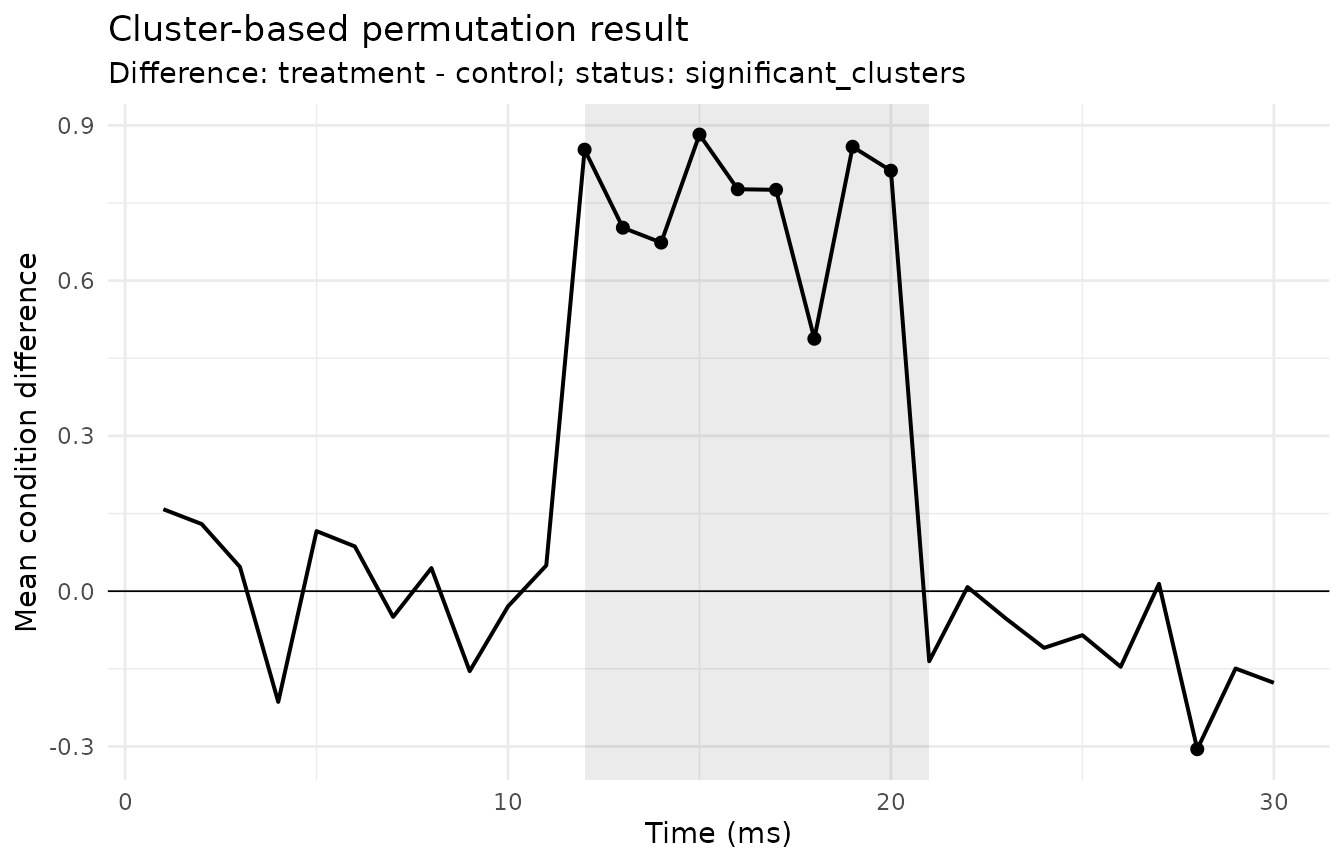
#> 1          42.47172    0.01                TRUE                     ok
Plot the cluster result
plot_gazepoint_cluster_permutation(
  cluster_result,
  plot_type = "difference",
  significant_only = FALSE
)
Cautious report text
report_gazepoint_cluster_permutation() returns a compact
report object. The generated wording is deliberately cautious: detected
ranges are treated as cluster-level time intervals, not as exact
effect-onset or effect-offset estimates.
cluster_report <- report_gazepoint_cluster_permutation(cluster_result)

cluster_report$report_text
#> [1] "The cluster-permutation workflow identified 1 cluster(s) below alpha = 0.05 over the following time-bin range(s): 12-20 (p = 0.01) . These ranges should be reported as cluster-level time intervals, not as precise effect-onset or effect-offset estimates."
Threshold sensitivity
Cluster-level results can depend on the cluster-forming threshold. A compact sensitivity table helps document whether the broad pattern is stable across reasonable threshold choices.
threshold_sensitivity <- run_gazepoint_cluster_threshold_sensitivity(
  prepared,
  thresholds = c(1.25, 1.5, 1.75),
  condition_order = c("control", "treatment"),
  n_permutations = 49,
  min_time_bins = 2,
  seed = 123
)

threshold_sensitivity$summary
#>   cluster_threshold n_clusters n_significant_clusters min_p_value
#> 1              1.25          1                      1        0.02
#> 2              1.50          1                      1        0.02
#> 3              1.75          1                      1        0.02
External export helpers
The external export helpers prepare long-format files and README notes for possible continuation in specialist tools. They do not run or validate the external analyses.
external_dir <- tempfile("gp3_cluster_export_")

external_files <- export_gazepoint_mne_cluster_input(
  prepared,
  outdir = external_dir
)

external_files
#>                                                                          file
#> 1   /tmp/RtmpVxkm3q/gp3_cluster_export_5927dfb9a2e/mne_cluster_long_input.csv
#> 2 /tmp/RtmpVxkm3q/gp3_cluster_export_5927dfb9a2e/README_mne_cluster_input.txt
#>      file_type export_status
#> 1 mne_long_csv            ok
#> 2       readme            ok
Guardrails for unsupported extensions
Some advanced method names are available as explicit guardrails. They intentionally stop with explanatory messages rather than silently supporting methods outside the validated scope.
try(run_gazepoint_tfce(), silent = TRUE)